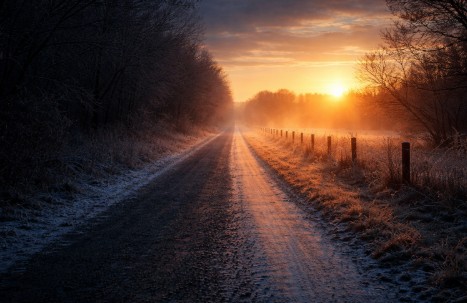
On the Winter Solstice
The winter solstice is not loud.
It does not announce itself with fireworks or proclamations. It arrives quietly, almost unnoticed, marked not by what begins—but by what has finished.
Across cultures and centuries, the solstice has been understood as a hinge: the moment when the year stops falling away and begins, slowly, to return. The longest night. The shortest day. A pause at the bottom of the arc.
Ancient people noticed this because they had to. Their survival depended on light, warmth, timing, and attention. Stone circles were aligned to it. Fires were kept through it. Feasts were held not in abundance, but in defiance—proof that the community had endured long enough to see the light turn back.
The solstice was not a celebration of victory. It was a recognition of survival.
In many traditions, this moment was understood as a threshold state—what some would later call a bardo: a space between death and rebirth, between what has ended and what has not yet taken form. The year, in that sense, dies here. Not dramatically. Simply exhausted. Spent of its light.
And in that death, there is an invitation.
The solstice asks very little of us. It does not demand optimism. It does not insist on resolutions or declarations. It only offers clarity: whatever you carried through the past year—useful or not—you are allowed to set it down.
Grief that has finished teaching.
Anger that no longer sharpens.
Plans that never became real.
Versions of yourself built for conditions that no longer exist.
This is not forgetting. It is composting.
Across agricultural societies, winter was when fields rested, not because they were unimportant, but because rest was part of their function. Nothing grows endlessly. Nothing improves without pause. The solstice marks that truth in the sky itself.
From this night forward, the light does return—but imperceptibly at first. A minute here. A sliver there. No sudden transformation. Just proof that motion has resumed.
That, too, is the lesson.
New life does not arrive fully formed. It begins quietly, below the surface, unnoticed by anyone not paying attention. The solstice does not promise ease. It promises direction.
The year will move again. So will you.
If there is something to do on this day, it is not celebration in the modern sense. It is acknowledgment. A moment to stand still inside the machinery of time and say: this is where the turning happens.
Everything after this grows.
Everything before this is finished.
And noticing that—really noticing it—has always been the point.