This piece is offered in honor of the long side of the winter solstice.
We have crossed the dark hinge of the year and come out the other side. The days are still cold and short, but the light has begun its slow return. That is worth noticing.
Congratulations on surviving another year. Not in the motivational sense—just in the literal one. You endured weather, work, loss, noise, obligation, and whatever private burdens you carried quietly. You are still here. That matters.
- May the systems that sustain us rest long enough to recover.
- May our bodies remember how to slow without guilt.
- May what is planted now be given time to take root.
- May the coming light be gentle, and the next year kinder than the last.
May we have the attention, gratitude, and the patience to let the seasons do what they have always done.
We live as if time is flat.
Hours stack on hours.
Days blur into weeks.
Work arrives in identical blocks, regardless of light, weather, soil, or human limits.
The calendar moves, but nothing else is allowed to change.
That is not how life has ever worked.
Time Was Once a Signal
The earliest human structures—physical, social, and spiritual—were built around cycles.
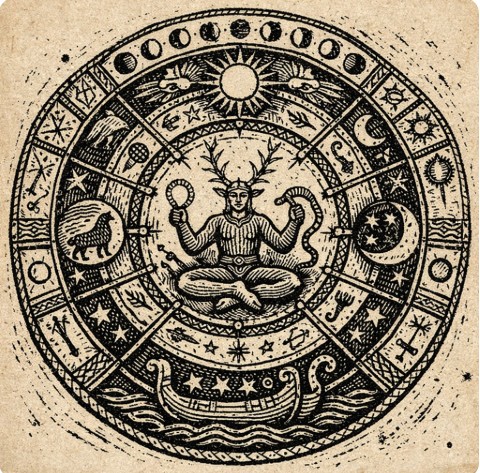
Stone circles aligned to solstices.
Temples oriented to sunrise.
Agricultural calendars embedded into ritual, law, and labor.
Not because people were mystical—
but because survival required attention to the world as it actually behaved.
The sun told you when to plant.
The cold told you when to rest.
The dark told stories.
The light told you to work.
Seasonality was not metaphor.
It was information.
Belief systems followed the same logic. Death and rebirth myths mirrored winter and spring. Harvest festivals marked abundance—but also restraint.
The sacred functioned as memory.
A way to remember what mattered when conditions changed.
The Flattening of Time
Then we flattened it.
Industrial schedules broke work free from daylight.
Electricity erased night.
Climate control smoothed seasons indoors.
Food appeared year-round, detached from soil and weather.
Labor became standardized—not because bodies changed, but because systems demanded predictability.
The clock replaced the sun.
Efficiency replaced rhythm.
At first, this felt like progress. And in many ways, it was.
Less physical labor.
Less dependence on weather.
More safety.
More consistency.
But we lost the pauses.
What We Lost
We stopped resting when the world rested.
We stopped slowing when energy was scarce.
We stopped noticing when systems needed recovery.
Now the costs appear everywhere.
People burn out because effort no longer ebbs.
Land depletes because extraction no longer pauses.
Energy systems strain because winter is treated like any other quarter.
Infrastructure fails because demand ignores seasonality.
We schedule against clocks, not conditions.
Technology reduced the need for constant physical labor. Instead of using that gift to reintroduce rhythm, we filled the space with more abstraction, more obligation, more always-on expectation.
We didn’t free time.
We monetized it.
The Question We Avoid
Which leaves a question worth sitting with:
If we no longer need to work the way we once did,
why are we still pretending time has no seasons?
What would it look like to design modern life—
work, energy use, education, production—
around natural flow instead of constant output?
Not a return to the past.
Not a rejection of technology.
Just a remembering.
Operating Instructions
Winter for consolidation.
Spring for experimentation.
Summer for output.
Autumn for harvest and reflection.
These cycles are not superstition.
They are operating instructions written into living systems.
We forgot them because we could.
The harder question is whether we can remember them again—
and what kind of future might emerge if we do.