The Charles Q. Clapp House and the Limits of Greek Revival
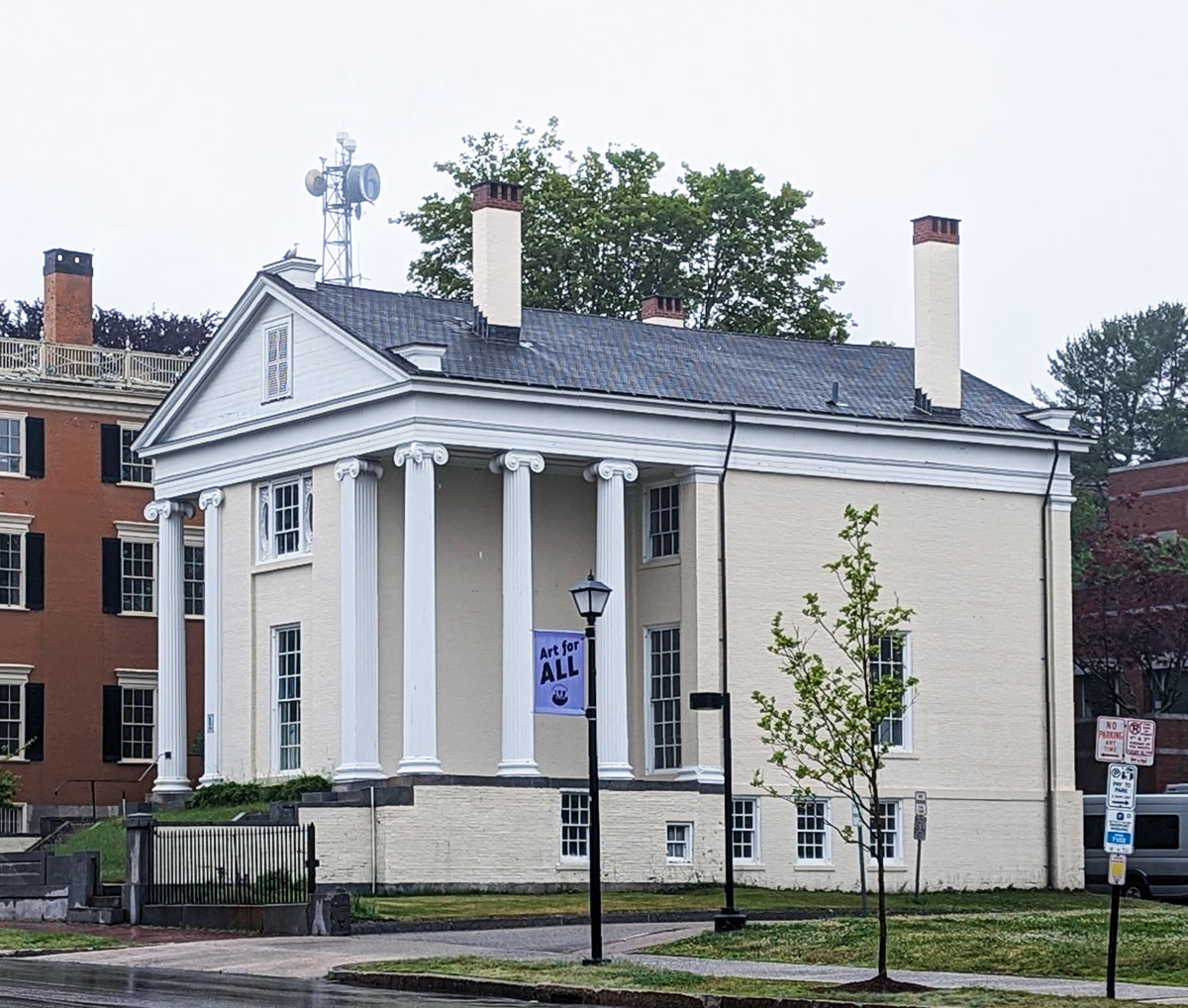
The Charles Q. Clapp House stands as a well-preserved example of mid-19th-century Greek Revival domestic architecture, and it is precisely because it is so competent that it makes a useful case study for the limits of the style. Greek Revival, when executed faithfully, is disciplined, formal, and unapologetically monumental. Those same qualities are also what make it fundamentally ill-suited to residential architecture.
The Clapp House borrows its vocabulary directly from ancient temples: symmetrical façades, a heavy entablature, classical columns or pilasters, and a rigid, frontal composition. These elements communicate authority, permanence, and civic importance. They were never meant to suggest comfort, adaptability, or domestic warmth. In antiquity, these forms framed ritual, governance, and collective identity—not daily life.
In a home, that mismatch is impossible to fully resolve, even in Portland, Maine, where opulent Victorian mansions demonstrate just how much better residential architecture can age when it is not pretending to be a temple.
Greek Revival houses like the Clapp residence often feel less like dwellings and more like scaled-down courthouses. The façades are stern and performative. Windows are subservient to symmetry rather than light. Floor plans are frequently constrained by exterior formality, prioritizing alignment over livability. Even when beautifully maintained, the architecture asks occupants to live inside a philosophical statement rather than a responsive shelter.
This is not a failure of craftsmanship or taste. It is a category error.
Greek Revival excels when used for large institutional buildings—banks, courthouses, capitols, libraries—especially when executed in stone. In those contexts, the massing, weight, and symbolic clarity make sense. Stone reinforces the illusion of timelessness; scale allows the proportions to breathe; and the public function justifies the theatrical severity. A limestone courthouse wearing a classical portico feels grounded and honest. A wooden house pretending to be a temple does not.
The Clapp House, like many Greek Revival residences, relies on paint and trim to approximate the authority that stone naturally provides. The result is architectural cosplay—earnest, historically literate, and fundamentally strained. No amount of correct molding profiles can fully disguise the fact that the building is borrowing gravity it does not structurally possess.
There is also a deeper issue at play. Homes must tolerate change. Families grow, habits shift, technology intrudes. Greek Revival is rigid by design. Its aesthetic resists modification, and additions often feel like apologies rather than evolutions. Styles that thrive in domestic architecture—Federal, Italianate, Craftsman—allow for asymmetry, expansion, and adaptation. Greek Revival does not.
The Charles Q. Clapp House deserves respect as a historical artifact and as a teaching tool. It shows us how seriously Americans once took the idea of architecture as moral expression. But it also demonstrates why borrowing the language of temples for private living spaces was a short-lived experiment.
Some styles are meant to shelter people. Others are meant to impress them. Greek Revival is firmly the latter—and it is at its best when it remembers that.