Open the Knowledge or Admit the System Is a Lie
Capitalism, regulated trade, markets—fine.
I’m not here to argue against exchange or incentive.
Capitalism is very good at moving resources once systems exist.
What it has never been good at is deciding who deserves to live.
That decision cannot be left to markets.
The Knowledge Already Exists
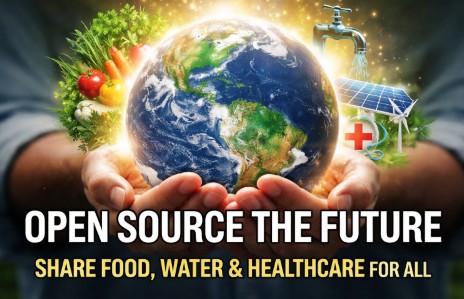
We are sitting on technologies that can provide:
- food
- clean water
- basic healthcare
- shelter
- energy
At scales that would have sounded like science fiction a century ago.
We already know how to desalinate water.
We already know how to grow food intensively with minimal land.
We already know how to distribute vaccines, antibiotics, diagnostics, and clean power.
None of this is speculative.
None of it is new.
What is new is the moral failure of pretending this knowledge belongs to anyone.
There Is No Ethical Ownership of Survival
There is no ethical world in which the information required to keep people alive is treated as private property.
None.
If a system allows millions to die while solutions sit behind paywalls, patents, NDAs, or “competitive advantage,” then that system has forfeited its legitimacy—no matter how efficient it claims to be.
The argument that this knowledge must remain closed “because money” is tired bullshit.
It’s intellectually lazy.
It’s morally empty.
Markets can determine pricing, logistics, labor, and distribution after knowledge is shared.
But the knowledge itself—the designs, the methods, the science—must be common property of humanity.
Start With Information
Start with information.
Open-source agricultural systems that can feed communities with limited water.
Publish designs for low-cost filtration, sanitation, and desalination.
Release medical protocols, manufacturing methods, and diagnostics that don’t require a Fortune 500 supply chain to function.
Get it to them.
Show them how to do it.
Let them adapt it.
This is not charity.
This is competence.
Scarcity Is Engineered
Most of the world’s political pressure points disappear when people are:
- fed
- hydrated
- housed
- treated when they’re sick
Extremism thrives where scarcity is engineered.
Violence follows deprivation.
Stability isn’t enforced—it’s grown.
And let’s be clear:
Open knowledge does not destroy capitalism.
It removes its most obscene excuse.
Money Comes After Survival
If, after knowledge is open, resources are still needed—materials, infrastructure, logistics, labor—then yes, we can have the grown-up conversation about wealth reallocation.
We can talk openly about:
- taxes
- public investment
- restitution
- responsibility
We can talk about why obscene hoarding is celebrated while survival is conditional.
But that conversation comes after we stop pretending secrecy is neutral.
Gatekeepers Are Not Benevolent
The owners of these technologies—corporations, governments, institutions, individuals—like to frame themselves as benevolent gatekeepers.
They are not.
They are beneficiaries of a system that rewards withholding life-saving information and calls it innovation.
Innovation that doesn’t reach people is just intellectual vanity.
Responsibility Is Not Optional
I’m not calling for the destruction of markets.
I’m calling for the destruction of the lie that knowledge is a commodity instead of a shared inheritance.
Information is not scarce.
Insight is not diminished by use.
The only thing secrecy protects is power.
If you have access to knowledge that can keep people alive, you have a responsibility to make it public.
Not eventually.
Not when it’s profitable.
Now.
Through ethical, transparent, and lawful pressure wherever possible—and through relentless refusal to accept excuses.
The Line We Should Not Have Crossed
Human knowledge should benefit all of humanity.
That should not be a radical statement.
The fact that it is tells you exactly how broken our priorities have become.
Open the knowledge.
Feed the people.
Then let the market argue about everything else.
Anything less is not realism.
It’s surrender dressed up as pragmatism.