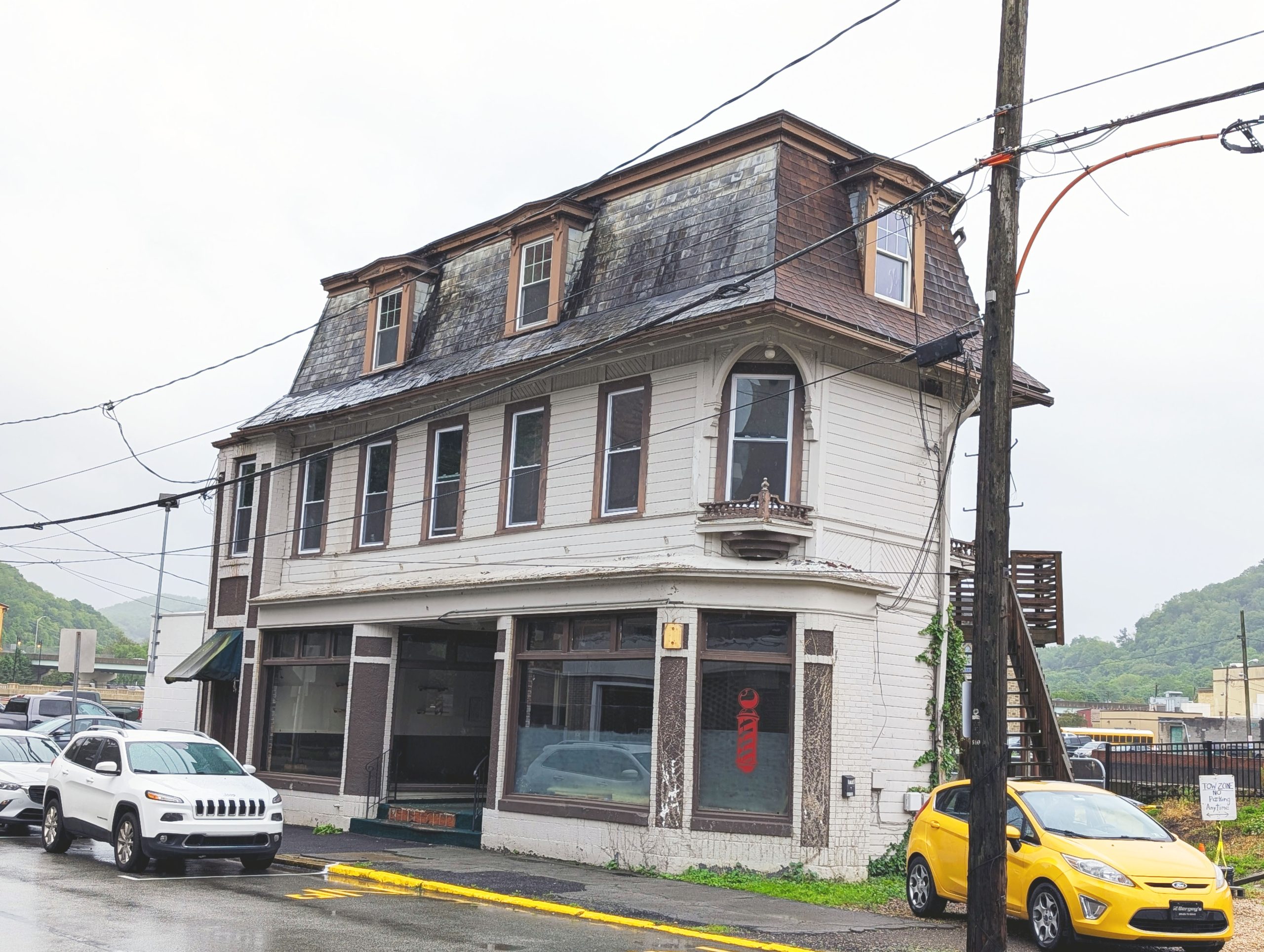
At 510 Vine Street in Johnstown, there is a building that does not quite belong to its surroundings—and that is exactly why it matters.
In a city built of brick pragmatism and industrial necessity, this structure leans into ornament, silhouette, and ambition. Its defining feature is unmistakable: a Second Empire–style mansard roof, slate-clad and sharply angled, rising above the street with a confidence rarely seen in small Appalachian industrial towns. Dormer windows puncture the roofline, turning what could have been dead attic space into livable volume. The roof is not decorative excess; it is functional theater.
Second Empire architecture—popular in the United States from the 1860s through the 1880s—was about projecting modernity, cosmopolitan taste, and permanence. It was borrowed from Paris and transplanted into American cities that wanted to signal they were not temporary boomtowns, but places with a future. Seeing it here, on Vine Street, tells you something important about Johnstown at the moment this building went up: this was a city investing in itself.
The building’s proportions reinforce that message. The ground floor was designed for commerce—large display windows, street presence, accessibility—while the upper stories suggest offices or residential use, softened by architectural details that go beyond pure utility. Even today, weathered and quiet, the building still reads as intentional. Someone cared how this corner looked.
A Working Building, Not a Monument
This was never a civic showpiece. It was a working building.
For much of its known modern life, Schrader’s Flower Shop occupied the space. That pairing makes more sense than it might first appear. Florists need light, visibility, and a building that feels welcoming rather than industrial. The storefront windows would have framed arrangements against the street, while the upper floors quietly held storage, workrooms, or offices. It was a neighborhood business in a building that already carried a sense of dignity.
That matters. Buildings like this are not meant to be frozen in amber. Their value comes from continuity of use, not preservation-as-museum. The fact that it served everyday needs—births, funerals, anniversaries, apologies—made it part of the city’s emotional infrastructure, not just its physical one.
Standing at a Threshold Again
Today, the building sits in a familiar Johnstown posture: intact, underused, waiting.
And that raises the right question—not what was this, but what could this be next?
Its scale and location make it ideal for uses that benefit from visibility and character without needing massive square footage. A small café or wine bar would fit naturally beneath the mansard roof. A boutique shop, studio retail, or gallery would benefit from the windows and the building’s inherent visual authority. A professional office—architecture, design, counseling, nonprofit—would gain instant gravitas just by occupying the space.
This is the kind of building that does half the branding work for you.
And yet.
There is also something quietly right about imagining it as a flower shop again.
Florists are rare now, replaced by grocery-store bundles and algorithmic delivery. But flowers are still how we mark the human moments that refuse to be digitized. A building that has already learned how to hold that role does not forget it easily.
A Hope, Not a Demand
Cities survive not by erasing their past, but by letting it echo.
The building at 510 Vine Street does not need to become something flashy or ironic to be relevant. It simply needs to be used with the same care it was designed with. Whether it becomes a café, a studio, a shop, or once again a place filled with cut stems and damp green buckets, the hope is the same:
That it continues to be a working piece of the city—
not just standing,
but participating.
Some buildings are landmarks.
Others are anchors.
This one has already proven it knows how to be the latter.