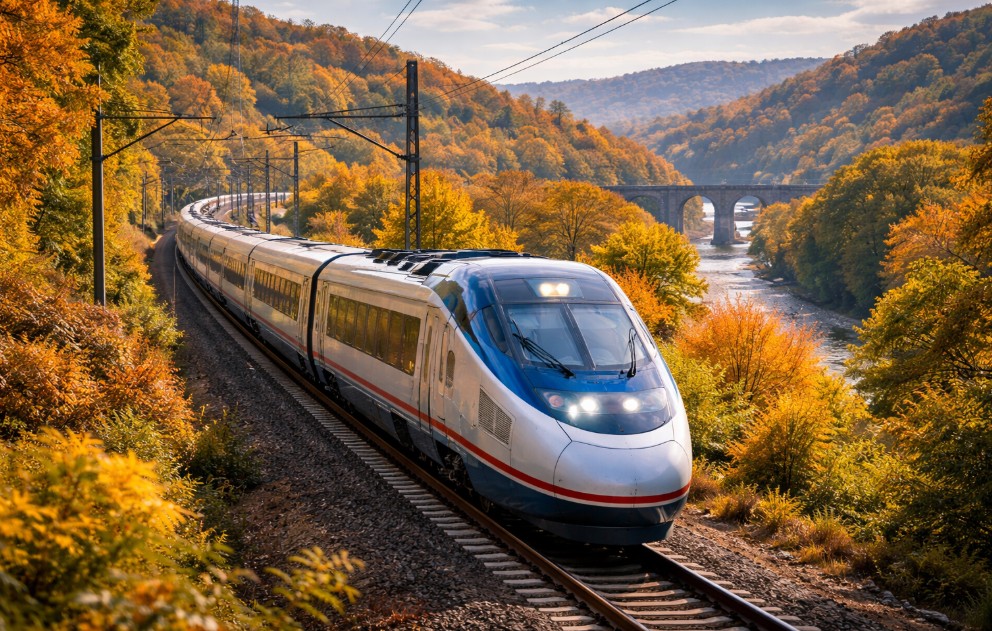
High Speed Rail for Pennsylvania
An Incremental, State-Scale High-Speed Rail Framework for the Commonwealth
Some ideas feel too big until you shrink them down to their real size.
High-speed rail is one of those ideas.
People hear the phrase and picture a grand national project — coast to coast, billions pouring in every direction until the whole thing collapses under its own ambition.
But what if the point isn’t to connect the nation?
What if the point is to connect Pennsylvania to Pennsylvania?
Let’s walk through this the way we would at a state fair, right between the prize pies and the 4-H rabbits: plain talk, no hype, grounded in what already exists.
1. Pennsylvania Is Already Shaped for This
Look at a map.
Pennsylvania’s cities don’t scatter — they align:
Philadelphia → Reading → Lancaster → Harrisburg
Pittsburgh → Johnstown → Altoona → State College
This is rail geometry you can actually work with.
Unlike much of the country, Pennsylvania still has the physical foundations of a world-class rail system:
- Long, straight historic rights-of-way
- Existing electrification on key corridors
- Underused lines that need modernization, not reinvention
- Mountain passes and alignments already engineered a century ago
If this were a baking contest, Pennsylvania already has the dough rolled, the pan greased, and the oven preheated. Most states are still hunting for measuring cups.
2. This Isn’t About Changing Rural Pennsylvania — It’s About Protecting It
“Rail” scares people because they imagine sprawl following the tracks.
In practice, the opposite happens when rail is done correctly:
- Development clusters around stations
- Farmland stays farmland
- Small towns remain small on purpose
- Pressure to subdivide rural land drops
You keep the countryside intact by letting cities absorb growth efficiently.
High-speed rail isn’t a bulldozer.
It’s a shield.
3. The Core Idea: Three Lines, One Commonwealth
Forget the national map.
Forget federal fantasy budgets.
This is a state-scale system, built in pieces that already make sense.
A. The Keystone Line
Philadelphia ↔ Harrisburg ↔ Pittsburgh
This is the backbone.
- Upgrade existing corridors
- Straighten the worst curves
- Modernize mountain segments
- Let trains run fast where geometry allows
No new concept — just execution.
B. The Academic Connector
Pittsburgh ↔ Altoona ↔ State College ↔ Harrisburg
This line links:
- Medical centers
- Research institutions
- Engineering and manufacturing talent
It strengthens the interior of the state without paving a single additional pasture.
C. The Optional Northern Branch
Scranton ↔ Wilkes-Barre ↔ Allentown ↔ Philadelphia
Not required for phase one — but powerful.
It ties the fastest-growing corridor back into the Commonwealth’s core.
Put together, these aren’t just rail lines.
They form a circulatory system — a Pennsylvania that actually functions as one connected place.
4. The Payoff You Feel in Daily Life
This isn’t abstract infrastructure theory.
It shows up in practical, measurable ways.
Less Turnpike Grind
Remove even 15–20% of long-range drivers from I-76 and everything improves: freight flow, safety, stress.
Bigger Job Markets Without Forced Relocation
Live in Johnstown. Work in Pittsburgh or Harrisburg.
Your ZIP code stops defining your ceiling.
Real Support for Small Towns
Tourism becomes easy.
Weekends become statewide.
The “we should visit someday” trips actually happen.
Flood and Disaster Resilience
A fast east-west rail corridor doubles as a logistics lifeline when highways fail.
Construction and Manufacturing Jobs
And much of the steel, labor, and expertise already lives here.
5. The Part Everyone Worries About — Solved
Most people hear “high-speed rail” and assume taxes are about to climb forever.
That only happens when you try to build everything at once.
This doesn’t work that way.
You build it incrementally:
- Philadelphia ↔ Harrisburg (already electrified)
- Harrisburg ↔ Pittsburgh (unlocks the state)
- The Academic Connector (lifts the interior)
Each phase stands on its own.
Each phase builds political and operational confidence.
This is barn-raising logic, not moonshot thinking.
6. The Pitch, Plain and Simple
Let’s build a rail system that connects Pennsylvania to itself — not to the world, not to the coasts, just to each other.
It strengthens cities.
It protects rural counties.
It keeps farmland farmland.
It opens jobs that already exist.
It reduces traffic without widening highways.
And it lets the Commonwealth work the way it always should have.
This isn’t speculative.
This isn’t ideological.
It’s geometry, infrastructure, and restraint.
And if any state is positioned to do it right — it’s Pennsylvania.
Bright Meadow Group
Systems Analysis and Solutions Consulting
Bright Meadow Group is the consulting arm of the Cernunnos Foundation, focused on practical, systems-level solutions to infrastructure, environmental, and regional design challenges. We work by observing how systems actually function, designing within real constraints, and intervening where leverage is highest.
Learn more at: https://brightmeadowgroup.com