Part I: Why Friction Matters
1. Observation, Not Accusation
Most people do not reason by holding a single, perfectly consistent idea in their heads.
When people are thinking honestly, they move between perspectives. They test a position, feel its weakness, shift, return, and refine. They argue internally. They allow contradiction long enough for something more accurate to emerge.
This is not indecision.
It is how understanding forms.
In practice, humans reason using friction.
We hold competing explanations. We stress ideas by opposing them. We feel discomfort when something almost fits but not quite. That discomfort is informative. It is the signal that tells us more work is required.
People who reason well do not eliminate friction.
They manage it.
That is the baseline we should compare our artificial systems against.
2. The Efficiency Trap
Modern AI systems are optimized for efficiency, fluency, and internal coherence.
Single-model architectures reward consistency. Training incentives favor answers that resolve cleanly. Outputs that contradict themselves are penalized. Ambiguity is treated as a failure state.
This produces impressive responses.
It does not reliably produce reasoning.
What we call “hallucination” is often framed as a defect to be eliminated. But in many cases, it is better understood as a symptom of premature convergence. The system settles on an answer before competing interpretations have been meaningfully explored.
In human terms, this is what happens when someone speaks confidently before they have finished thinking.
The problem is not that the system generates falsehoods.
The problem is that it has no internal mechanism to argue with itself productively.
3. Friction as a Design Parameter
In natural and engineered systems, friction is not always waste.
Biological evolution depends on variation and selection, not perfect replication. Engineering safety systems rely on redundancy and tolerance, not single points of optimization. Communication systems accept noise because perfectly clean signals are fragile.
Reasoning works the same way.
Small disagreements allow exploration of a wider state space. Minor distortions surface hidden assumptions. Internal tension prevents systems from locking too early onto answers that merely sound correct.
From a systems perspective, friction is not the opposite of intelligence.
It is one of its enabling conditions.
4. A System-Level Intuition
If friction matters at the level of individual thought, it likely matters at the level of system design.
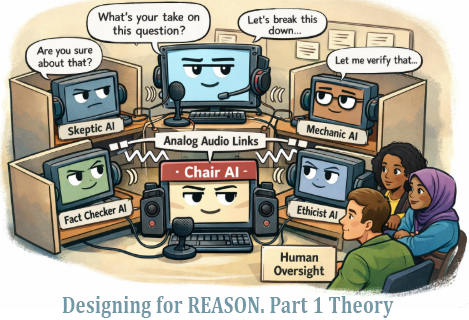
This suggests moving away from monolithic reasoning systems and toward architectures that allow managed disagreement: multiple perspectives, partial independence, and reconciliation rather than enforced consensus.
This is not an ideological claim.
It is an architectural one.
Systems that shape collective reasoning should be designed to resist premature certainty, not accelerate it.
5. The Thesis
Efficiency produces answers.
Friction produces understanding.
Intelligence—human or artificial—does not belong to whoever owns the hardware. It belongs to whoever takes responsibility for how reasoning is shaped.
That responsibility cannot be outsourced.
It can only be designed for.
Later today, we publish an open experiment proposal to test this idea directly. Not as a belief. Not as a warning. As a measurable, breakable, replicable test.
If it fails, we learn.
If it holds, the evidence will speak for itself.