Shalom. As-salaam alaikum. Peace be unto you.
This is an article about how the people who use those greetings have been at war for over two thousand years.
This is not an article about religion.
It is about misunderstanding.
It is about the human drive to preserve oneself—physically, culturally, spiritually—and the way that drive hardens into fear when the future feels uncertain. It is about our need to believe that our lives mean something beyond their brief span, and how we reach forward into history hoping to leave a mark that says we were here, and it mattered.
Every culture carries this impulse.
Every people does.
It is not a flaw.
It is a feature of being human.
We want safety.
We want dignity.
We want our children to live better than we did.
We want our stories to survive us.
These desires are nearly universal. Yet history reads like a catalog of slaughter carried out in their name.
The paradox is this: what separates us is not our goals, but our interpretations of how to protect them.
Language was meant to help us share meaning.
Culture was meant to store wisdom.
Instead, both have become filters—tools that clarify inside a group while distorting what lies outside it. Words that feel precise to one people feel threatening to another. Symbols that provide comfort to one community feel like domination to the next.
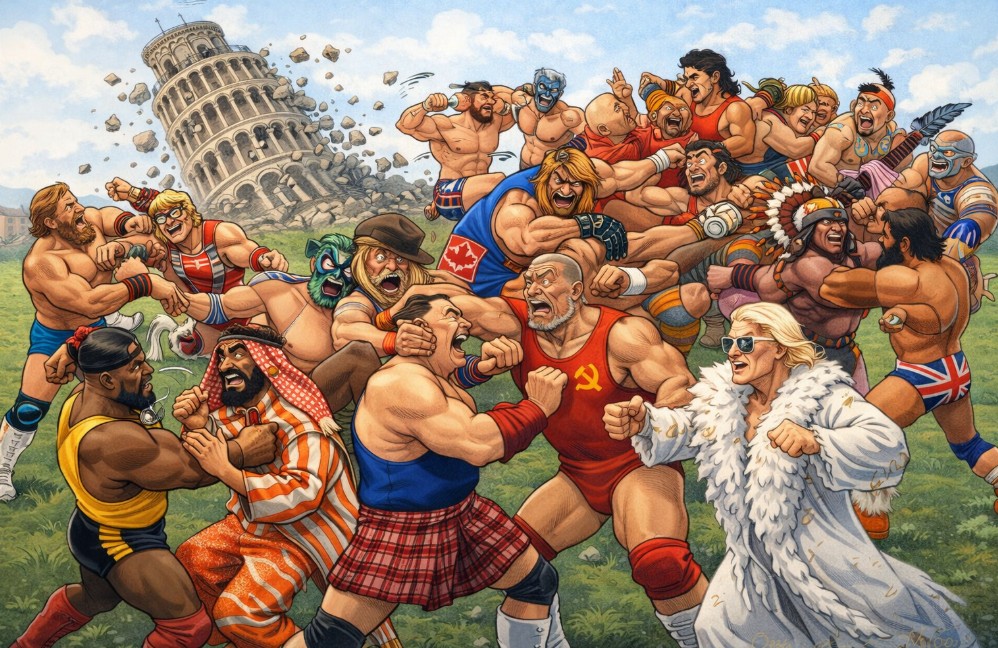
This is the real curse of Babel.
Not that humanity speaks many languages, but that we mistake language for reality itself.
We forget that words are approximations.
That traditions are responses to historical conditions, not eternal truths.
That identity is a lens, not a border wall.
When fear enters the system—when resources tighten, when dignity feels threatened, when the future looks unstable—we stop listening for meaning and start listening for danger. We flatten complexity. We divide the world into camps. We choose sides and call it clarity.
But duality is not morality.
Yin and yang are not good and evil.
Left and right are not up and down.
Light requires shadow to be seen at all.
Every functioning system depends on balance. When one side attempts to eliminate the other instead of understanding it, the system destabilizes. In nature, that leads to collapse. In human societies, it leads to war.
We do not fight because we are different.
We fight because we refuse to accept that difference does not require domination.
The modern world moves too fast for reflection. Outrage travels faster than empathy. Narratives outpace nuance. Entire populations are reduced to caricatures because it is easier than sitting with discomfort. Easier than admitting that the people we fear wake up every morning with the same knot in their chest—the same worry about safety, purpose, and belonging.
Anger is usually grief that has not been understood.
Fear is often pain that has not been heard.
Slowing down does not mean surrender. It means refusing to let panic dictate meaning. It means choosing to understand the why beneath another person’s rage before responding to the rage itself.
We all suffer the curse of Babel.
We suffer it every time we confuse disagreement with evil.
Every time we believe our language contains the whole truth.
Every time we defend identity instead of examining it.
The curse does not end through conquest, conversion, or uniformity. Those are just new towers built from old stones.
It ends when we submit—not to one another, but to reality.
To the reality of our shared humanity.
To the reality that fear is not unique.
To the reality that meaning is not diminished by being shared.
When we learn to communicate through what we have in common—before we argue about what divides us—the noise quiets. The tower stops rising. And for the first time in a long while, we might hear one another clearly.
Peace be unto you.
As-salaam alaikum.
Shalom.