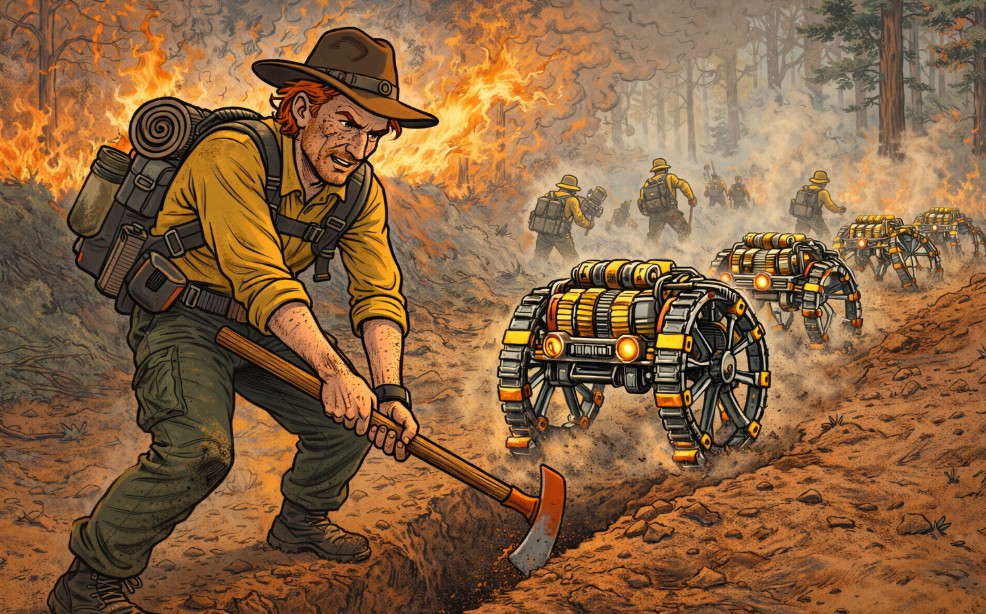
Running the Line
A great friend of mine from the prehistoric days of my 1990s Navy life was Shawn McEwen.
Shawn is a hero. Everyone who served on my ship knows it. His quick action—taken with serious personal risk—prevented a boiler room catastrophe aboard USS Niagara Falls. That kind of courage doesn’t come from training manuals. It comes from instinct, judgment, and a willingness to move when others freeze.
In the real world, Shawn is the quintessential Western man. And like many people cut from that cloth, his life didn’t follow a single arc. One of the paths he took was as a fire jumper.
I always loved listening to his stories. Not because they were dramatic—though they often were—but because of how matter-of-fact they were. The endurance. The judgment under exhaustion. The quiet acceptance of risk. These are people who walk directly into chaos carrying everything they need on their backs, because there’s no other way to get it there.
And then, one day, years later, I was scrolling the internet and saw a short clip of a wheel-runner robot scrambling effortlessly over broken ground.
And my brain did what it does.
What if the hardest part of wildland firefighting—the part that drains people before the fight even begins—didn’t have to be done by human bodies anymore?
What if firefighters could arrive ready to work, instead of already spent?
What if we stopped asking people to move weight through terrain that defeats machines—and started designing machines for the terrain instead?
That question leads directly to this.
A Terrain-Native Logistics Problem
Wildland and open-field fires are not lost because firefighters lack courage, training, or tools. They are lost because time, terrain, and fatigue compound faster than people can move weight through chaos.
Every fire professional understands this intuitively: the most punishing work on the line is not suppression—it is getting the equipment to the place where suppression can begin. Hose, fittings, saws, hand tools, medical gear—heavy, awkward loads must be carried uphill, across debris, through smoke, often under extreme heat and stress. Vehicles cannot follow. When they try, they get stuck, damaged, or become hazards themselves.
This is not a firefighting problem.
It is a logistics problem under extreme terrain constraints.
And it is one that modern robotics can now solve.
The Hidden Bottleneck in Wildland Fire Response
Across forests, parks, grasslands, and wildland–urban interface zones, firefighting consistently encounters the same constraints:
- Terrain that defeats wheels and tracks
- Slopes that exhaust crews before work even begins
- Debris fields that slow or halt supply movement
- Limited vehicle access that increases risk and delays attack
The result is predictable:
- Slower initial attack
- Increased firefighter fatigue
- Higher injury rates
- Greater fire growth before containment
- Escalating suppression costs and property loss
The cost of these delays is measured not just in dollars, but in burned acreage, lost structures, damaged ecosystems, and human risk.
A Right-Now Technological Opportunity
There already exists a class of ground robotics optimized for exactly this kind of environment: terrain-native, impact-tolerant, compliant-mobility runners.
Think less robot firefighter and more terrain-native pack animal—a purpose-built logistics tool designed to move weight where people shouldn’t have to.
Unlike wheeled or tracked vehicles, these systems move using continuously rotating, compliant legs that absorb shock, tolerate debris, and maintain mobility across terrain that would stop conventional platforms. They are mechanically simple, robust, and well suited to carrying loads over irregular ground at speed.
This is not speculative technology.
It is mature enough to be deployed today—if applied to the right problem.
Wildland hose and equipment delivery is that problem.
The Hose & Equipment Runner Concept
The proposed system is not a firefighting robot. It does not spray water, make tactical decisions, or replace human judgment.
It is a terrain-native logistics runner, purpose-built to move equipment where people are currently forced to do so at great cost.
Core mission:
Rapid, safe delivery of hose and equipment across hostile terrain during wildland and open-field fire operations.
Typical payloads include:
- Rolled hose packs
- Nozzles, gated wyes, fittings
- Hand tools (axes, shovels, Pulaskis)
- Chainsaws and support gear
- Medical kits and water
Why This Mobility Class Works Where Others Fail
Terrain tolerance
Roots, rocks, slash, burn scars, loose soil—these environments defeat wheels and tracks but are exactly where compliant runners excel.
Slope performance
On steep hillsides, rotating compliant legs maintain ground contact where traction-based systems slip or stall.
Shock isolation
Loads are protected from repeated impact. The system is designed to collide with terrain, not delicately avoid it.
Mechanical simplicity
Fewer actuators and simpler control reduce cost, increase durability, and support field repairability.
This is a logistics animal, not a precision instrument.
How Crews Would Actually Use It
The system integrates into existing fireground operations with minimal disruption:
- Load at staging
- Assign destination
- Autonomous or supervised run
- Drop and clear
- Return, reposition, or power down
Firefighters arrive ready to work—not exhausted from transport.
Safety, Scale, and Why This Matters
This system removes firefighters from the most fatiguing and injury-prone work while reducing vehicle exposure and wasted time.
Even marginal improvements in logistics efficiency compound:
- Faster hose deployment → earlier containment
- Reduced fatigue → longer effective work periods
- Fewer injuries → lower medical and staffing costs
Wildfires cost tens of billions annually. A system that saves minutes early can save millions later.
Conclusion
Wildland firefighters do not need another promise of future automation. They need tools that reduce risk and increase speed today.
A terrain-native hose and equipment runner does exactly that:
- It moves weight where humans shouldn’t have to.
- It works where vehicles cannot.
- It integrates without disrupting doctrine.
- It converts human energy into suppression, not transport.
The fireground will always be dangerous.
But logistics does not have to be.
Identifying problems like this—where effort is being wasted instead of multiplied—is the kind of systems analysis Bright Meadow Group exists to do.
Sometimes the solution isn’t a bigger machine or a new doctrine.
Sometimes it’s just running the line better.