A Five-Acre Regenerative Urban Farm for Maximum Food Production
This system is built on the core insight demonstrated by Will Allen:
Living soil and living water must remain connected, even when that increases maintenance.
Most modern aquaponic systems attempt to sterilize and simplify. Allen accepted biological complexity in exchange for productivity and resilience. This design extends that principle to perennial crops, protein production, and full urban food security.
It is not hobby farming.
It is infrastructure.
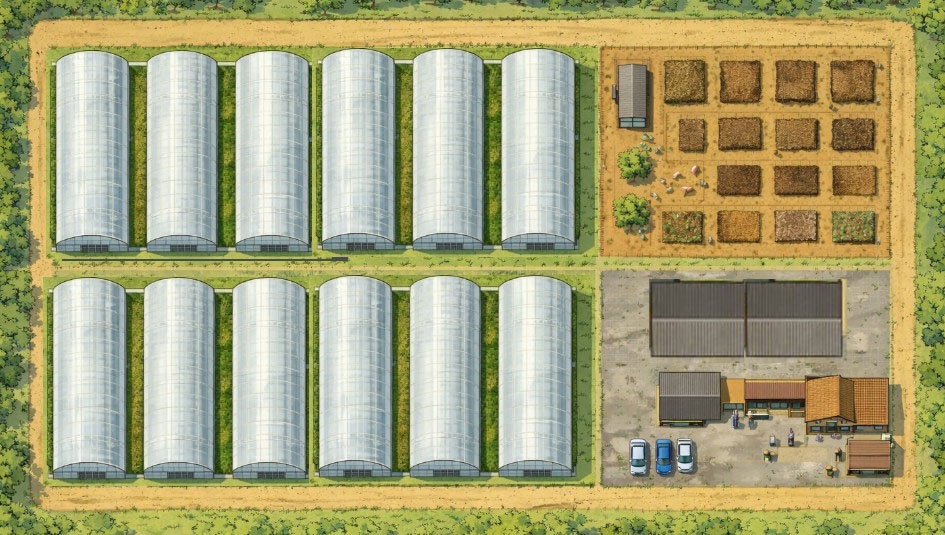
Site Overview (5 Acres Total)
1) Greenhouse Production Zone — 3 Acres
Three acres of passive-solar greenhouses optimized for season extension without mandatory supplemental heat.
Design features:
- South-facing orientation
- Double-wall poly
- Thermal mass (water tanks, masonry, soil beds)
- Earth berming where possible
- High rooflines
- Automated ventilation
- Shade management
Goal:
Four-season production without structural dependence on fossil fuel heat.
Heating remains optional.
The system must function without it.
2) Poultry & Biomass Cycling Zone — 1 Acre
(Mobile Tractor + Distributed Compost System)
This acre functions as the biological digestion system of the farm.
It uses:
- Mobile chicken tractors
- Rotational paddocks
- Distributed mulch windrows
- Targeted decomposition
There is no permanent coop footprint.
Birds are housed at night in mobile tractors and released daily into active paddocks.
This prevents manure accumulation and disease vectors while maximizing compost processing.
Paddock Layout
- 10–14 rotating paddocks
- Central is
- Tractor access lanes
- Windrows inside each paddock
Rotation cycle: 30–45 days minimum.
This fully disrupts parasite and pathogen buildup.
Compost & Mulch Management
Each paddock contains staged windrows:
- Fresh biomass
- Mid-stage compost
- Fungal-dominant breakdown
- Finished mulch
Chickens are rotated to the paddock with the highest insect activity.
They instinctively target the most biologically productive material.
No mechanical turning required.
Daily Operation
Morning:
- Move tractor
- Release birds
Day:
- Birds work windrows
- Consume pests
- Fertilize soil
Evening:
- Recall to tractor
- Secure housing
Next day:
- Move again
No buildup.
No stagnation.
No permanent contamination.
Outputs
- Eggs
- High-quality compost
- Finished mulch
- Nitrogen-rich litter
- Pest suppression
This acre replaces:
- Fertilizer inputs
- Waste hauling
- Mechanical composting
- Chemical pest control
3) Operations & Market Zone — 1 Acre
Includes:
- Wash/pack facility
- Cold storage
- Dry storage
- Tool shop
- Fish processing area
- Office / classroom
- Farm store
- Parking
- Loading dock
This isolates logistics from production.
No cross-contamination.
Aquaculture Core
Two primary fish systems.
Tank Group A: Channel Catfish
- High biomass
- High fat
- High nutrient output
- Primary fertilizer engine
Tank Group B: Yellow Perch
- Cleaner feeding profile
- High market value
- Balanced production
Management Model
- Continuous fry stocking
- Rolling harvest
- Size-based removal
- No batch cycles
Feeding is intentionally generous (within oxygen limits).
Goal:
Maximize protein growth and nutrient production.
This creates “fertile water.”
Not sterile water.
Living Water Distribution
Instead of full sterilization:
- Settling basins
- Bioactive sumps
- Worm filters
- Mineral beds
- Living media beds
Solids are managed biologically.
Water remains alive.
This follows Allen’s soil-in-the-loop principle.
Integrated Food Forest (4 Layers Powered by Fish Water)
Fish effluent drives four perennial layers within and adjacent to greenhouses.
1) Dwarf & Semi-Dwarf Fruit Trees
Grown in large containers/barrels:
- Apple
- Pear
- Plum
- Cherry
- Fig
Root zone: living soil
Interface: flowing nutrient water
Riparian orchard model.
Trees function as permanent nutrient sinks.
2) Fruiting Shrubs
Primary species:
- Mulberry (dual-use: human + poultry)
- Blueberry
- Raspberry
- Blackberry
- Currant
- Gooseberry
Mulberry is strategic:
High yield
High sugar
Livestock feed
Zero processing
3) Vines & Climbers
Trellised on greenhouse structure:
- Grapes
- Hardy kiwi
- Passionfruit (warm zones)
- Cucumbers
- Squash
Vertical calorie production.
No wasted airspace.
4) Annual Greens & Herbs
Fast-turnover production:
- Lettuce
- Spinach
- Kale
- Chard
- Basil
- Cilantro
- Parsley
- Like
- Dill
- Scallions
Primary cash-flow crops.
High frequency income.
Nutrient Loop
Complete biological cycle:
Fish → Water → Plants → Waste → Chickens → Compost → Soil → Plants
No waste streams.
No external disposal.
Calorie Strategy
This is not “salad farming.”
It prioritizes:
Protein
Fat
Sugar
Starch
Micronutrients
Sources:
Fish → protein/fat
Eggs → protein/fat
Fruit → sugars
Greens → vitamins
Grapes → preserves
Mulberry → animal feed
This supports subsistence and market production.
Labor Structure
Designed for:
- 8–12 full-time staff
- 10–20 seasonal
- Apprentices
All cross-trained.
No siloed expertise.
Expected Annual Output (Conservative)
Fish: 60–90 tons
Produce: 500k–800k lbs
Eggs: 250k–350k
Fruit: 80k–120k lbs
Revenue:
$2.5M–$5M+ annually
Without subsidies
Why This Works
- Biology replaces machinery
- Perennials stabilize income
- Waste is eliminated
- Energy demand is minimized
- Maintenance is accepted, not avoided
This is Allen’s philosophy scaled.
Giving Will Allen Proper Credit
Allen proved:
- Soil belongs in aquaponics
- Waste is value
- Community matters
- Complexity builds resilience
This model extends:
- Perennials
- Protein scaling
- Market integration
- Infrastructure permanence
It is not a new philosophy.
It is the full build-out.
Final Assessment
This system is:
Technically feasible
Biologically stable
Financially viable
Regionally scalable
It represents what urban food infrastructure should be.
Not boutique.
Not fragile.
N
Permanent.