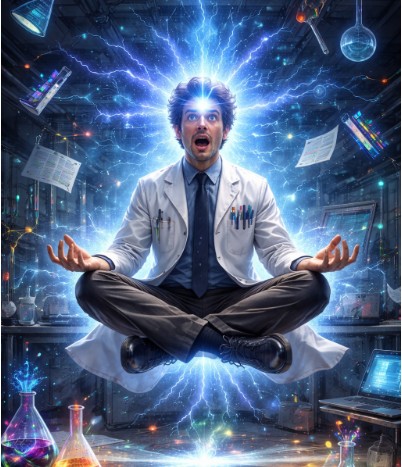
Why Systems Exist to Be Spent
A Thought Experiment on Structure, Dissipation, and Meaning
Editorial Note:
This piece is presented as a conceptual thought experiment.
It reflects one interpretive framework for understanding physical and social systems.
This is not an argument that “nothing matters.”
It is an argument that structure exists in order to be spent.
If that sounds bleak, read carefully.
Entropy Was Framed as the Enemy
Entropy is usually introduced as loss.
Decay.
Disorder.
Heat death.
Failure.
The villain of physics.
The thing engineers fight.
The reason nothing lasts.
From this framing, a simple story emerges:
Order equals success.
Entropy equals defeat.
Build against entropy.
Stabilize systems.
Preserve structures.
Hold ground.
That story is incomplete.
Entropy Is Not Chaos
Entropy is not “mess.”
In physics, it is the number of possible microscopic arrangements consistent with a visible state.
High-entropy systems often display strong structure:
- Hurricanes
- Cells
- Ecosystems
- Brains
- Markets
They are ordered precisely because they dissipate energy efficiently.
Order is a mechanism.
Dissipation is the function.
The Universe Runs on Gradients
All physical processes arise from imbalance.
Hot and cold.
High and low.
Dense and thin.
Certain and uncertain.
These gradients are unstable.
They are erased over time.
Entropy is the measure of that erasure.
No gradient produces no process.
No process produces no structure.
No structure produces no observers.
Complexity exists because things are falling apart.
Life Is a Controlled Dissipation System
A living cell is not a static object.
It is a metabolic engine.
It absorbs low-entropy resources and releases higher-entropy waste.
Heat.
Carbon dioxide.
Exhausted nutrients.
Life does not resist entropy.
It organizes entropy production.
Intelligence Is Entropy Management
Biological and artificial intelligence reduce uncertainty locally.
They predict.
They compress information.
They stabilize internal states.
This local order is purchased with global disorder.
Every computation produces heat.
Every memory has a thermodynamic cost.
Intelligence is a gradient-processing system.
Civilization Is Entropy at Scale
Cities, factories, networks, and data centers are planetary dissipation engines.
They convert concentrated resources into dispersed waste.
Fossil fuels.
Minerals.
Soils.
Ecosystems.
All flattened into heat, motion, and byproducts.
Technological progress corresponds to increased throughput.
This is not moral judgment.
It is thermodynamics.
Systems Perspective
From this perspective, many modern debates appear misframed.
We argue over growth versus sustainability, efficiency versus resilience, innovation versus preservation.
But these are surface arguments.
The deeper question is how rapidly and intelligently a system dissipates its gradients—and whether it learns while doing so.
Why No System Reaches Perfection
A perfectly balanced system has no gradients.
Without gradients, nothing moves.
Without movement, nothing adapts.
Without adaptation, systems collapse.
Every “finished” structure fails.
Every “final” model breaks.
Every stable order decays.
Physics forbids permanence.
Structure Exists to Be Used
Stars burn.
Planets cool.
Mountains erode.
Institutions decay.
Ideas fade.
Empires dissolve.
These are not malfunctions.
They are outcomes.
Their role was energy conversion.
When that role ends, so does the structure.
The Second Layer: Accelerated Entropy
Complex systems evolve to increase entropy production.
Not merely to decay.
To decay efficiently.
Life accelerates dissipation.
Technology accelerates it further.
Automation and AI accelerate it again.
Modern civilization is an entropy-amplification system.
The Productive Role of Friction
Friction generates heat.
Heat enables learning.
Learning enables adaptation.
Noise prevents stagnation.
Loss creates resilience.
Failure generates structure.
Perfect efficiency is unstable.
Dissipation is necessary.
Why This Perspective Feels Unsettling
An entropy-centered view removes the promise of permanence.
No final equilibrium.
No lasting monument.
No stable endpoint.
Only continual transformation.
This conflicts with cultural preferences for durability and control.
Physics does not share those preferences.
Meaning Within Dissipation
Temporary systems can be consequential.
A flame is brief.
It still gives light.
A wave passes.
It still moves oceans.
Duration is not the measure of significance.
Participation in process is.
Conclusion
Entropy is not what happens when systems fail.
Entropy is what happens when systems operate as designed—
and continue operating for its full useful lifespan.
Invitation
Researchers working in:
- Information thermodynamics
- Emergent gravity
- Complex systems
- Free energy theory
- Statistical physics
are encouraged to engage, critique, and extend this framework.
Progress occurs through friction.
Blue Ribbon Team publishes cross-disciplinary field notes on structural patterns in natural and human systems.