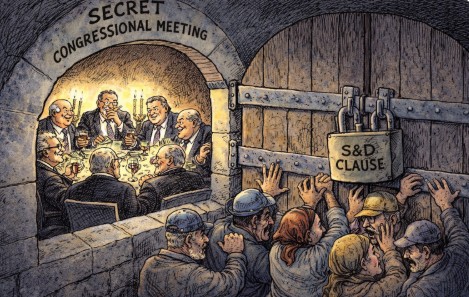
Speech, Debate, and the Cowardice of Secrecy
The Speech and Debate Clause was not written to protect Congress from the public.
It was written to protect Congress for the public.
That distinction matters.
Somewhere along the way, a constitutional shield against executive intimidation was quietly repurposed into an all-purpose excuse for doing the people’s business out of sight. What was meant to preserve legislative independence has metastasized into procedural darkness, where accountability goes to die of “natural causes.”
The Framers were many things, but they were not subtle about this:
Speech and debate are public acts.
They are civic performances, not private murmurs.
A legislature that cannot withstand observation has already forfeited the moral authority the Clause was meant to defend.
What the Clause Actually Protects
The Speech and Debate Clause exists to ensure that members of Congress may speak freely without fear of retaliation from the executive or judiciary.
It is protection against coercion, not against scrutiny.
It assumes—almost arrogantly—that the public will hear what is said and judge it accordingly.
In other words, the Clause presumes daylight.
The modern interpretation flips this on its head.
Routine communications—emails, memos, staff coordination, and “informal” conversations that somehow manage to steer national policy—are buried behind claims of privilege that have nothing to do with protecting debate and everything to do with avoiding consequence.
This is not constitutional conservatism.
It is institutional cowardice.
Transparency Is Not Exposure.
It Is Reinforcement.
A transparent legislature is harder to bully, not easier.
When speech is public and preserved, it cannot be selectively leaked, quietly altered, or retroactively laundered through press statements and staff briefings.
If Congress were serious about defending its independence, it would stop hiding behind secrecy and start anchoring its work in a continuous public record.
Not disclosure after scandal.
Not oversight after damage.
Visibility as default.
A Simple republican Standard
If the work of Congress is truly legislative, then:
- It should occur on a publicly visible, recorded, and archived platform.
- Communications should be timestamped, immutable, and searchable.
- Speech and Debate protection should remain absolute—but aimed outward, not inward.
Secrecy should exist only where constitutionally unavoidable, not where it is administratively convenient.
Classified material should be narrowly defined, aggressively sunset, and logged as an exception—not operated as a parallel government.
And no, transparency does not waive privilege.
It simply acknowledges who the privilege is owed to.
Why This Matters Now
A Congress that hides breeds distrust.
A Congress that leaks breeds paranoia.
A Congress that speaks plainly in public restores legitimacy without demanding blind faith.
The Speech and Debate Clause was never meant to turn lawmakers into monks operating behind cloister walls.
It was meant to let them argue fiercely, openly, and without fear.
The Uncomfortable Truth
The Clause is not a right to secrecy.
It is a right to speak freely where everyone can hear you.
If Congress wants to reclaim its constitutional dignity, the answer is not better messaging or tighter privilege claims.
It is procedural transparency so complete that retaliation becomes impossible and corruption becomes obvious.
Sunlight is not the enemy of speech.
It is the condition that makes it matter.