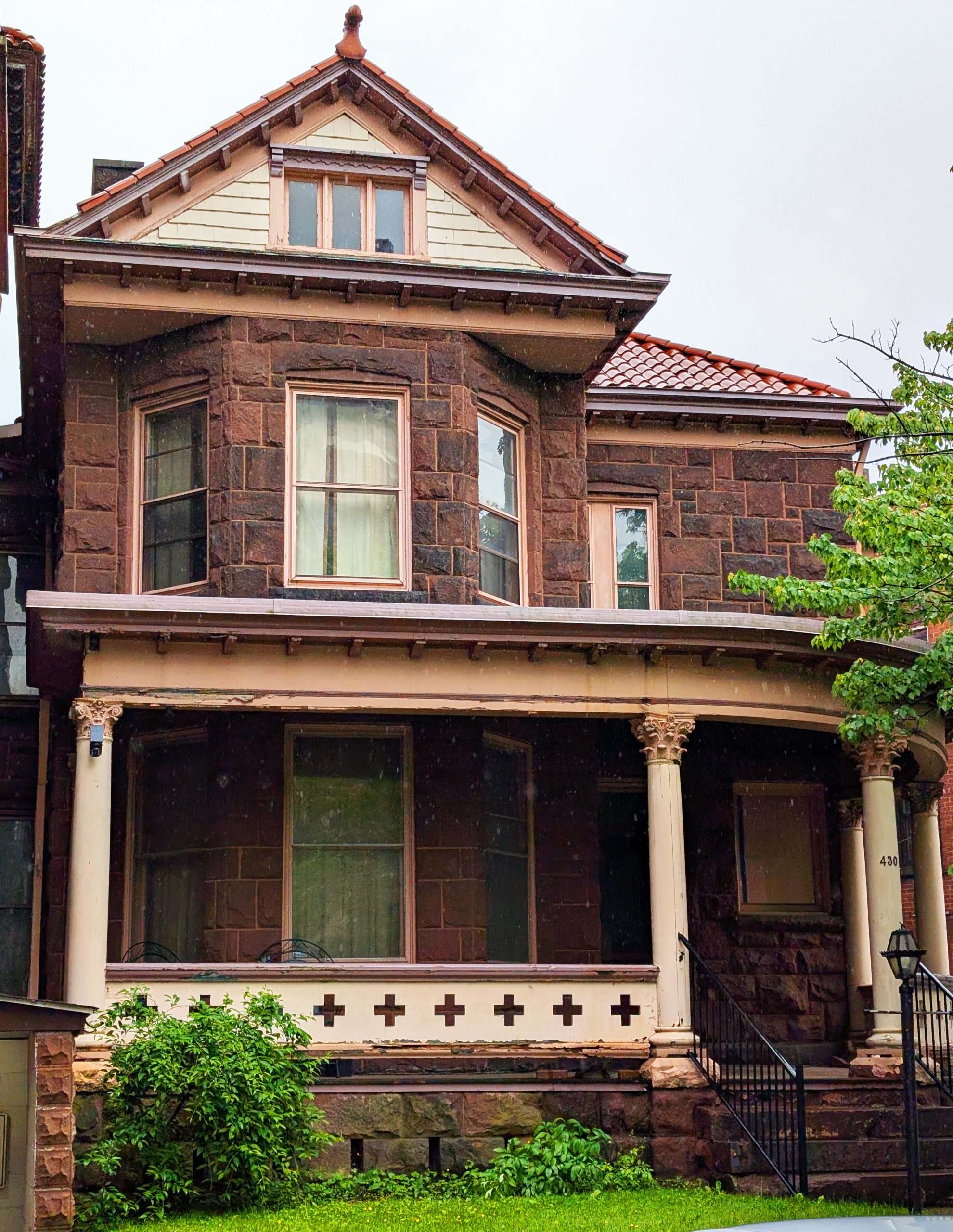
This house is an example of why Johnstown never fits neatly into one architectural category.
Johnstown wasn’t built in one confident burst. It was built, broken, rebuilt, expanded, abandoned, and repurposed—over and over again—by forces much larger than any individual resident. Steel booms, wartime surges, industrial collapses, and repeated catastrophic floods meant the city was constantly resetting itself. Every generation inherited a partially damaged landscape and made practical, hopeful, and sometimes ambitious decisions about how to live in it.
That cycle left layers.
Walk a few blocks in almost any direction and you’ll see modest workers’ cottages beside ornate Victorian homes, early-20th-century stone houses next to postwar brick boxes, turn-of-the-century storefronts beside midcentury renovations. Few neighborhoods are stylistically “pure.” Most are historical mosaics—records of who had money, who lost it, who rebuilt anyway, and who decided to stay.
This house sits right in that story.
Built of heavy local stone, it reflects a period when permanence mattered—when materials were chosen to last, and craftsmanship was a point of pride. The thick masonry walls, deep-set windows, and substantial porch speak to an era when Johnstown was confident in its industrial future and willing to invest in homes that felt almost civic in their solidity.
The wide front porch is especially telling. This wasn’t just shelter. It was social space. A place to sit in the evening, watch the street, talk to neighbors, cool off after long shifts. In working and middle-class Johnstown, porches were outdoor living rooms—part of the social infrastructure of the town.
Above that, the gabled roofline, dormer windows, and decorative trim hint at late Victorian and early Craftsman influences. It’s restrained, not flashy, but carefully composed. Someone cared how this house looked from the street. Someone wanted it to feel respectable, modern, and enduring.
The tiled roof extension and layered additions suggest later adaptations—evidence of changing needs, repairs after storms or floods, and the slow evolution of family life inside. Like much of Johnstown’s housing stock, this isn’t frozen in time. It’s been edited by decades of use.
Even the weathering tells a story. The softened edges, faded trim, and darkened stone aren’t neglect so much as endurance. This house has seen economic peaks and collapses, population swings, floods upstream, and long winters. It’s still standing.
What makes it special isn’t that it’s rare.
It’s that it’s typical of Johnstown at its best.
Solid. Practical. Quietly dignified. Built during a moment of confidence. Maintained through periods of uncertainty. Adapted rather than abandoned.
In a city shaped by steel mills, rivers, disasters, and reinvention, houses like this are historical documents. They show how ordinary people responded to extraordinary conditions—not with monuments, but with homes meant to last.
This one still does.