A Copper Age Lesson for AI
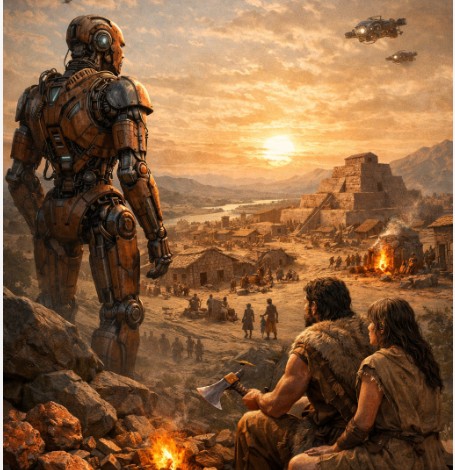
I’m sitting here listening to a three-hour history lecture on the Copper Age, tracing the flow of metals and trade between Central Europe and Mesopotamia. Somewhere between ore sources, river routes, and collapsed cities, an old pattern surfaced—one we all know, but rarely sit with long enough.
Every time a new technology enters human civilization, it doesn’t just add convenience or efficiency.
It reorganizes how we live.
And when the way we live changes, everything else follows.
Cities rise and fall.
Power structures shift.
Economies rewire themselves.
Entire social orders collapse—sometimes almost overnight.
At the height of Anatolia’s influence, even small changes in metals technology could make a city incredibly wealthy one decade and a burned-out husk the next.
This isn’t a rare event.
It’s the story of humanity.
From our earliest known cities—some only recently uncovered, deliberately buried by hands long gone—to later civilizations reshaped by disease, climate shifts, resource depletion, catastrophe, and innovation, humanity has destroyed itself and rebuilt again and again.
Hundreds of thousands of times, if you zoom out far enough.
And, thank Darwin, we have tended toward improvement.
Not because we are gentle.
Not because we are wise by default.
But because survival favors learning.
Over time, we’ve become slightly better at not erasing everything that came before us. We preserve more knowledge. We carry culture forward. We build archives instead of bonfires.
That alone is an extraordinary evolutionary shift.
I’m not saying any of this to state the obvious.
History is never just trivia.
It’s instruction.
The fear you feel about rapid technological expansion is real. It always has been. Throughout history, major technological shifts bring upheaval precisely because they redistribute power—and power never moves quietly.
But here’s the part we often forget:
Over the last two thousand years of Western civilization—yes, eurocentric as that framing may be—we have radically improved our response to technological disruption. That capacity to adapt, document, cooperate, and iterate is a large part of why Western powers dominated for so long.
Not moral superiority.
Not destiny.
Systems.
As knowledge spreads faster and cooperation becomes broader, this adaptive advantage doesn’t disappear—it accelerates.
Unless we choose a different path.
Burning it all down may feel satisfying in moments of fear or anger, but history is clear: it rarely produces wisdom. More often, it just resets the board and forces the same lesson to be learned again—at a higher cost.
Technology feels like the enemy because change is dangerous. That instinct is not wrong.
What matters is whether we meet danger with panic or with memory.
We’ve navigated these transitions before.
Not perfectly.
Not peacefully.
But successfully enough to still be here.
So look to history.
Not to romanticize it, and not to fear it—but to find your path forward.
Because if we choose to torch everything instead, all we’re really doing is asking whether we’ll handle the next Copper Age any better than the last.
And that’s a risky experiment to run again.