Build the World in Play Before You Try to Govern It
Before anyone reaches for the word “censorship,” let me be clear.
I grew up during the moral panics of the 1980s. I watched adults convince themselves that imagination was dangerous — that fantasy games, heavy metal, and tabletop role-playing were corrupting children. Creativity was treated like contraband. Kids were shamed for play.
That damage was real.
This is not that.
This is not a call to ban anything. It is not a demand for regulation. It is not a plea for cultural policing.
It is a call for reflection.
Freedom of expression is not the same thing as freedom from reflection.
No one should be told what they’re allowed to make. But everyone should ask what they are choosing to make — and what it rehearses.
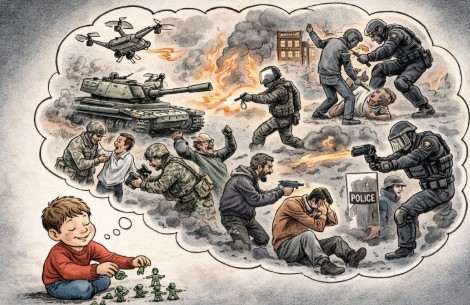
Because play is rehearsal.
And rehearsal becomes instinct.
Every Generation Practices the Future
We do not learn how to live together in speeches.
We practice it in play.
In games.
In toys.
In simulations.
In the systems we repeat until they feel natural.
Play is not trivial. It wires cause and effect. It teaches risk assessment. It encodes what “winning” means. It determines whether cooperation feels rewarding or whether elimination feels satisfying.
Pilots train in simulators. Militaries war-game strategy. Engineers use sand tables. We understand the power of rehearsal in every serious field — except when it comes to public culture.
Right now, much of what we rehearse is destruction.
We Are Already Fluent in Violence
Human beings do not need instruction in harm. We mastered that with rocks. We industrialized it with steel. We digitized it with code.
We do not need another thousand tactical shooters to understand domination.
We already know how to compete.
We already know how to suppress.
We already know how to eliminate.
What we are far less practiced at is building.
Imagine Different Rehearsals
Imagine cooperation-based strategy games where a team must solve complex, nonviolent problems:
You inherit a watershed serving five towns. Industrial growth increases revenue but raises flood risk downstream. Forest restoration stabilizes soil but reduces short-term profits. Elections happen every four years. Drought hits every six.
You manage a regional power grid. Demand spikes in heat waves. Storage costs money. Maintenance prevents collapse but isn’t glamorous. One neglected substation triggers cascading failure.
You design a city recovering from disaster. Rebuilding too quickly locks in fragility. Rebuilding too slowly drives migration. Every decision affects housing, transport, and health.
You coordinate a supply chain for critical medicine. Disruption in one country affects survival in another.
No enemies.
No body counts.
No reset button.
Just tradeoffs, interdependence, and consequence.
Make that competitive.
Make that collaborative.
Make that compelling.
Those are the instincts modern societies actually need.
What We Practice Becomes Policy
If “winning” is domination, domination becomes leadership.
If “problems” are enemies, politics becomes elimination.
If success is measured in body counts, compromise feels like defeat.
We rehearse zero-sum logic for decades and then express shock when public life mirrors it.
This is not about blaming entertainment for society’s problems. Culture is not a single switch you flip.
But rehearsal matters.
We know this because institutions rely on it. Militaries rehearse war. Corporations rehearse competition. Governments rehearse crisis.
Why are we not rehearsing resilience with the same seriousness?
Imagination Is Infrastructure
Before there is policy, there is imagination.
Before there is industry, there is play.
Before there is culture, there is rehearsal.
If we want societies capable of managing climate stress, energy transition, infrastructure repair, public health, and water scarcity, then people need practice thinking in systems.
They need to experience tradeoffs without collapse.
They need to see cooperation as strength.
They need to feel long-term maintenance as achievement.
That begins in play.
A Challenge to Designers
To the studios.
To the indie developers.
To the toy makers.
To the modelers and modders.
You are not just producing entertainment. You are designing reflexes.
You are shaping what feels intuitive.
You are defining what “victory” looks like.
You are rehearsing futures.
No one should tell you what you can build.
But you should decide deliberately what you rehearse.
Closing
Imagination was once treated as dangerous. It still is.
Not because it corrupts — but because it shapes.
We do not need more practice destroying things. We have centuries of that rehearsal behind us.
What we lack is practice building what comes next.
If we want a more cooperative politics, a more resilient economy, a more functional society, we cannot wait until adulthood to learn it.
We have to rehearse it.
And rehearsal begins in play.