I’ve Talked About Why I Moved Here. Let Me Tell You Why You Should.
I’ve written before about why I chose to plant myself in Johnstown, Pennsylvania.
Now I want to talk directly to you.
Not about my reasons.
About yours.
If you are looking for somewhere to live, build, work, create, raise a family, or restart a life without surrendering your income and attention to rent, traffic, and noise, you should be looking seriously at Johnstown.
Most people aren’t.
That’s precisely why it still works.
Close to Power — Without Being Consumed by It
Johnstown occupies an unusual geographic position.
It sits within driving distance of Pittsburgh, Philadelphia, Washington, Baltimore, and New York — close enough to remain connected to major economic corridors, far enough to avoid being absorbed by them.
You are not isolated.
You are not off the map.
You are not cut off from opportunity.
You are simply not paying coastal premiums for proximity.
In structural terms, Johnstown sits within orbit of one of the densest concentrations of wealth and institutional power in the world — without being crushed by it.
That is leverage.
Real Community, Not Performance
Life here feels human.
Not curated.
Not status-driven.
Not optimized for spectacle.
People know their neighbors.
They show up.
They build things and keep things running.
This is a place shaped by steel, rail, water systems, energy, logistics, healthcare, and manufacturing. Competence built this region. Competence sustains it.
Cities organized around speculation often collapse when capital shifts.
Cities organized around practical capacity adapt.
Johnstown belongs to the second category.
Layered, Not Monolithic
If your mental image of western Pennsylvania is simplistic, you’re missing the structure.
Steel drew immigrants from across Europe. Later waves brought African American communities, Latino families, refugees, and internal migrants. That layering remains visible in neighborhoods, churches, food, and civic institutions.
This is not a monoculture.
It is a layered civic organism.
Layering creates resilience.
Natural Landscape Without Theatrics
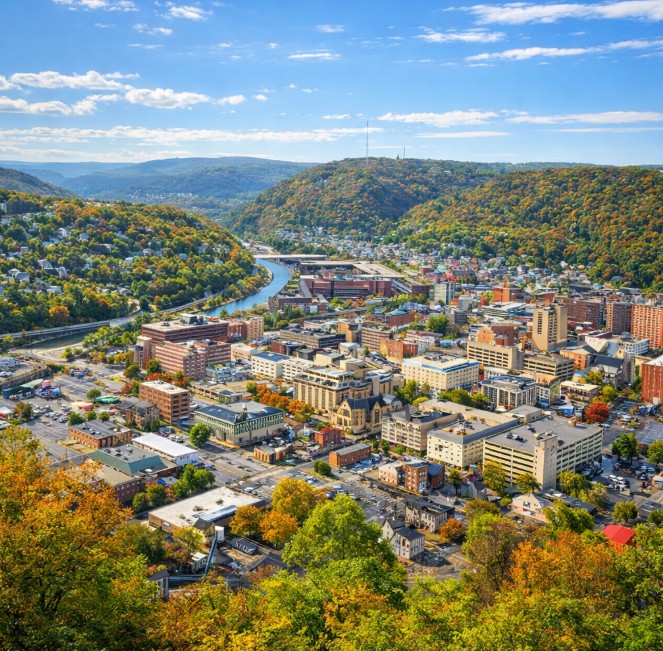
The Allegheny highlands and river valleys surround the city with forests, hills, and water systems that are part of daily life — not weekend commodities.
You can hike in the morning, work in the afternoon, and sit by water in the evening without logistical friction.
The region also has lower exposure to many of the most severe climate disruptions affecting other parts of the country. That stability grows more valuable each year.
Space: The Undervalued Resource
Johnstown still has room.
Commercial buildings.
Industrial facilities.
Warehouses.
Historic storefronts.
Vacant lots with infrastructure in place.
Not wasteland.
Opportunity space.
Lower startup costs.
Manageable expansion.
Room for labs, studios, workshops, campuses, plants.
Scarcity suffocates innovation in dense metros.
Here, space remains negotiable.
The Arithmetic of a Livable Life
Cost of living here is genuinely low.
Housing.
Utilities.
Insurance.
Overhead.
That shifts the equation.
You can save.
You can take calculated risks.
You can build without drowning in fixed costs.
You can pursue meaning without permanent financial panic.
Creativity expands when survival pressure decreases.
Architecture and Memory
Downtown brick.
Victorian neighborhoods.
Industrial civic buildings.
Historic storefront grids.
This is not interchangeable sprawl.
It is a place with visible memory — and places with memory tend to attract builders who value continuity.
A Place for Builders
Here is the core argument:
Johnstown rewards people who want to build.
Not flip.
Not extract.
Not speculate.
Build.
Businesses.
Institutions.
Educational models.
Environmental systems.
Cultural infrastructure.
The barriers to entry are low.
The social networks are navigable.
The needs are visible.
The Cernunnos Foundation moved here with intent — not to comment from a distance, but to build inside the ecosystem.
This region does not require hype.
It requires competence and commitment.
People notice that.
And they respond to it.
Strategy, Not Nostalgia
This is not about recreating the past.
It is about leveraging existing infrastructure:
Transportation corridors
Water and power systems
Workforce capacity
Educational institutions
Healthcare networks
You are not starting from zero.
You are building on foundation.
Why This Matters Now
Many American cities are drifting toward:
Unaffordable housing
Speculative real estate cycles
Civic fragmentation
High overhead with low return
At the same time, structurally sound communities are being ignored.
That imbalance will not hold indefinitely.
When people begin looking for durable environments again, places like Johnstown are positioned to benefit.
The shift is already underway.
I’ve told you why I moved here.
Now you know why you might.