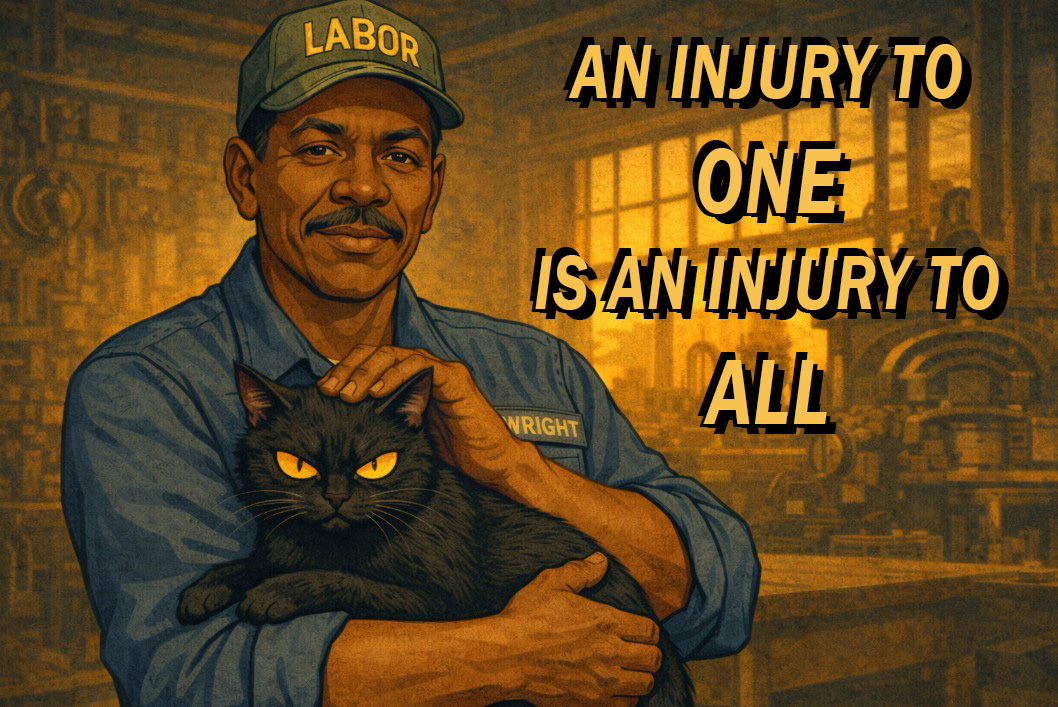
Name’s Philip Randolph Wright.
Mister Wright if we are doing business.
And if we’re talking about work—real work, the kind that feeds families and builds a country—then there’s a rule older than any contract and stronger than any supervisor’s clipboard.
An injury to one is an injury to all.
Now that line didn’t come from a lawyer’s office. It came from working people learning the hard way that a man standing alone is easy pickings.
Management knows that.
Always has.
They don’t usually start with the strongest hand in the room. No sir. They start with the tired one. The slow one. The one who’s been fighting a cough all winter or taking care of a sick wife at home.
They start with the one who can’t quite keep up anymore.
And the rest of us—well—we watch.
Maybe we even nod along a little.
Because the boss doesn’t frame it as an attack. Oh no. He frames it as performance.
Speed.
Accuracy.
Attendance.
Consistency.
He’ll find whatever number on the chart makes that man look small.
And if you happen to be the fast one that day? The accurate one?
Well now he’s praising you.
Not because he respects you.
Because he’s measuring you against your neighbor.
That’s the first wedge.
Before long you’re doing a little extra work to “help the team.” Covering the tasks for the guy who got written up. Picking up the slack from the woman who got sent home early.
You tell yourself it’s temporary.
But the boss is watching.
And once the weak ones are pushed aside, once the sick ones are gone, once the tired ones have been squeezed out—
He turns back to you.
Now the chart says your accuracy slipped.
Now your attendance doesn’t look so good.
Now someone else is the fast one.
You see the pattern yet?
They don’t hunt the strong.
They feed on the separated.
That’s why labor learned its lesson a long time ago.
The Industrial Workers of the World used to say it plain:
“An injury to one is an injury to all.”
And the idea didn’t stay in the union hall.
Years later a German pastor named Martin Niemöller tried to warn the world what happens when people keep quiet while others are singled out.
He said it like this:
First they came for the socialists, and I did not speak out—because I was not a socialist.
You know the rest.
By the time they came for him, there was nobody left to stand beside him.
Different time. Different place.
Same human mistake.
We convince ourselves the problem belongs to somebody else.
That the slow worker deserves it.
That the older worker should retire.
That the sick one just isn’t reliable anymore.
But here’s the truth a shop steward learns quick:
Those workers weren’t weak when they walked through the gate.
The work made them tired.
Thirty years of lifting steel will slow any man down.
Twenty winters of night shifts will wear out any back.
Twenty thousand miles of factory floor will grind the knees right off a saint.
Management didn’t inherit tired workers.
They manufactured them.
So when you see the old hand struggling a little, understand something.
That man isn’t the weak link.
He’s the history of the shop.
Every scar on his hands is production the company already sold.
And if they can discard him like scrap metal, they’ll discard you just as easy when your turn comes.
That’s why solidarity isn’t charity.
It’s survival.
You don’t stand up for the slow worker because you’re kind.
You stand up for him because one day you’ll be the slow worker.
You don’t defend the sick one because it’s noble.
You defend them because every worker gets sick eventually.
And you protect the old ones because every honest job eventually makes a man old.
So don’t let them divide you by numbers on a board.
Don’t let them turn your strengths into weapons against your own crew.
Because the oldest truth labor ever learned still holds.
An injury to one is an injury to all.
Ignore that rule, and management will feed off the weak, the sick, and the tired until there’s nothing left but fear on the floor.
Remember it—
and suddenly the shop looks different.
Men stand straighter.
Women speak up sooner.
And the boss learns something important real fast.
Workers standing together are the one thing no spreadsheet knows how to measure.
That’s the Wright way of seeing it.
Now you know, Jack.