Nature Made: Bryce Canyon, Utah
“I go to nature to be soothed and healed, and to have my senses put in order.”
— John Burroughs
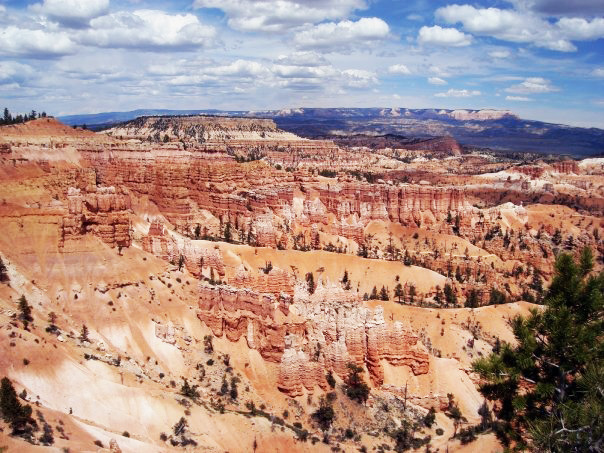
There are landscapes that impress you with size, and there are landscapes that impress you with detail. Bryce Canyon National Park does something more unusual: it overwhelms you with both at once.
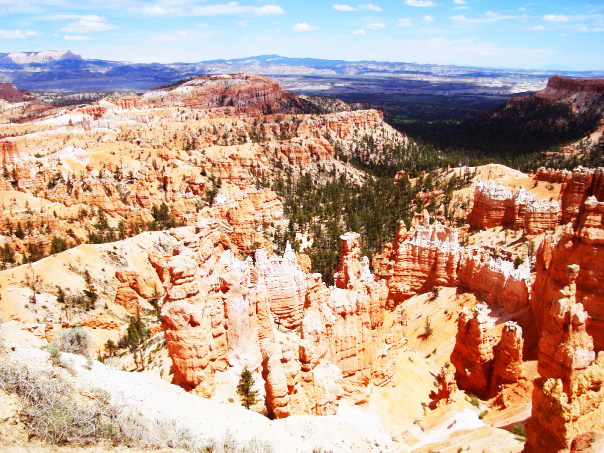
From the rim, the land seems to collapse into a vast amphitheater of stone. Thousands of narrow towers rise from the canyon floor like a petrified city. These formations—called hoodoos—are tall columns of soft sedimentary rock shaped slowly by frost, rain, and gravity.
They stand in ranks and clusters, some thin as chimneys, others broad and layered like castle walls. Between them lie steep slopes of orange dust and scattered pine trees that seem improbably rooted in the rubble. From a distance the scene looks almost sculpted, but the closer you look, the clearer it becomes that this landscape is still in motion.
Bryce is not technically a canyon in the usual sense. Instead, the plateau edge has been eaten away into a series of amphitheaters carved into the Claron Formation, a stack of limestone, mudstone, and sandstone deposited in ancient lakes tens of millions of years ago. Water seeps into fractures, freezes overnight, expands, and breaks the rock apart piece by piece. Over centuries those fractures widen, leaving isolated columns behind.
That freeze–thaw cycle happens here hundreds of times each year. It is one of the most efficient sculptors in nature.
The colors—soft pink, burnt orange, cream, and pale gray—come from iron and mineral deposits locked into the rock when those ancient lakes dried. As the sun moves across the sky the colors shift continuously, turning the amphitheater into something like a slow geological light show.
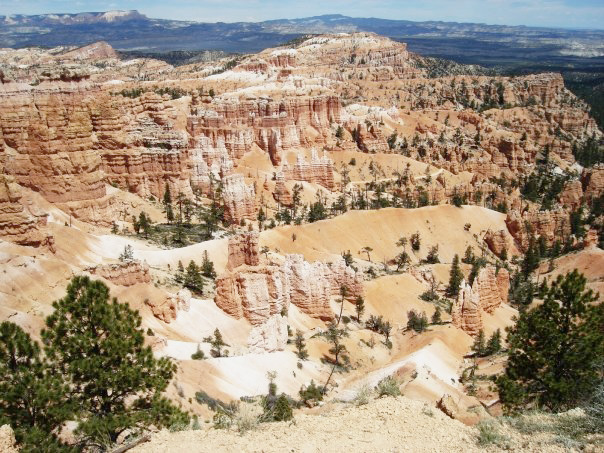
Yet despite the drama of the formations, Bryce has an unusual quietness. Wind moves softly across the plateau. Ravens drift over the rim. Far below, the scattered pines create dark threads between the orange towers.
It feels less like standing above a canyon and more like standing on the balcony of a natural cathedral.
Bryce Canyon reminds you that landscapes are not static. Every spire here is temporary. Every ridge is eroding. The amphitheater is slowly widening, tower by tower, season by season.
Nature built it patiently, and it is still working.
And from the rim, with the whole labyrinth of stone spread out below, it is easy to see why some places feel less like scenery and more like a process you have been allowed to witness.