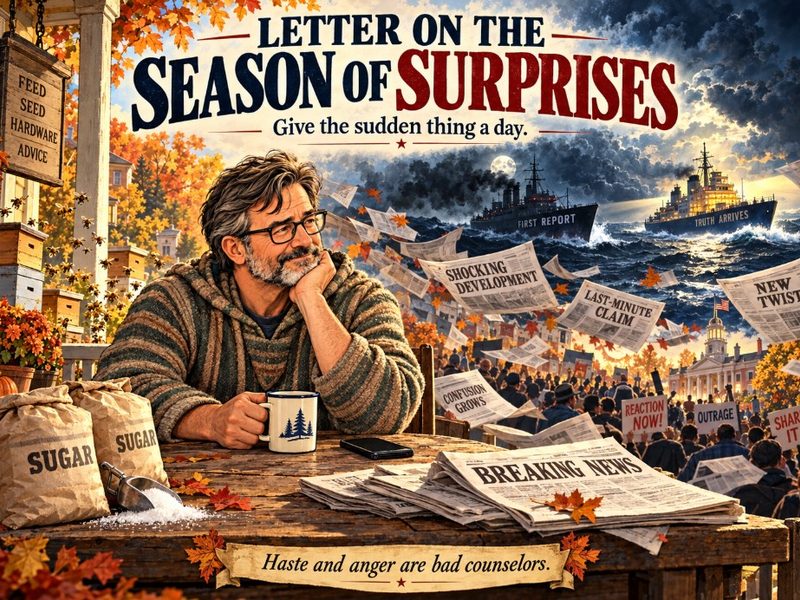
I’ve found myself lately in a curious loop of conversations.
They begin politely enough. Someone raises a question — not even an argument, just a problem — and for a brief, hopeful moment it feels as though we might do that rare thing Americans once did rather well: think together.
The topic hardly matters. I’ve watched this happen across a whole parade of modern anxieties: energy, technology, labor, education, culture, science, the environment — even something as simple as how we design the systems that quietly hold daily life together.
Within minutes — sometimes seconds — the conversation slips its leash.
What began as a question becomes a proxy war.
What was framed as a problem becomes a position.
And before anyone has finished their coffee, we’re no longer discussing what is, but who is to blame.
No solutions are examined. No premises tested. The original question lies abandoned on the floor like a coat no one bothered to pick up.
Instead, the room fills with speeches.
I’ve come to believe this isn’t primarily a political problem.
It’s a behavioral one.
We’ve confused speaking with contributing.
Too many conversations now resemble a firing range where everyone arrives already chambered — waiting not to listen, but to announce. The goal is not understanding; it’s declaration. Not exploration, but identification.
Grammina used to say — and I suspect she was misquoting someone wiser —
“A man who’s just waiting to talk has already decided he’s right.”
Listening, by contrast, requires the humility to accept that another person might be holding a piece of the map you lack.
That humility has gone badly out of fashion.
Ego plays its part, of course. There’s a quiet thrill in being seen as correct, especially in a culture that rewards certainty over curiosity. But certainty is cheap when it’s borrowed wholesale from a tribe.
Discussion — real discussion — asks more of us.
It asks us to risk being unfinished in public.
It asks us to hold our conclusions lightly enough that they can be adjusted by new information. It asks us to value another person’s input not as an obstacle, but as raw material.
That’s uncomfortable work.
It doesn’t trend well.
So we trade it for performance.
The deeper irony is that nearly all of us are, in fact, on the same trip.
Different seats. Different views out the window. Perhaps even different ideas about the destination.
But the road is shared.
The problems are shared.
The consequences most certainly are.
Treating every conversation like a zero-sum contest doesn’t just stall progress — it actively narrows the field of possible solutions. When the only acceptable outcome is my way, the chance that we discover a better way collapses.
Helping one another doesn’t mean surrendering judgment. It means being open to the possibility that improvement is collaborative.
And yes — occasionally it does mean accepting that someone else’s way might be better.
That shouldn’t be humiliating.
It should be reassuring.
A republic, after all, was never meant to be a chorus of soloists. It was designed as a structure where friction slows us down just enough to think, where deliberation tempers passion, and where the act of listening is treated as a civic skill — not a weakness.
We don’t need fewer opinions.
We need more participants willing to be changed by conversation.
Grammina put it more plainly, as she often did:
“If nobody learns anything, Nate, all you did was make noise.”
The republic can survive disagreement.
It cannot survive the abandonment of discussion itself.
We’re all on the same road.
We may as well help each other read the signs.