The Mathematics of Standing Together
There are moments in civic life that clarify everything.
Not because of legislation.
Not because of court rulings.
Not because of press conferences.
Because of presence.
The so-called “Battle of Minneapolis” was not a battle in the military sense. No artillery. No front lines. No generals studying maps.
What unsettled the moment was something much simpler.
People.
Simply people.
Showing up.
In a political culture now dominated by narrative engineering, consultant messaging, fundraising pipelines, and algorithmic persuasion, the oldest form of power still unsettles authority the most:
physical, undeniable, collective presence.
And that is why it is made difficult.
Permits. Barricades. Curfews. Security zones.
Layers of process that appear administrative but function as friction.
The purpose is not always suppression.
Often it is simply delay.
Because once people assemble in sufficient numbers, something shifts in the public mind. The abstract becomes visible.
A complaint becomes a crowd.
Money can buy advertising.
Money can buy airtime.
Money can buy consultants, strategists, and lobbyists.
But money has a harder time purchasing something much older than all of those things.
A gathering of people who decide to stand together.
That is the vulnerability.
The holders of power understand this better than anyone.
When large groups assemble peacefully and remain present, the political equation changes. The story can no longer be reduced to polling numbers or messaging frameworks.
Scale becomes visible.
Opposition becomes physical.
Presence becomes pressure.
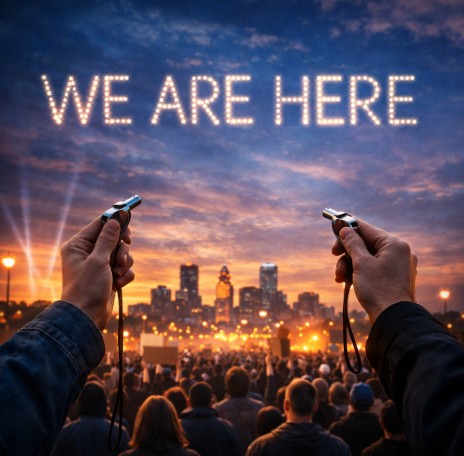
In Minneapolis there was a small detail that carried its own symbolism.
Whistles.
Not weapons.
Not violence.
Not destruction.
Sound.
Sharp. Repeated. Impossible to ignore.
A simple signal:
We are here.
You can disagree with the message.
You can dislike the crowd.
But you cannot pretend it does not exist.
And that matters more than people sometimes realize.
History shows the same pattern repeatedly.
Governments can regulate speech.
They can arrest individuals.
They can infiltrate movements.
They can reshape narratives.
But when large numbers of ordinary people assemble without violence, suppression becomes complicated.
Because enforcement becomes spectacle.
And spectacle carries consequences.
Power prefers quiet.
Quiet is manageable.
Quiet keeps dissent fragmented and invisible.
Noise is destabilizing.
Not destructive noise.
But the unmistakable sound of people refusing to disappear.
That is what solidarity really is.
Not a slogan.
Not a banner.
Not even a movement name.
It is the quiet mathematics of people standing in the same place at the same time and acknowledging that they are not alone.
Simply showing up changes the atmosphere.
It reminds everyone watching — including those inside the institutions of power — that authority ultimately rests on consent.
And consent can shift.
Presence is not everything.
But presence is where everything begins.
If something feels wrong in your community, your state, or your country, the first response should not always be retreat into private frustration or algorithmic arguments.
Sometimes the most powerful act is simpler.
Be present.
Speak clearly.
Stand peacefully.
And allow your voice to join others.
Not with destruction.
Not with violence.
But with visibility.
The whistle, after all, is not a weapon.
It is a signal.
A reminder that in the long arc of civic life, the most enduring force has always been the willingness of ordinary people to stand beside one another and say:
We are here.