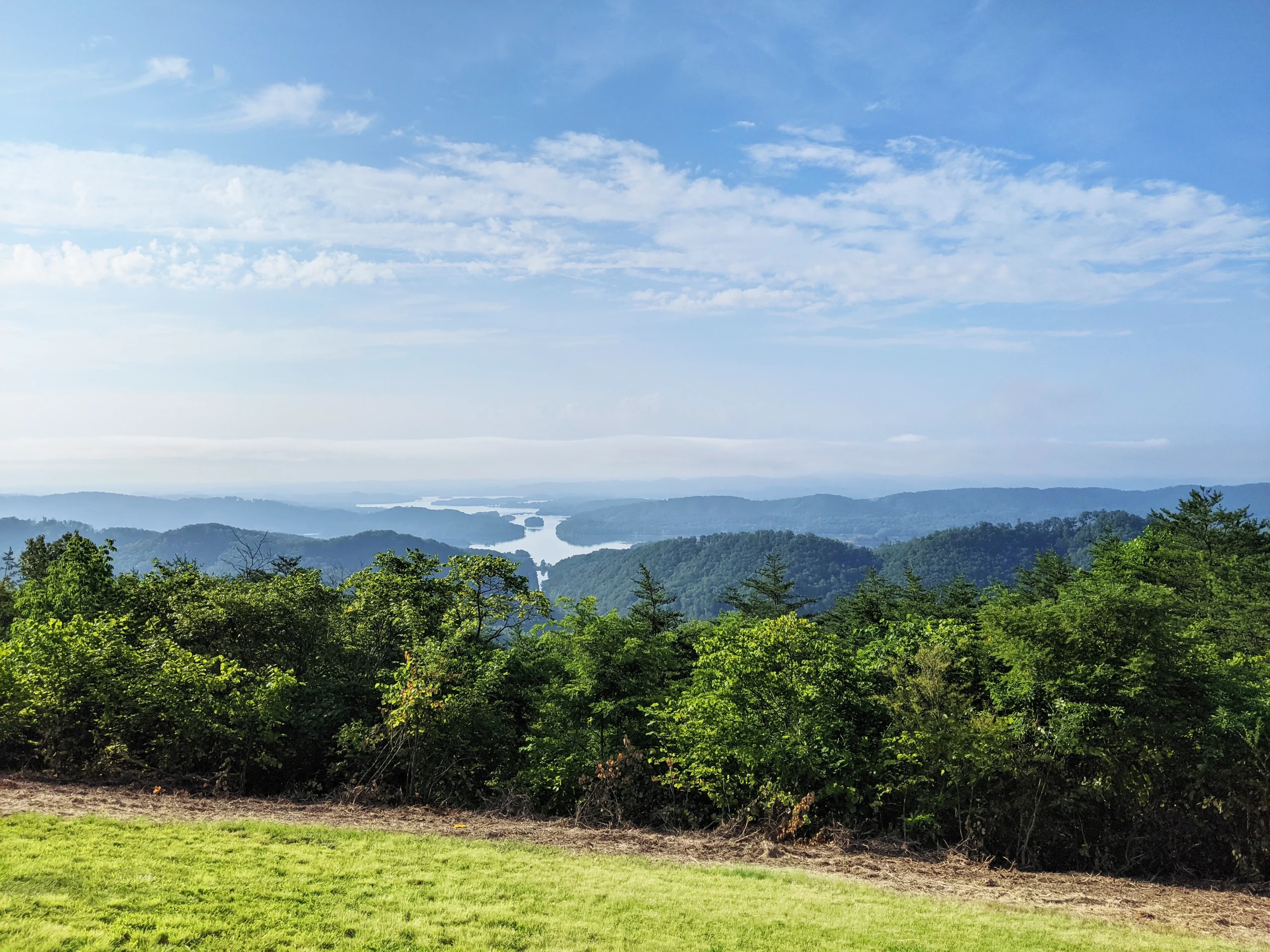
Cherokee Lake | Grainger County, Tennessee
Where the Road Cuts the Mountain
Clinch Mountain Veterans Overlook, Tennessee
There are places where the land rolls.
And there are places where it holds.
Clinch Mountain does not roll. It holds a line.
You feel it before you understand it—on the approach, climbing U.S. Route 25E, the road tightening as it gains elevation, the forest closing in, the turns beginning to stack. The mountain doesn’t rise suddenly. It asserts itself gradually, then all at once.
And then, just as suddenly—
It opens.
The overlook arrives without ceremony.
A pull-off. A wall. A break in the trees.
And beyond it, the entire structure of the region reveals itself.
Not as scenery—but as system.
Below you, Cherokee Lake stretches out in long, branching fingers, filling the valleys that were already there. This is not a lake in the traditional sense. It is a map of the land, flooded—every inlet tracing the memory of an old path, every curve marking where water once moved freely before it was held.
The ridges run in parallel bands, one behind the next, fading from green to blue to gray as distance takes them. They are not random. They are the result of pressure—ancient compression folding the earth into long, repeating lines.
Hard rock stands. Soft rock yields.
Time does the rest.
From this height, the pattern becomes obvious.
Ridge. Valley. Water. Repeat.
Over and over again.
The air itself participates.
Humidity softens the edges. The far ridges dissolve into haze. Depth becomes something you feel rather than measure. The entire scene breathes in layers—each one quieter than the last.
This is the part of the country that doesn’t need spectacle.
It operates on accumulation.
And the road—25E—cuts directly through it.
Not around. Not over.
Through.
It is, quietly, one of the better motorcycle routes you’ll find if you know what to look for.
Not because it’s famous. It isn’t.
Because it’s honest.
The climb is steady. The curves are natural to the terrain. The transitions—from enclosed forest to sudden exposure—are timed by the mountain, not by design.
You ride up in rhythm.
You break into the open.
You stop whether you planned to or not.
This overlook is part of a larger scenic byway, but it doesn’t feel curated. It feels discovered.
That matters.
There’s a difference between a view that’s been packaged and one that simply exists, waiting for the right line through the landscape to reveal it.
Clinch Mountain has been here a long time.
Long before the road.
Long before the lake.
Long before anyone thought to stop and look.
The water adapted.
The road adapted.
Everything here follows what was already written.
Stand there long enough and the scale resets you.
Not in a dramatic way.
In a structural one.
You don’t leave thinking about conquering anything.
You leave understanding that the best routes—the ones worth remembering—are the ones that work with the land instead of against it.
And for a few minutes on that ridge, with the engine cooling behind you and the valley laid out in front—
You can see exactly what that means.