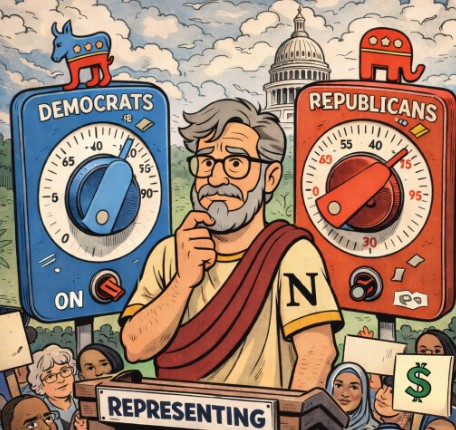
The coffee had gone cold by the time I found the statistic.
I wasn’t looking for it. I was reading something else entirely — one of those long, patient pieces
about the architecture of the early Congress, the kind of writing that makes you feel the weight of
what the founders were attempting. And then there it was, dropped into a footnote like a stone into
still water: the average House member votes with their party between seventy-five and eighty-five
percent of the time.
I sat with that for a while.
Seventy-five to eighty-five percent.
Grammina used to say — and she was mangling Tocqueville badly, but she wasn’t wrong — “When a man
stops listening to the people who sent him, Nate, he hasn’t changed his address. He’s changed his
employer.”
The Constitution is not a complicated document in this particular regard. A representative goes to
Washington to represent. The word is right there in the title, doing its honest work. The people of
a district — their industries, their landscapes, their worries about the school levy and the water
table and whether there will be work in ten years — send one of their own to carry those things
into the room where decisions are made.
That is the entire mechanism. That is the architecture.
James Madison understood that faction was the great disease of republican government. He did not
imagine he had cured it — he was too careful a thinker for that. What he designed instead was a
system of friction, a machine that would slow passion down long enough for reason to catch up. The
republic was never meant to be efficient. It was meant to be deliberate.
What he did not anticipate, or perhaps feared too much to say plainly, was that faction would
eventually eat the machine from the inside.
Washington saw it more clearly, and said so — famously, in his Farewell Address, written while his
own cabinet was already sorting itself into armed camps. He called partisan spirit “a fire not to be
quenched” and warned that it would open the door to foreign influence and internal corruption alike.
He said this while watching it happen in his own house. The warning and the disease arrived
together.
We did not listen. We rarely do to warnings that inconvenience us.
Now consider what seventy-five to eighty-five percent actually means in practice.
I am a fairly reasonable man. I have been married long enough to know my own opinions well, and I
have been lucky enough to share my life with someone whose thinking I respect enormously. We agree
on a great deal. On matters of politics and civic life, we are probably
— and I mean this generously — aligned about eighty percent of the time.
And that is my partner. Someone who shares my table, my mornings, my accumulated understanding of
what a decent life looks like. Someone with whom I have had ten thousand small and large
conversations about exactly these questions.
If my congressman is voting with his party eighty percent of the time, he is voting with me at best
as often as I agree with my partner on everything. He is not representing my district.
He is representing his donors’ district, which may overlap geographically with mine but
bears very little resemblance to it in its actual concerns.
And some of them are worse. Some members of Congress vote with their party ninety-eight,
ninety-nine percent of the time.
I have tried to imagine what that means honestly, without sarcasm,
and I cannot. I cannot construct a theory of representation that produces that number through
genuine deliberation. I cannot imagine a district so perfectly homogenous, a constituency so
perfectly unified, that one man or woman could truthfully say: I have listened to the people who
sent me, and they agree with my party’s position on ninety-eight of every hundred votes.
That number is not representation. That number is a ledger entry. It tells you who is actually
being served, and it is not the people who knocked on doors.
The money is not hard to follow. It flows through the party gates because the party controls the
gates — the committee assignments, the fundraising apparatus, the primary machinery that determines
whether a member survives the next election. A congressman who breaks with the party too often finds
the gates closed. A congressman who keeps them open finds them well-funded.
Madison called it the violence of faction. Washington called it fire. I think of it the way Grammina
thought about weeds in the garden — “They don’t mean anything by it, Nate. They’re just doing what
they do. You’re the one who has to decide whether to pull them.”
The republic does not fix itself. It never has. It requires citizens who are paying attention, who
remember what representation is supposed to mean, and who are willing to ask — plainly,
persistently, without being distracted by the theater — whose interests is this person actually
serving?
Not the party. Not the donor. Not the consultant who built the messaging.
The people who sent them. That is the job. It always was.
Liberty is the harvest of accountability — and accountability begins with knowing who owes
it to whom.