There is a version of this crisis that plays out in commodity markets. Prices rise. Analysts write. Governments convene. The problem gets managed.
That version doesn’t concern me right now.
What concerns me is the version playing out in the ground — in the fields of Bangladesh, Nigeria, Pakistan, the subsistence plots of Southeast Asia, the family farms of the American interior — where the calendar doesn’t wait for diplomatic resolution and planting season doesn’t care who controls the Strait of Hormuz.
The Cernunnos Foundation is not a news organization. We don’t track geopolitical crises for sport. But when a systems failure reaches the point where it threatens the food security of populations who were already operating without margin, we consider it within our purpose to say plainly what we see — and to offer what we know.
What we know is this: you can make fertility without a supply chain.
What Has Happened
Since February 28th, the Strait of Hormuz has been effectively closed to commercial shipping. The Persian Gulf is the single most concentrated source of nitrogen fertilizer on earth. Nearly half of globally traded urea originates there. A third of global seaborne fertilizer trade passes through that 21-mile passage. It is not passing through it now.
This is not a disruption in the ordinary sense. It is a removal. And it has arrived at the worst possible moment — the opening of spring planting season in the Northern Hemisphere, the window that determines what the world has to eat next winter.
The price signals are already loud. Urea prices have roughly doubled since the start of the year in some markets. Phosphate inputs are compromised. Sulfur, which is needed to make phosphate bioavailable to plants, is stranded. The cascade runs deep.
For American farmers, the pain is financial. For farmers in nitrogen-poor countries who depend entirely on imported inputs and who are already at the edge of what they can absorb — the stakes are different. We are talking about yield failures. We are talking about food insecurity at scale.
Even if the Strait opens tomorrow, the disruption to this planting cycle is already baked in. The logistics do not recover in time. The crops that go in the ground in the next six weeks will go in under whatever conditions exist right now.
What We Can Offer
The Cernunnos Foundation has spent years developing and publishing the systems that underpin the River Refugium Project. At the core of that work is a principle we return to constantly:
Living systems generate what industrial systems sell.
Nitrogen does not only come in a bag. It comes from biology. It has always come from biology. The Haber-Bosch process is less than 120 years old. The soil was fertile long before it.
We are releasing this guidance now because the situation warrants it. Not as a product. Not as a pitch. As a foundation whose purpose is the health of living systems and the communities that depend on them.
The Duckweed-Chicken-Compost Loop
This is the simplest version of what we know. It is not the whole of the River Refugium Project. It is the part that applies right now, at scale, with no capital requirement, in any climate where food is grown.
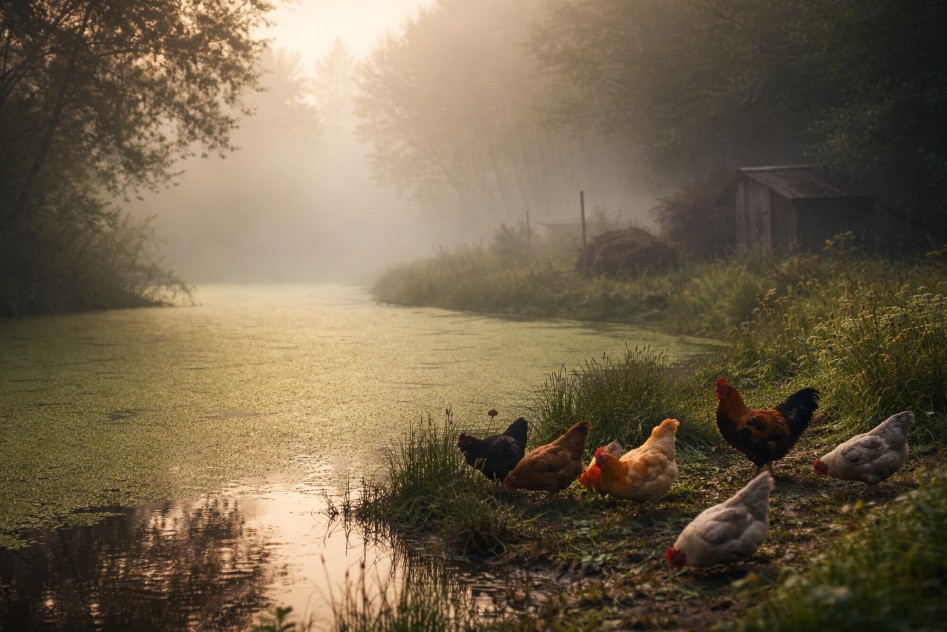
Duckweed is the fastest-growing plant on earth. It doubles its biomass in 24 to 48 hours under good conditions. It grows on still or slow-moving water — ponds, tanks, drainage channels, flooded margins. It pulls dissolved nitrogen and phosphorus directly out of the water column. It runs 35 to 45 percent protein by dry weight. Every animal you are raising will eat it.
Chickens convert feed into two simultaneous outputs: eggs and manure. Chicken manure is among the highest-nitrogen animal wastes available. The problem most small operations have is that the manure sits and loses nitrogen to the air as ammonia before it can be used. The solution is to keep the floor moving.
Lay fresh duckweed on the coop floor every day. The chickens scratch it, eat what they want, and mix the rest with their manure. Sweep or wash that mixture out daily into a composter. The duckweed captures the nitrogen that would otherwise off-gas. The result is a hot, biologically active compost that produces usable soil amendment in three to four weeks.
The composter closes the loop. Organic nitrogen goes in. Biology processes it. Plant-available fertility comes out. Layer in kitchen scraps, crop residue, spoiled grain, weeds — whatever you have. The duckweed-manure base accelerates everything.
Scale It to What You Have
This system does not require capital. It requires surface water and throughput.
More water surface means more duckweed. More duckweed means more throughput. More throughput means richer, faster compost.
In many of the regions facing the sharpest crisis right now — equatorial zones, river delta agriculture, monsoon farming areas — nutrient-rich water is not scarce. It runs past the fields. Nutrient-loaded ditches, ponds, and irrigation channels already contain the dissolved nitrogen that duckweed needs to grow. The infrastructure exists. The biology is already there.
If you are in a country where chemical fertilizer cannot be sourced right now: Cut duckweed from whatever surface you have access to. Feed it through whatever poultry you have. Move the result into a composting pile. Add anything organic you can find. Turn it. Give it heat and time.
You are not replacing chemical fertilizer permanently. You are building a bridge — getting a crop in the ground until supply chains recover. A crop in the ground at reduced fertility is worth infinitely more than a perfect plan waiting on a dock in the Persian Gulf.
A Note on Scale and Urgency
The Cernunnos Foundation does not make claims we cannot support. We are not saying this loop replaces modern agriculture at industrial scale. We are saying it is deployable right now, at the household and small farm level, with no outside inputs, in the places most at risk.
If you have a ten-gallon tank and three chickens, you can produce meaningful soil amendment for a kitchen garden within a month.
If you have a pond edge and a small flock, you can supplement fertility across a significant planting area.
If you are a subsistence farmer in a nitrate-poor country with access to any standing water — start today. The water you have is probably already growing duckweed. If it isn’t, it will.
This is not an emergency preparedness exercise. This is the emergency.
Why We Publish This Here
The Blue Ribbon Team exists because we believe the future gets built in public. Ideas that could help people do not belong locked in proposals waiting for funding.
The River Refugium Project has been our attempt to demonstrate that principle in practice — to build a functional, replicable, open-source system for turning nutrient pollution into food, ecology, and community resilience. We have published every iteration of it here.
This guidance is an extension of that work into an acute crisis moment. It is offered freely. Share it without restriction. Translate it. Adapt it. If it helps one farmer get a crop in the ground this spring, that is enough reason to publish it.
The soil remembers what it was before the supply chain. We are here to help people remember it too.
Robert Smith is the founder of the Cernunnos Foundation and principal of Bright Meadow Group. The River Refugium Project is an open-source aquaponic soil generation and ecological restoration framework. Full documentation is available on the Blue Ribbon Team website.
Cernunnos Foundation | Bright Meadow Group | Blue Ribbon Team Johnstown, Pennsylvania | April 2026