Nature Made: Garden of the Gods
Shawnee National Forest, Southern Illinois
The first thing the eye does in a place like this is fail.
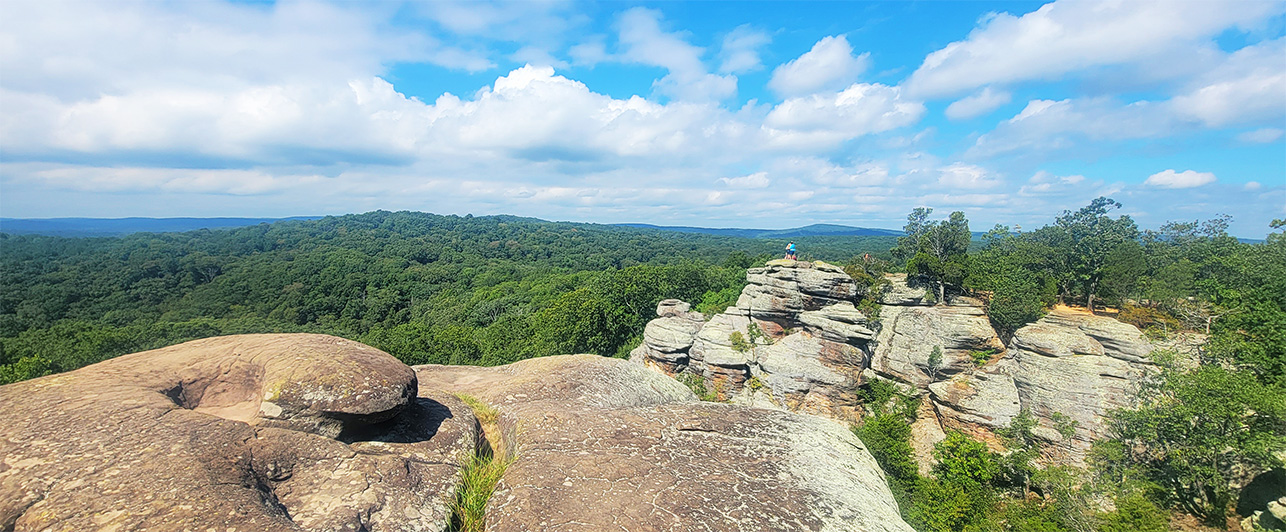
It tries to measure distance, to assign scale, to turn the scene into something manageable. But the stone refuses that effort. The formations rise from the forest without apology — rounded, fractured, improbably shaped — and the eye, accustomed to walls and windows, simply cannot hold them.
This is what Thoreau understood at Walden, what Emerson felt on the bare common: there are places where the mind’s usual furniture becomes useless. You do not think your way into a landscape like this. You are absorbed by it.
The sandstone here is Pennsylvanian in origin — laid down as sediment in ancient rivers, uplifted, cracked, and worn over spans of time that defy ordinary comprehension. The large basin carved into the rock in the foreground is not the work of hands. It is the work of persistence: rainwater collecting, freezing, expanding, returning. A process so slow it becomes invisible, yet so relentless it reshapes stone.
This is nature’s preferred method. Not force, but repetition. Not violence, but patience without limit.
Across the gap, a formation stands like a broken wall, layered and stacked, its edges softened by centuries. A single human figure stands at its top — small, almost indistinguishable — and provides the only real measure of scale. Without that figure, the rock is scenery. With it, the rock becomes argument.
Not just natural, but experiential. Not just old, but older than the category of old.
There is a humility enforced here that is not the performative kind. It is the simple recognition that this place existed long before you arrived and will continue long after you leave. Emerson called it the “NOT ME” — the vast external world that neither requires nor acknowledges your presence. Standing on this stone, you feel that with unusual clarity. The clouds do not pause. The forest does not still. The wind moves freely across the surface, indifferent to your appreciation of it.
Yet this land has not always been scenery.
Long before it was designated a park, before trails were cut and overlooks named, this region was homeland to the Shawnee people. The forest, the ridges, the waterways — all of it existed within a lived and deeply understood geography. Not wilderness in the modern sense, not something “untouched,” but something known. The sandstone outcrops, striking as they are to the modern visitor, would have been features within a broader landscape of meaning: markers, shelters, high points offering visibility and orientation.
The transformation from homeland to park is neither simple nor clean. Land inhabited and understood by Indigenous peoples was gradually displaced, redefined, and eventually preserved — but only after its original context had been stripped away. The name “Garden of the Gods” is itself a reinterpretation, assigning grandeur through classical reference, framing the land as spectacle rather than system.
The rock does not change based on what it is called.
Thoreau believed that in wildness is the preservation of the world. He did not mean merely that forests should be kept. He meant that contact with the unmanaged, the ancient, the indifferent — contact with things that operate outside human timelines — is necessary to the health of the mind. We become distorted without it. We begin to mistake urgency for importance, novelty for meaning.
A place like this corrects that distortion.
The formations feel eternal, but they are not — they are simply slow. Given sufficient time, they too will erode, collapse, and become something else. Nothing here is fixed. And yet, within a human lifespan, it appears that way. That stability creates the illusion of permanence, which in turn allows the mind to rest. To observe without needing to account for change.
The view from this overlook stretches outward in layered greens until the forest dissolves into blue haze. There is a figure on the stone across the gap — another person drawn to the edge, to the exposure, to the experience of standing in a place that resists easy interpretation.
They do not know they are being watched.
They are simply looking out.
That is enough.
That small human fact — a person standing at the edge, looking outward — is the thing that completes the scene. Not because the landscape needs us, but because we need it. We need the confrontation with proportion. The reminder that our presence is temporary, conditional, and small. That the world ran its long operations before us and will continue them after.
Emerson wrote that the greatest delight the fields and woods minister is the suggestion of an occult relation between man and the vegetable. He meant that we are not separate from this. We come from the same long making. The stone underfoot, the lichen spreading across its surface, the small plants finding purchase in cracks — all of it is continuous with us, not opposite to us.
To stand here is not to escape the human world.
It is to remember what the human world is made of.
The rock remains. The forest continues. The clouds shift and the light changes and the basin fills with rain and empties again, repeating its patient work. Another grain of sand released. Another fraction of an inch receded.
The place is in motion.
It always has been.
Cernunnos Foundation Note
The Nature Made series documents landscapes and ecosystems as open educational and artistic resources. These works are shared freely to encourage observation, learning, and appreciation of the natural world.
Knowledge of the living landscape belongs to everyone.