Or: How to Turn a Retention Pond Into a Production System Instead of a Seasonal Mistake
Your neighborhood looks excellent.
Lawns cut like a golf course. Edges trimmed within an inch of their lives. Flower beds rotated on schedule. HOA landscaper earning every dollar.
From the street, it’s borderline resort quality.
And then there’s the pond.
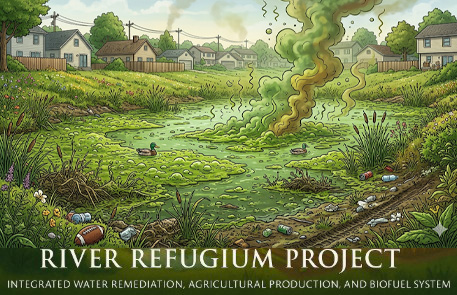
By mid-summer: it turns green, it smells, it gets that surface film that looks alive in the wrong way, and nobody wants to walk near it.
The same space that should be your centerpiece becomes something people actively avoid.
What You’re Actually Looking At
You’ve been told it’s “an algae problem.”
It isn’t.
It’s a nutrient accumulation system doing exactly what it was designed to do.
That pond is collecting lawn fertilizer runoff, organic debris, pet waste inputs, and atmospheric deposition. It is a slow-motion biological reactor.
And when enough nutrients build up, biology responds: bacteria bloom, algae follows, oxygen drops, smell rises.
That’s not failure.
That’s unmanaged success.
What You’re Currently Paying For
Your landscaper doesn’t fix the system.
They manage the symptoms: chemical treatments, algaecides, occasional dredging, surface cleanup.
Which means you are paying to add nutrients to the landscape, wash them into the pond, kill what grows, and repeat next year.
That is a closed loop.
Just not a productive one.
The Slightly Uncomfortable First Move
Cut the pond maintenance line item.
Not the landscaper entirely.
Just the part where they fight a system they don’t control.
Because right now: you are paying someone to lose the same fight every summer.
The Ideal Solution (Most People Aren’t Ready Yet)
You bring in a systems designer. Someone who reworks plant selection, soil profiles, runoff patterns, and biological filtration — and eliminates chemical inputs, excess nutrient loading, and the bloom itself.
The pond stabilizes. The system balances. Maintenance drops.
This is the correct solution.
It is also a leap most HOAs will not take on the first try.
The Halfway Move (This Is Where It Gets Interesting)
Keep your golf course aesthetic. Keep your landscaper. But change what the pond is.
Step 1: Accept the Truth
That green water? That smell? That bloom?
It is fertility.
Misplaced, unmanaged, but real.
Step 2: Capture It
Instead of killing it, you intercept it. Intake from the pond. Run it through a controlled system: bacteria zones (nutrient conversion), plant uptake (nutrient removal), mechanical filtration (solids capture).
This can take two practical forms:
Option A: Edge Greenhouse
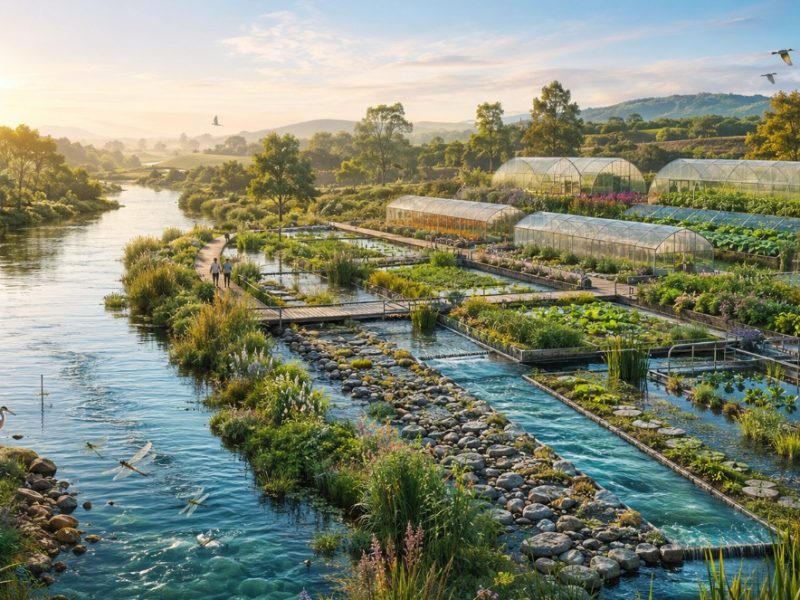
A small greenhouse at the pond edge with aquaponic beds, controlled flow, and plants actively consuming nutrients. Your landscaper now grows replacement shrubs, seasonal flowers, and native plant stock — using the pond as the input.
Option B: Mobile System (RRP-style)
A modular “mechanical swamp” on a trailer: pumps, bio-media, settling tanks, plant channels. It moves, it processes, it returns cleaner water. No permanent build required to start.
Step 3: Reframe the Job
Your landscaper is no longer “the person who keeps the pond from getting gross.”
They become “the operator of a small biological production system.”
Same labor. Different outcome.
What Changes Immediately
The pond clears faster. Smell drops. Chemical use drops or disappears. Maintenance becomes predictable. The system starts paying you back in plant material.
And most importantly: you stop fighting the nutrient cycle and start directing it.
The Deeper Shift (This Is the Point)
Right now your neighborhood is designed like this:
Inputs → Waste → Cleanup → Cost
This changes it to:
Inputs → Capture → Production → Value
That is not an environmental argument.
That is an operational one.
And Yes — It Scales
What works in a subdivision pond works in corporate campuses, municipal stormwater systems, golf courses, and highway retention basins.
Same physics. Different scale.
Final Thought
You don’t actually have a pond problem.
You have a misplaced fertility problem.
Every summer, your system proves it to you by turning green.
You can keep paying to suppress it — or build something that uses it.
The landscaper will still show up. The lawns will still look perfect.
The only difference is: when people walk past the pond in July —
they won’t speed up.
They’ll stop.
Bright Meadow Group — Systems Analysis and Solutions Consulting
You don’t have a pond problem.
You have a system that’s doing exactly what it was built to do — with no one directing it.
That’s where we come in.
Bright Meadow Group designs and implements working biological systems that convert nuisance conditions into productive infrastructure.
What We Do
We evaluate your site as a system: water flow and retention patterns, nutrient loading sources, existing landscaping and maintenance practices, infrastructure constraints and opportunities.
Then we design a solution that reduces maintenance, eliminates chemical dependency, and creates usable outputs.
Two Practical Deployment Paths
1. Edge-Based Greenhouse Systems — Aquaponic growing systems integrated with your pond. Continuous nutrient capture and water polishing. On-site production of flowers, shrubs, and replacement plant stock. Reduced material purchasing and seasonal turnover costs.
2. Mobile Treatment Systems (RRP “Mechanical Swamp”) — Trailer-mounted modular filtration and biological processing. Rapid deployment with minimal site disruption. Scalable for HOAs, campuses, and municipal systems. Immediate improvement in water clarity and odor.
Our Approach
We do not sell equipment first.
We start with one on-site evaluation day: you show us the problem, we map the system, we outline viable solution paths.
If it fits, we design and build. If it doesn’t, you still leave with a clear understanding of what you’re dealing with.
The Bottom Line
You are already paying for this system.
Right now, it produces algae and odor.
With the right design, it produces value.
Let’s Build Something That Works
Bright Meadow Group
Systems Analysis and Solutions Consulting
If you’re ready to stop fighting your pond and start using it — we’re ready to design the system.
If you would like to read more on the River Refugium Project and its systems, follow this link.