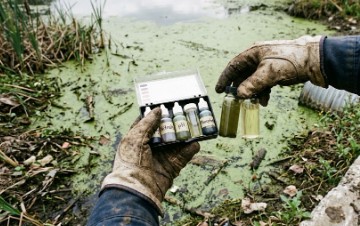
A call to farmers, pond owners, tinkerers, DNR shops, and university labs to stop waiting for permission and start running tests.
You Already Know the Water Is Bad
You don’t need a federal report to tell you.
You can smell it.
That green pond behind the subdivision that turns into a soup event every August. The farm lagoon that’s been there for thirty years and still looks the same. The creek downstream of the hog operation that runs yellow-green after rain. The retention basin the city treats with copper sulfate three times a year because nothing else works.
Filthy water is everywhere. Most of it is in plain sight. All of it is being managed in exactly the same way it was managed twenty years ago: chemicals, suppression, avoidance, and the occasional report that recommends more monitoring.
That is not a solution. That is deferred resignation dressed up in regulatory language.
We have been working on a different model.
Not a study. A system.
And now we need people to test it.
What the RRP Is, Briefly
The River Remediation + Resource Recovery System is a framework for turning degraded water bodies into productive biological infrastructure.
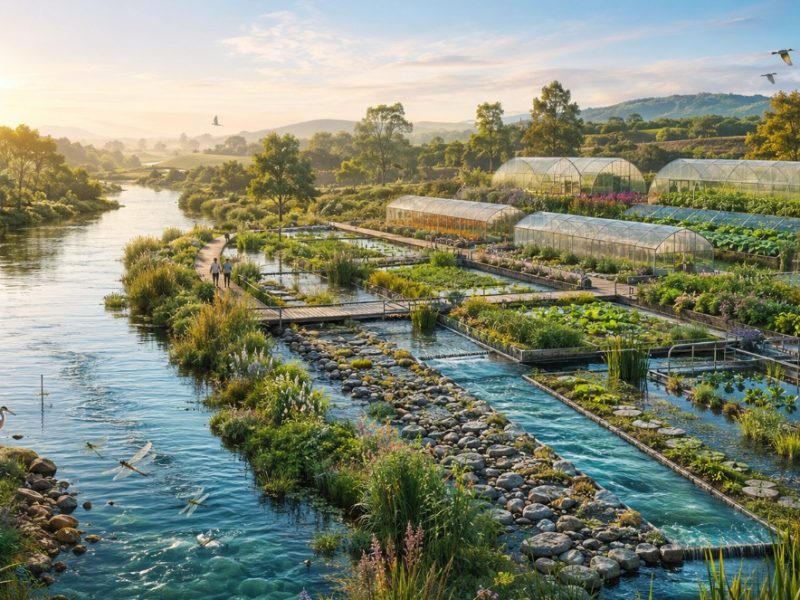
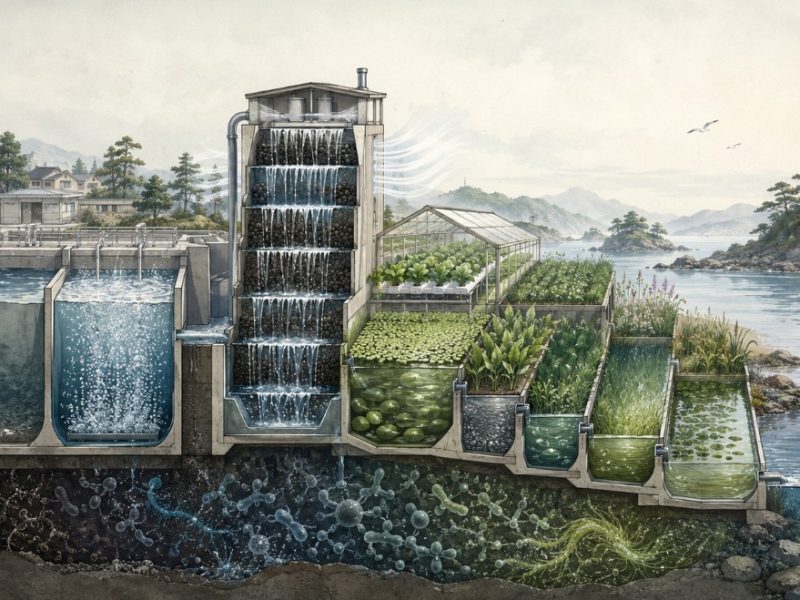
The core idea is this: filthy water is not a problem to be treated. It is a nutrient stream to be redirected. Aquaponic systems — normally used to grow food in clean water — can be run in reverse, drawing on polluted inputs and using biological uptake, filtration, and staged processing to pull the contamination out. The biological material extracted from that process — algae, plant biomass, captured solids — feeds into thermochemical conversion (hydrothermal carbonization or liquefaction) to produce biochar, bio-crude precursors, or soil amendments. The water coming out is measurably cleaner than what went in.
Run that cycle long enough, at sufficient scale, and you are not managing a polluted water body. You are operating a production system.
We have published the full technical framework. Eighteen documents. Open access. No paywall.
What we do not yet have is a wall of field data proving it works across different contamination profiles, scales, and geographies.
That is where you come in.
Why We’re Asking the DIY Community First
Aquaponics was not built by institutions.
It was built by backyard tinkerers, small-scale farmers, hobbyists, and obsessives who wanted to know what would happen if they connected a fish tank to a grow bed and pointed a pump at the problem.
The literature was thin. The equipment was improvised. The methodology was informal.
The results were real.
Over about a decade, that distributed experiment accumulated enough documented outcomes that the institutional world had to take it seriously. Universities started running trials. Extension services published guides. Commercial operations emerged.
That is the model we want to repeat here.
Not because institutions are useless — we are explicitly inviting them — but because the fastest path to a credible dataset is a lot of people running a lot of tests on a lot of different dirty water bodies, documenting what they find, and sharing it openly.
The RRP framework is the hypothesis.
Your pond, your lagoon, your creek, your lab tank is the test environment.
Your water quality data is the evidence.
What We’re Actually Asking You to Do
Find a Filthy Body of Water
You probably already have one. Candidates include: farm ponds receiving nutrient runoff from fields or livestock operations, detention and retention ponds in developed areas with established algae problems, agricultural lagoons and manure management ponds, degraded stream reaches with documented impairment, constructed wetlands underperforming their design spec, university or institutional water bodies suitable for controlled testing, and municipal or DNR-managed water bodies with documented impairment.
The water does not need to be uniformly bad. It just needs to have a measurable problem and enough volume to run a small system against it.
Establish a Baseline
Before you do anything else: measure what you have.
Core parameters: total nitrogen (TN) and total phosphorus (TP), ammonia-nitrogen (NH₃-N), nitrate-nitrogen (NO₃-N), dissolved oxygen (DO), pH, turbidity / Secchi depth, chlorophyll-a (proxy for algal biomass), and biochemical oxygen demand (BOD).
Optional but useful: coliform counts if animal waste is a factor, heavy metal screen if industrial inputs are possible, conductivity / total dissolved solids.
Test frequency: at minimum, weekly during active system operation. Monthly baseline readings before and after. More is better.
Basic test kits are sufficient for a starter protocol. Lab verification of key parameters at baseline, midpoint, and end is worth the investment.
Build the Simplest Version of the System You Can
You do not need to build the full RRP architecture to generate useful data.
The minimum viable test unit is: a pump drawing from the target water body, a media bed or deep water culture channel stocked with fast-growing plants (water hyacinth, duckweed, and water lettuce are ideal for high-nutrient situations; standard aquaponic crops for cleaner inputs), and return flow to the water body or to a settling/collection tank.
Extensions that add data value: a solids settling chamber before the grow beds, a bio-filter zone (mature aquaponic media, biochar, ceramic rings), a second-stage polishing bed after primary plant uptake, and an algae scrubber or algae cultivation stage to concentrate biomass for thermochemical processing.
If you have a greenhouse, use it. Temperature-controlled growing conditions will give cleaner data and faster plant response.
If you have a trailer or can mount the system on skids: even better. Mobility means you can move the test to different water bodies and build a comparative dataset.
Document Your Path
This is the non-negotiable part.
Collect and keep: water quality readings at each test point logged with date and time, system configuration notes (what you built, how it changed over time, why), plant growth observations (species, density, harvest weight if possible), failure events and how you responded, photographs — before, during, after, close-ups of the grow medium, the water color, the plant coverage — and anything unexpected.
The format does not matter. A spreadsheet and a phone camera are enough to start.
What matters is that someone else could read your notes and understand what you did, what changed, and what the water looked like at each stage.
Undocumented results are anecdotes. Documented results are data. We need data.
The Theory You Would Be Testing
Here is the core claim, stated plainly:
Aquaponics, traditionally a food production system, can be run in reverse as a remediation tool — drawing on polluted inputs, extracting the nutrients biologically, and returning measurably cleaner water. Paired with thermochemical processing of the harvested biomass, the system becomes a closed resource recovery loop with net-positive outputs.
That is not a complicated hypothesis.
It is grounded in well-understood biology and established process engineering.
But it needs to be demonstrated across a range of real-world conditions — not just in controlled lab environments where the inputs are tidy and the variables are managed.
Real water bodies are messy. They have multiple contaminant streams, variable temperatures, competing biology, unpredictable weather events, and social and regulatory constraints that no laboratory study accounts for.
That messiness is exactly why field testing matters. And why we are asking for it from people who work in the field.
Who Should Be Running These Tests
Farmers With Manure Lagoons and Nutrient Ponds
You are managing concentrated nutrient accumulation systems under regulatory pressure. The question is whether biological uptake through a controlled aquaponic draw can measurably reduce loading before your ponds discharge or overflow. Your data would be the most economically significant in the dataset.
Pond Owners — HOA, Private, and Rural
Ornamental and retention ponds are often nutrient-saturated with no productive outlet. A small edge system — a few grow beds, a pump, an afternoon to set it up — can generate usable comparative data over a single summer season. If you are already treating the pond with algaecide, you have a comparison baseline built in.
DNR Staff and State Watershed Groups
You have access to impaired water bodies, monitoring infrastructure, and regulatory context that private operators cannot replicate. A structured trial on a documented impairment reaches a different tier of credibility than a backyard experiment — even if the underlying system is the same. We want your data and your professional framing.
Universities and Research Institutions
Controlled replication, statistical rigor, and peer-review pathways. If you can take this protocol and run it through formal methods, the resulting publication accelerates the pathway from field demonstration to policy consideration. We are explicitly designing the documentation framework to be compatible with academic data standards.
Serious Hobbyists and Systems Tinkerers
You built the foundation of modern aquaponics. You can do it again. If you have already been running aquaponic systems and want to push the inputs toward the ugly end of the spectrum — harder water, higher nutrient loads, more realistic contamination profiles — you will generate some of the most interesting data in the set.
What Happens With Your Data
We are building a shared open-access dataset.
Your documented results — water quality readings, system configurations, before/after comparisons — will be aggregated, anonymized if you prefer, and published through Cernunnos Foundation and Bright Meadow Group channels.
The goal is a body of evidence sufficient to demonstrate efficacy across diverse contamination profiles and geographies, identify the conditions under which the system performs best and worst, surface the failure modes and how they were addressed, support grant applications and regulatory engagement for larger-scale deployment, and give the next operator — the one who builds on your work — a real foundation instead of a blank page.
Nothing is behind a paywall. Nothing requires a licensing agreement.
You document it, you own it, and we aggregate it with your permission.
If your work generates a product — a strain, a configuration, a protocol that actually works at your scale — you built that. The framework is open. The application is yours.
The Bigger Picture (Read This Part)
We are not trying to build a niche remediation product.
We are trying to demonstrate that flipping aquaponics into a remediation mode — and closing the loop with thermochemical processing — constitutes a terraforming technology.
That is not rhetorical exaggeration.
Degraded water is not a localized problem. Agricultural nutrient loading, urban runoff, concentrated animal feeding operation discharge, and decades of industrial impact have produced impaired water bodies on every continent. Most of them are being managed reactively, at enormous cost, with poor outcomes.
A distributed, operator-scalable remediation system that draws on the contamination as its input rather than fighting it, produces measurable biological outputs from what it extracts, converts that biomass into stable carbon materials and fuel precursors, and returns cleaner water to the system as its byproduct — is not a water treatment technology.
It is a regenerative infrastructure model that can be deployed at the scale of a backyard pond or the scale of a river corridor, by a single farmer or a regional consortium, with off-the-shelf equipment or custom industrial systems.
If that model is validated at small scale by a hundred different operators across a hundred different water bodies, the case for scaling it becomes hard to ignore.
We are not asking you to save the world. We are asking you to run a test, measure what happens, and write it down. The rest follows from that.
How to Get Involved
Download the full RRP documentation series from the Cernunnos Foundation:
All eighteen documents are available at no cost. The RRP Field Documentation Kit — with standardized forms for system configuration, water quality monitoring, and biomass harvest tracking — is available as a companion download.
Contact Bright Meadow Group directly if you want to discuss your site, your water quality situation, or how to structure your test:
If you run a test, document it, and want it included in the aggregated dataset: send us what you have. We will work with whatever you have.
If you run a test and prove us wrong: send us that too. Wrong in which direction matters enormously. Either way, the dataset gets better.
Final Thought
When aquaponics was young, the people who built it did not wait for a university to tell them it was possible.
They put fish in tanks. They grew plants on the water. They measured what changed.
They built something.
There are filthy bodies of water everywhere.
The theory says you can clean them, extract what the contamination contains, and turn it into something useful.
Prove it.
Document your path.
Share what you find.
This is how it starts.
Bright Meadow Group
Systems Analysis and Solutions Consulting
robert@brightmeadowgroup.com | www.cernunnosfoundation.com
River Remediation + Resource Recovery Series | Open Access | No Paywall
One thought on “Prove the Fix- RRP”
Comments are closed.