A Love Letter in Iron Money, and the Highway That Tore the Envelope
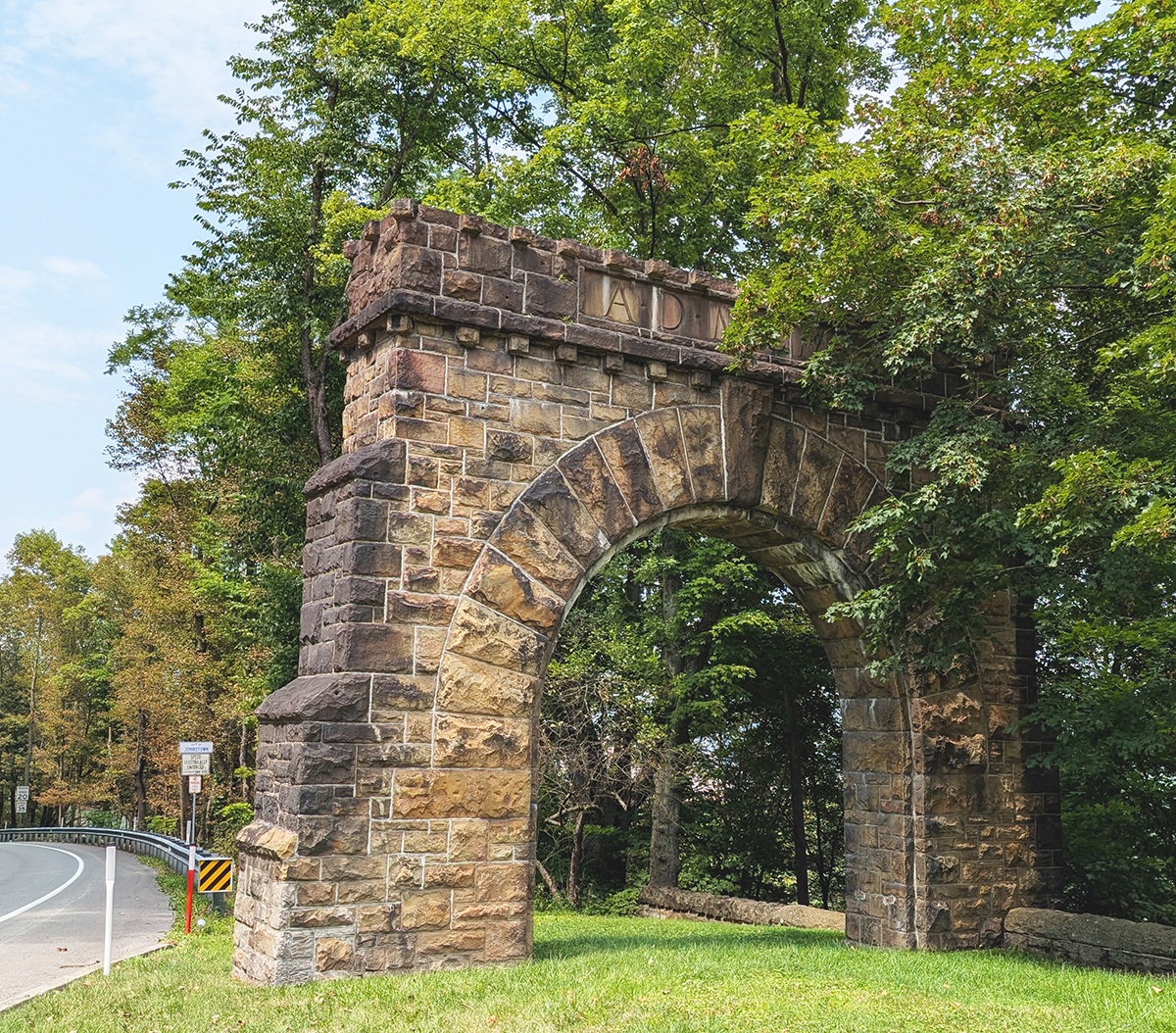
If you’ve driven down Menoher Boulevard into Johnstown, you’ve passed it — or at least passed by it — even if you never caught the name. The Chapin Arch. Cut stone, weathered to that mottled brown the rain leaves on every old building in this town. Built in 1910 — A.D. MCMX carved up top, in case you weren’t sure where you stood in time. It sits in a patch of grass beside the road now like something somebody forgot to finish.
It wasn’t supposed to be a roadside curiosity. It was supposed to be a gate.
Philip Chapin had it built in memory of his wife Anna, who was a daughter of Daniel J. Morrell — the man who ran the Cambria Iron Works for decades and whose money built half the proper houses on Yoder Hill. So this arch is what happens when iron-mill aristocracy grieves. It’s a love story, written in the only material the family really trusted: stone laid by other people’s hands, paid for with money pulled out of other people’s labor.
You can sit with that contradiction or you can pretend it isn’t there. I’d rather sit with it. Anna died, and her husband loved her enough to set cut stone at the entrance of a cemetery so that every soul going up to bury their own kin would pass under his wife’s name. That’s grief turned into civic architecture. That’s what happens when you have the means.
Mixed emotions, sure. Cambria Iron ground down a lot of people to put up something that beautiful. But the arch is here, and most of what those wages built is gone. Take the monument. Read the receipt. Both things are true.
What got me out there with the camera, though, isn’t the love story. It’s what got done to it.
The Chapin Arch was the upper of two ceremonial gates on the carriage road that led from Johnstown up Yoder Hill to Grandview Cemetery. The lower one was the Morrell Arch, built in 1904. Two arches, one road, a winding mile up the hill — the kind of approach a town builds when it wants you to slow down before you reach the dead. The whole route was the point. That sequence was the monument.
Then came the state Route 271 project. They put a road through. They cut the cemetery’s old approach in half. The Morrell Arch was torn down. The Chapin was scheduled for the same treatment until neighbors organized volunteer labor and repaired it instead of letting it fall.
That last part deserves dwelling on, because it tells you everything about a particular American sickness.
A cemetery is one of the few places left in this country where people are supposed to remember they aren’t in a hurry. A cemetery has a road into it on purpose. The road is part of the monument. You drive slow because you’re driving toward something that should remind you to drive slow. And we — the bureaucratic, hard-hat, throughput-obsessed, “let’s shave six minutes off the commute” version of we — looked at that and decided what it really needed was a faster way through.
There is no shortage of ugly land in this country to put highways through. There are abandoned strip mines. There are industrial flats nobody’s claimed in eighty years. There are stretches of nothing the deer have taken back. You can run a road through any of it. What you don’t do — what a culture with any sense of what a monument is for would never have done — is bisect the funeral road of a 235-acre cemetery to clip a few minutes off a drive.
Highways are not neutral. They are statements about what a society values. Every time we route one through something old and meaningful, we are announcing, in concrete and asphalt, that speed matters more than memory. We did it to neighborhoods. We did it to wetlands. We did it to a love letter carved into a hillside in 1910.
The Chapin Arch survived because regular people refused to let it die. Not state preservation, not the cemetery’s resources, not the wisdom of road planners. Volunteers. Public outcry. People showing up with whatever they had to fix what was about to be condemned.
Grandview itself is one of the most beautiful cemeteries in Pennsylvania, and once our editor’s back online we’re going to publish a ride-down-the-hill video that takes you through the whole place — the Unknown Plot, Buzz Wagner’s monument, the old Portage Railroad sleeper stones, the long quiet sweep of marker after marker across nearly 140 years of this town’s life. It’s worth the time. It’s worth slowing down for.
Until then, take this much: when you drive past the Chapin Arch on Menoher, look at it. It’s a love story carved in iron money, half-orphaned by a highway, kept upright by neighbors. That is a lot to hold in one hunk of sandstone.
We owe the people who saved it. We owe the people buried up the hill. And we owe ourselves the discipline to remember, the next time someone wants to run a road through something that matters, that there is always — always — somewhere else to put it.