A Proposal for Johnstown, Pennsylvania
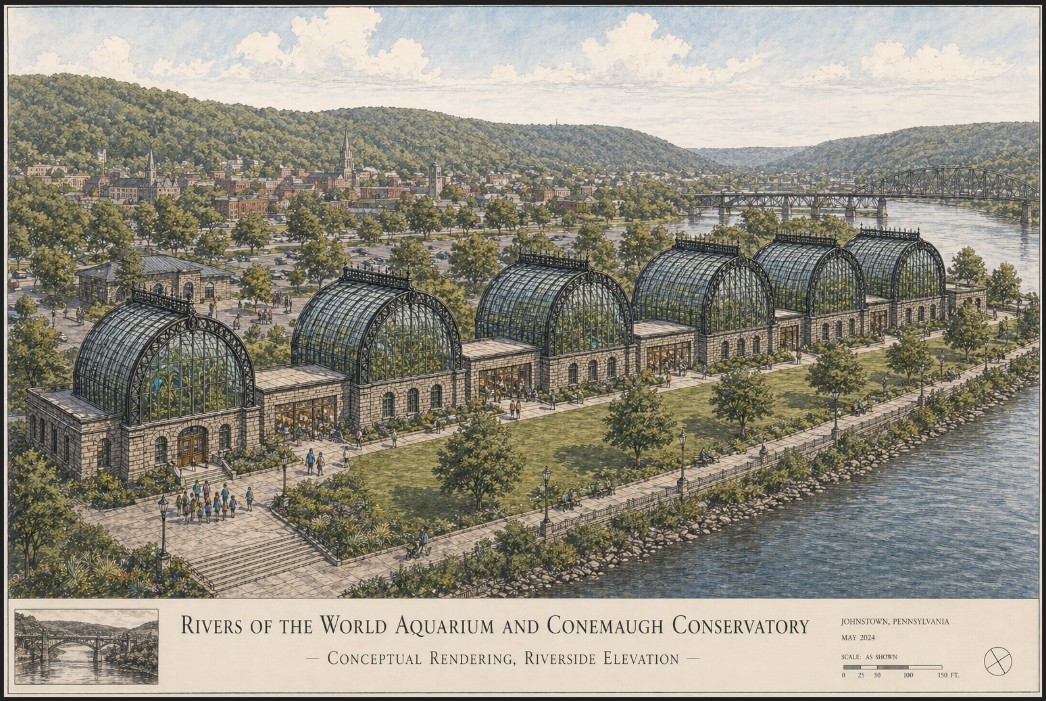
Bright Meadow Group is bringing forward a high-leverage opportunity for the City of Johnstown: an attraction that does not exist anywhere else in the United States — six immersive continental river pavilions under glass, each one a Crystal Bridge–scale botanical conservatory paired with the freshwater fish native to that continent’s great rivers. No saltwater. No zoo. No exotic-animal politics. Sited on a Johnstown brownfield parcel, the project doubles as a remediation initiative and an anchor tourism asset. Comparable projects in Chattanooga, Newport, and Oklahoma City have demonstrably reset the trajectories of the cities that built them. Johnstown is uniquely positioned to build the most distinctive version of it in the country.
This proposal is offered to the city as a starting framework. The technical lift sits well within the capability of Johnstown’s existing industrial and engineering base. BMG is available to support that work in whatever role is most useful — full design lead, technical advisor, public-facing communicator on the biological systems, or simply as a resource the working group can call when a question lands in our specific domain. We are flexible by design.
Why Johnstown, Specifically
Most cities that want a major botanical or aquarium attraction get stuck on the same problem: land.
A flagship downtown botanical garden in any healthy real-estate market is land-cost-prohibitive before the first pane of glass goes up. That is why the only American example of the form at scale — the Myriad Botanical Gardens in Oklahoma City, with its Crystal Bridge Conservatory — was built on what was, at the time, depressed urban land that the city was actively trying to find a use for. They got a flagship attraction out of a problem parcel.
Johnstown has the same opportunity, multiplied. We have acres of post-industrial brownfield close to the river. Old steel sites. Rail yards. Mill footprints that have been waiting forty years for someone to figure out what to do with them. Most cities would kill for one of these parcels at the price they sit at here. We have several.
Add to that:
- The rivers are already here. The Stonycreek and Little Conemaugh meeting at the Point is already a tourism artifact — much of the city’s existing visitor draw is built around water.
- The flood story already moves people through Johnstown. The Flood Museum, the Path of the Flood, the Inclined Plane — there is an existing tourism corridor that an anchor attraction would massively amplify.
- The Pittsburgh and DC drive radii put Johnstown in front of millions of households as a long-weekend destination, not just a regional one.
Land is the reason this attraction does not already exist somewhere else. Johnstown removes that reason.
The Six Pavilions
The model is the Crystal Bridge Conservatory in Oklahoma City — a single tropical greenhouse that has anchored the Myriad Gardens since the 1980s and still draws hundreds of thousands of visitors a year. Picture that, and now picture six of them on a campus, each one a self-contained biome representing a different continent’s rivers.
Antarctica is out for obvious reasons. That leaves six.
Pavilion 1 — South America (Amazon Basin). The signature pavilion. Heliconia, victoria water lilies, ceiba and kapok understory. Discus, angelfish, neon tetras, plecos, peacock bass behind glass at scale. This is the pavilion that sells the tickets.
Pavilion 2 — Africa (Congo / Nile / Zambezi). Papyrus, blue lotus, raffia palms, baobab silhouette. Cichlid diversity displays — Lake Tanganyika and Malawi alone are a draw — plus bichirs, elephant-nose, African lungfish, a juvenile Nile perch tank.
Pavilion 3 — Asia (Mekong / Ganges / Yangtze). Lotus, water hyacinth, river bamboo, mangrove transition. Gouramis, loaches, archerfish, datnoid, freshwater stingrays.
Pavilion 4 — Australia / Oceania (Murray–Darling and Pacific island streams). Paperbark, banksia, the genuinely showy Australian flowering natives that Americans almost never see. Rainbowfish — which deserve a major American display and currently do not have one — barramundi, saratoga, archerfish.
Pavilion 5 — North America (Mississippi / Colorado / Great Lakes / Gulf Coast). This is the “home” pavilion and quietly the most important one. Cardinal flower, pickerelweed, swamp hibiscus, native iris, bald cypress. Largemouth and smallmouth bass, sunfish diversity, gar, paddlefish, redfish in the brackish display, alligator gar. Pennsylvania natives anchor a regional gallery — brook trout, yellow perch, walleye, sturgeon.
Pavilion 6 — Europe (Danube / Volga / Iberian rivers). The temperate-climate pavilion, useful for shoulder-season heating savings. Mediterranean flora, water iris, willows. Sturgeon, pike, zander, European catfish (the wels is a destination fish on its own), brown trout, grayling.
Connecting walkways, an outdoor garden between pavilions, an event space, café, gift shop, classroom space for schools. Standard botanical-garden anatomy.
Why No Saltwater
This is the design decision that makes the whole project actually buildable and operable in a small city, and we want to make it explicit because it is going to look like a constraint to people who have not thought it through. It is not.
Saltwater public aquariums are infrastructure. They require massive seawater synthesis or shipping logistics, dedicated life-support staffing on a hospital-grade rotation, expensive and politically loaded animal-acquisition pipelines (collection permits, CITES paperwork, public scrutiny over sharks and rays), and disease/quarantine systems that small institutions struggle to fund.
Going freshwater-only:
- Cuts the operating cost by an order of magnitude.
- Eliminates the political surface area that drags down zoos and marine parks.
- Lets us work entirely in plant-and-fish biology that horticultural and aquatic specialists in our region can already handle.
- Gives the project a differentiated identity instead of a junior-varsity version of an existing attraction. Every American city’s public aquarium is mostly saltwater. Nobody owns the freshwater story. Johnstown can.
The world’s great rivers are more biologically diverse than the open ocean by several measures. That story has not been told to the American public at scale. We tell it.
The Back of House — and Where Local Industry Carries the Project
This is the part of the proposal that most often becomes a question of “where does the technical capability come from.”
The honest answer is that Johnstown already has it.
The civil, environmental, mechanical, and structural engineering work this project requires is well within the capacity of the firms and institutions already operating in this region. Concurrent Technologies, JARI’s network, Pitt-Johnstown’s engineering programs, the Penn State extension, and the regional design and fabrication firms that have served the defense and industrial sectors here for decades — collectively they have more than enough technical depth to design, build, and operate a campus of this scale. This is not a project that has to be imported.
What Bright Meadow Group brings to the table is a specific, narrow expertise in one piece of the back-of-house: the biological water-treatment and aquaponic-loop systems that govern fish health, plant performance, and operating cost across all six pavilions. For two years BMG and the Cernunnos Foundation have published the open-access River Refugium Project — an eighteen-document framework for using aquaponic biology to remediate nutrient-loaded water through plant-and-microbe systems and close the loop with thermochemical processing. The full series is hosted at www.cernunnosfoundation.com/rrp.
The same biology runs the back of house at the Conemaugh Conservatory. Every pavilion’s water system is a closed-loop aquaponic plant. The fish supply nutrients to the plants on display. The plants clean the water for the fish. Maintenance staff are horticulturists with aquatic crossover, not marine biologists on call. The complex doubles as a working demonstration site for the RRP framework — a draw for school groups, university partnerships, EPA Region 3, and regional watershed planners.
BMG’s role in that piece can be exactly as large or as small as the working group wants it to be. If local engineering leadership wants to take the biological systems on directly, the RRP framework is already published and free to use; we provide reference material and answer questions. If a deeper technical hand is useful, BMG can sit inside the design team. If something in between makes sense — peer review, training, advisory, RRP-specific site walks — we do that. The framing is deliberate: this proposal does not depend on Bright Meadow Group’s continued involvement to succeed. It will go forward if local industry decides to run it without us. That is a feature.
Brownfield as Feature, Not Bug
Most attractions of this scale get built despite the site. This one gets built because of it.
A site selection process targeting a contaminated post-industrial parcel along the Conemaugh allows the project to qualify for funding streams that a clean-site project cannot touch:
- EPA Brownfields Program — assessment, cleanup, and area-wide planning grants.
- PA DEP Industrial Sites Reuse Program — direct grant and loan support for redevelopment of contaminated commercial properties.
- Opportunity Zone investment — Cambria County’s designated zones make private capital materially cheaper for projects sited inside them.
- USDA Rural Development — community facilities and Business & Industry pathways.
- NEH and IMLS — interpretive, educational, and museum-side funding once the institution is stood up.
- Water-quality and carbon credit markets — the back-of-house RRP biology produces measurable nutrient extraction, which has emerging market value under the Chesapeake Bay TMDL framework that the upper Conemaugh feeds into.
The remediation story and the attraction story are the same story. The water that drains the site gets cleaned by the same biology powering the public-facing pavilions. That is not a metaphor. That is plumbing.
The remediation receipts are also part of the funding case and need to be real, measured, and published. That is one piece where a regional environmental engineering partner — Penn State, Pitt-Johnstown, or a private firm with brownfield experience — should be involved from day one, alongside whatever role BMG ends up playing.
The Economic Case
The American comparables are unambiguous. Cities that built river-anchored freshwater (or freshwater-leaning) attractions on post-industrial sites consistently pulled out of decline.
Chattanooga, Tennessee. The Tennessee Aquarium opened in 1992 on a freshwater-river thesis. It anchored a downtown revitalization that turned Chattanooga from a textbook rust-belt city into a model riverfront economy within a generation. Direct visitor spend supports thousands of regional jobs and remains the largest single tourism driver in southeast Tennessee.
Newport, Kentucky. Newport Aquarium opened in 1999 across the Ohio from Cincinnati. It re-anchored a downtown that was on the canvas. Within a decade Newport on the Levee was the dominant entertainment district on that side of the river.
Oklahoma City. Myriad Botanical Gardens / Crystal Bridge — built on what was depressed downtown land — is now the green heart of an OKC downtown that no one in 1985 would have predicted would look the way it does today.
The Conemaugh Conservatory is not a hypothetical asset class. It is a well-understood asset class with a documented track record of pulling cities up. The differentiator is that Johnstown is uniquely positioned to build the most distinctive version of it in the country — six continental freshwater pavilions, no marine, integrated remediation — on the cheapest land available to any project of this scale.
Conservative regional economic modeling for a project of this footprint at Johnstown’s drive radius supports a working visitor target in the high six figures annually within five years of opening, with secondary downtown spend, hotel-night, and event-rental revenues that compound on top.
A Phased Build
This does not all get built at once. Phasing protects the project and the city.
Phase 0 — Site selection and feasibility (12 months). Identify the brownfield parcel. EPA assessment grant. Geotechnical, hydrology, and remediation scoping. Initial architectural concept. Confirmed funding stack outline.
Phase 1 — Anchor pavilion and gateway (24–36 months). Build North America (the home pavilion, the easiest plant and fish acquisition, the strongest local-civic story) plus the entry building, parking, and back-of-house water plant sized for full eventual capacity. This alone is a regional attraction. The site begins generating ticket revenue here.
Phase 2 — South America and Africa pavilions (24 months). The two pavilions with the highest visitor draw outside of North America. By the end of Phase 2 the campus is a national-tier destination.
Phase 3 — Asia, Australia, Europe pavilions (36 months). Fills out the full six-continent vision. Total project horizon: roughly seven to ten years from groundbreaking, in line with comparable projects.
Each phase is independently fundable and independently operable. There is no scenario where the project gets stranded mid-build.
How Bright Meadow Group Can Be Involved
We are deliberately offering a flexible posture, because a project of this size is a working group’s project, not a consultant’s project. BMG’s involvement can sit anywhere on the following spectrum and move along it as the work develops:
- Resource only. The RRP framework is already published open-access. Any engineering team in the region can pull it down, use it, and never need to talk to us. We answer questions if asked.
- Advisory. Periodic technical review of the biological systems design, a seat at design-review meetings, and assistance with funding-narrative language tied to the remediation and water-quality credit pieces.
- Embedded technical lead on biological systems. BMG inside the design team for the back-of-house water and plant systems, with full responsibility for that scope.
- Public-facing communicator. Writing, speaking, and education work tied to the RRP demonstration story, school groups, university partnerships, and press.
- Project-sustaining role. A larger, longer-term seat if the working group ultimately decides that’s the cleanest way to keep continuity across the build.
Any of these is fine. None of them is a precondition. The proposal is the proposal regardless.
What’s Being Asked For
A working group. Not a vote on the attraction yet — just a working group with a defined scope, a defined timeline, and authority to scope a Phase 0 study.
Bright Meadow Group will contribute the technical framework, the design philosophy, and connection to the open-source RRP body of work without charge to the city for the scoping phase. What the city brings is the parcel inventory, the planning and zoning relationship, and the political will to take a real swing at an anchor attraction instead of another small grant project.
Johnstown has spent decades trying to be a city that recovers from its industrial past. This is the project that lets us be a city that uses it.
The land is here. The water is here. The biology works. The funding pathways are real. The comparables are not speculative. The technical capability to execute already lives in the region.
Let’s build something the country has not seen yet, on the ground we already own.
Bright Meadow Group Systems Analysis and Solutions Consulting Cernunnos Foundation — River Refugium Project (open access at www.cernunnosfoundation.com/rrp) robert@brightmeadowgroup.com