This is not an attack.
It is a structural question.
If we claim to live in a free market society — one built on competition, innovation, and open exchange — how does intellectual property fit inside that claim?
And more importantly:
Does it?
The Premise of a Free Market
A free market rests on a few basic assumptions:
- Anyone may enter.
- Anyone may compete.
- Better ideas win.
- Efficiency is rewarded.
- Stagnation is punished.
Markets are supposed to work because no one gets permanent advantage.
If you stop improving, you fall behind.
That pressure is the engine.
What Intellectual Property Actually Does
Intellectual property does the opposite.
It creates:
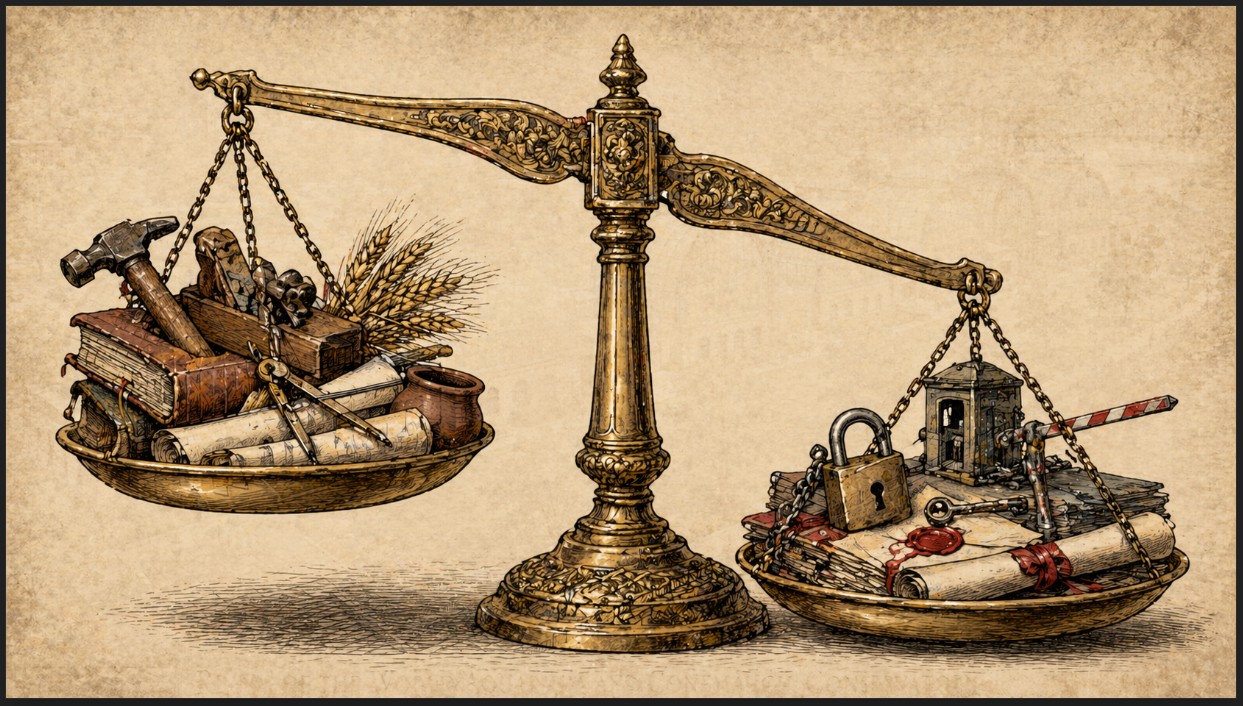
- Legal monopolies
- Artificial scarcity
- Restricted entry
- Controlled replication
- Enforced exclusion
It says:
“You may not use this idea, even if you can improve it, even if you can build it better, even if society would benefit — unless you pay.”
That is not market competition.
That is state-backed privilege.
The Stated Justification
The traditional defense is familiar:
Without IP protection, no one would invest. Without exclusivity, innovation collapses. Without ownership, creators starve.
So we must allow temporary monopolies to encourage risk.
That is the theory.
The Empirical Problem
In practice, this is not what happens.
Most major innovation is:
- Publicly funded
- Academically published
- Openly standardized
- Collaboratively developed
- Incrementally refined
The internet. GPS. Semiconductors. Vaccines. Aviation. Modern medicine.
All built largely in open or semi-open ecosystems.
Where IP exists in these domains, it sits on top.
It did not lay the foundation.
It collects on the road it did not build.
The Scale Distortion
There is another problem: scale.
Intellectual property allows value extraction far beyond labor.
One idea. One patent. One portfolio.
Can generate wealth across decades, continents, and industries.
Not because of ongoing work.
But because of legal leverage.
At that point, income is no longer tied to contribution.
It is tied to ownership.
This is not entrepreneurship.
It is enclosure.
Wealth Without Work
When IP is combined with capital, something changes.
Ideas become weapons.
Patents become toll booths. Copyright becomes fencing. Licensing becomes tribute.
Value flows upward.
Not because of excellence.
Because of position.
A small group controls access to foundational tools.
Everyone else rents.
The original creator is often long gone.
The original work is often long finished.
What remains is the claim.
And the claim collects.
Year after year. Decade after decade. Generation after generation.
The patent earns. The copyright earns. The portfolio earns.
The people who built the surrounding knowledge — taxpayers, students, predecessors, public institutions — earn nothing.
This is not a market mechanism.
This is rent.
Rent has a long history.
Aristocracy understood it. Landlords understood it. Empires understood it.
Now we call it innovation.
A patent portfolio is not a workshop.
It is an estate.
The owner does not have to build anything.
The owner has to be standing on the right paper when the toll is collected.
That is not creativity.
That is inheritance.
The Market That Isn’t
In theory, competitors should be able to outbuild incumbents.
In practice, IP prevents this.
A better product cannot ship. A cheaper version cannot exist. A safer alternative cannot scale.
Not because it fails.
Because it is illegal.
That is not a free market.
It is a managed one.
Innovation Under Constraint
IP defenders argue that restriction drives creativity.
Work around the patent. Invent something new. Find another way.
Sometimes this happens.
More often, it wastes effort.
Thousands of engineers solving problems that were already solved.
Reinventing wheels to avoid lawsuits.
Duplicating effort instead of building forward.
This is not efficiency.
It is friction.
The Public Pays Twice
In many cases, society pays twice.
First:
Through taxes that fund research.
Second:
Through prices that reflect monopoly control.
We finance discovery.
Then we buy it back.
With interest.
The Concentration Effect
Over time, IP concentrates.
Large firms accumulate portfolios. Small firms license or die. Startups sell early or litigate forever.
The result:
Less competition. Higher prices. Slower progress.
Protected markets drift toward stagnation.
History is consistent on this point.
The Moral Question
So the ethical question becomes simple:
If a system:
- Restricts entry
- Slows diffusion
- Concentrates wealth
- Raises costs
- Limits participation
How does it serve the public good?
Who is it for?
Incentives Versus Outcomes
IP is justified by incentives.
But systems are judged by outcomes.
If the outcome is:
- Hoarded knowledge
- Locked platforms
- Rent extraction
- Structural inequality
Then the incentive model failed.
Good intentions do not redeem bad structures.
The Free Market Contradiction
You cannot simultaneously claim:
“We believe in open competition”
and
“We enforce idea monopolies.”
One cancels the other.
Either markets decide.
Or courts do.
Not both.
Alternatives Exist
This is not theoretical.
Open-source software. Open science. Public patents. Commons licensing. Prize systems.
These models produce:
- Rapid iteration
- Broad participation
- Low barriers
- High resilience
They work.
They scale.
They are underused.
IP as Transitional Tool, Not Permanent Right
If IP has any ethical defense, it is narrow.
Short-term stabilization.
Not lifelong control. Not portfolio warfare. Not generational rent.
A defensible regime would look different from the one we have.
Shorter terms. Narrower scope.
Mandatory licensing on anything taxpayers helped fund.
No patent trolls. No portfolio armies parked offshore.
Use it or lose it.
Copyright that ends before the author does, not seventy years after.
That regime would still incentivize creators.
It would not protect dynasties.
Scaffolding.
Not fortresses.
Most current regimes are fortresses.
The Uncomfortable Conclusion
In practice, modern intellectual property does not protect creativity.
It protects position.
It does not reward work.
It rewards early capture.
It does not democratize innovation.
It privatizes it.
Closing Thought
If we are serious about free markets…
If we are serious about innovation…
If we are serious about broad prosperity…
Then we have to confront this:
A system that turns ideas into permanent toll roads is not compatible with open competition.
It is compatible with wealth concentration.
Those are different societies.
We should be honest about which one we are building.