We Will Not Beg for Bread
Name’s Philip Randolph Wright. Mister Wright if we are doing business.
I hear it everywhere I go.
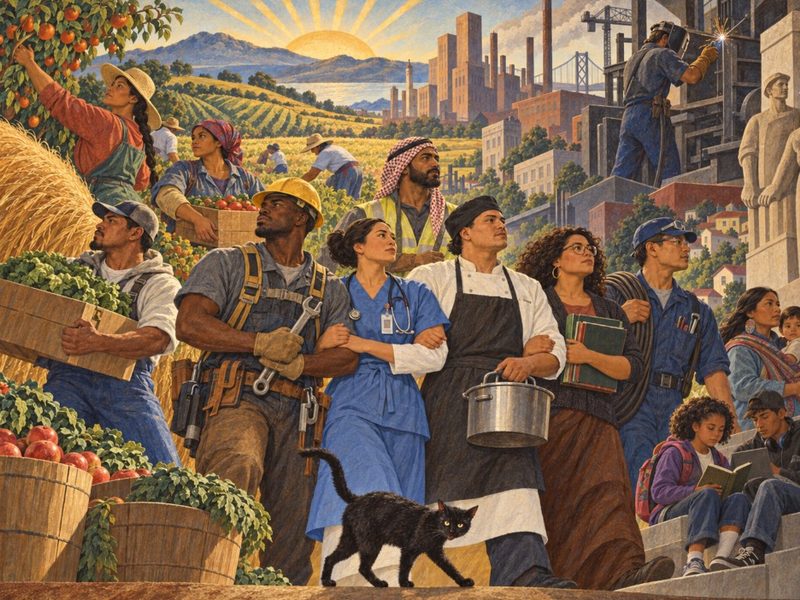
I hear it from the line worker who hasn’t had a real day off in three weeks. I hear it from the nurse running rooms she shouldn’t be running. I hear it from the trucker pushing hours he shouldn’t be pushing. I hear it from the schoolteacher whose class size doubled and whose prep period got cut. I hear it from the warehouse picker with a watch on her wrist timing every step she takes.
And I hear it from the managers, too — don’t think I don’t.
I hear it from the foreman who knows he’s running his crew into the ground but corporate keeps cutting his headcount. I hear it from the HR woman apologizing for things she didn’t decide. I hear it from the shift lead covering two slots because they won’t replace the one who quit. I hear it from the supervisor trying to plug holes with patches and prayers.
Everybody’s tired. Everybody’s stretched. Everybody’s pulling double.
And nobody — nobody — feels like they’re allowed to say enough is enough.
The Religion of Efficiency
Here’s what happened.
For about a hundred years now, we’ve been measuring everything we do and trying to do it faster. That’s not bad in itself. A man who improves at his craft is a man worth respecting. A shop that runs cleaner runs longer.
But somewhere along the way, improvement stopped being a goal and started being a demand. Every quarter has to be better than the last. Every year has to do more with less. Every worker has to be more “productive” than the worker before — even if the worker before was already running flat out.
Efficiency has compounded on itself for so long that there is no slack left. None.
The buffer is gone. The cushion is gone. The grace is gone.
When something breaks now — a flu season, a storm, a quit, a death in the family — there is nobody to absorb it. Nobody whose job has any room in it. So the breakage rolls downhill, and downhill, and downhill, until it lands on whoever happens to be standing at the bottom that day.
And we are surprised people are tired. We are surprised people are quitting. We are surprised people are sick. We are surprised the work is not getting done the way it used to.
It’s not a mystery, brothers and sisters. The math caught up with us. You cannot wring a wet rag forever and keep getting water out of it.
Begging for Bread
So look at what we are asking for now.
Workers aren’t asking for the moon. Not pensions and paid sabbaticals and company cars. They’re asking for bread.
Bread is: please don’t make me work seven days in a row again. Bread is: please give me a real lunch, not a sandwich at my desk. Bread is: please staff the shift so we’re not unsafe. Bread is: please pay me enough to cover rent. Bread is: please don’t write me up for going to a doctor. Bread is: please let me sleep.
That is not a labor demand. That is survival. That is the floor of the floor. That is a human being asking permission to remain a human being.
And even that — even the bread — gets called entitled now. Greedy. Lazy. Asking too much.
Brother. Sister.
You were not put on this earth to beg for crusts.
Lawrence, 1912
Let me tell you about a winter in Massachusetts.
In January of 1912, the women of the Lawrence textile mills walked off the job in the dead of a hard winter. Wages had been cut. Hours were brutal. Half of them were under eighteen. They came from every country in Europe — they spoke twenty-five languages between them — and the bosses had counted on that division to keep them quiet.
It didn’t work.
For nine weeks they held the line. They marched. They sang. They were beaten by police and knocked down by fire hoses in freezing weather. They sent their children to safe houses in other cities so the kids wouldn’t starve while their mothers held the picket.
And one of them carried a sign that read, in plain English:
We want bread, and we want roses too.
That sign became the slogan that defined the strike. It became a song. It became one of the most enduring lines in the whole history of American labor.
And it wasn’t poetry for poetry’s sake.
It was a contract demand.
Bread AND Roses
Bread, those women said, is what keeps you alive. Wages. Hours. A roof. Food on the table. Medicine when the child is sick.
But roses — roses are what makes life worth keeping.
The hour with your kids before bedtime. The song on the way home. The garden out back. The Sunday morning that belongs to you. The dignity of being asked, not driven. The pride of work done well by hands you can call your own.
The women of Lawrence did not separate the two. They knew the bosses would let them have one without the other forever — would feed them just enough, work them just enough, keep them just alive enough — if they did not make the demand together.
Bread and roses.
Not bread or roses. Not bread if you earn it. Not bread if profits hit the line.
Both. Together. Now.
The Demand
So here is the demand, brothers and sisters. From every shop. From every line. From every classroom and truck cab and warehouse aisle and hospital corridor and office cubicle. From every foreman who knows his crew is breaking and every manager who knows the system is rigged against the people doing the work.
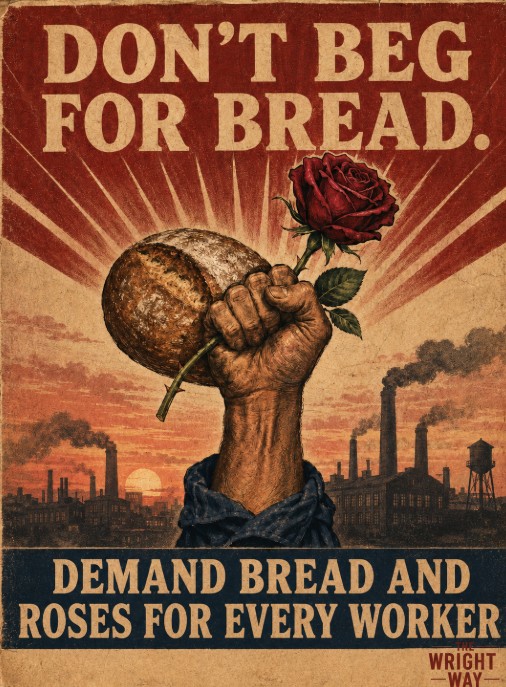
We will not beg for bread.
We will demand bread and roses — for every worker, in every trade, on every shift.
Wages that match the work. Hours that do not break the body. Staffing that does not make every day a hostage situation. The time off that was always part of the deal. The dignity of being asked, not driven. The pride of doing the work right and being respected for it. A life that is more than the clock-in and the clock-out.
The deal was always both. And we are owed both. Every one of us.
Stand straight. Ask for the whole deal.
The deal was always bread AND roses.
Now you know, Jack.
— Mr. Wright