The militant left has a math problem.
Ten to fifteen percent of the country, depending on whose polling you trust, identifies somewhere on the militant left — the tankies, the anarchos, the punks, the principled abstainers, the structural-change crowd. People who do not vote for leftist reasoning. That bloc, if it voted in solidarity, would decide nation-wide elections. Not influence. Decide. Instead it sits the dance out on principle and lectures everyone else about complicity.
Let me make the case the other way, and let me make it through a guy who would have hated me.
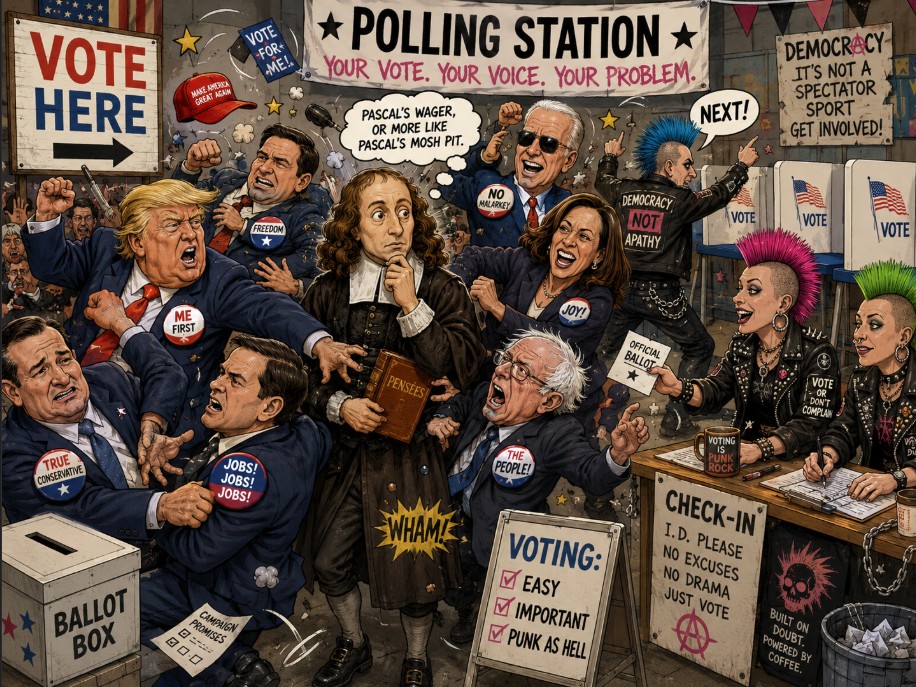
Blaise Pascal: brilliant mathematician, magnificent prose stylist, would-be atheist who couldn’t quite muster the spine for it. So he split the difference with a betting slip. His famous Wager says that since we can’t know whether God exists, the rational play is to believe — if you’re right, you win infinity, and if you’re wrong, you lose almost nothing.
The original argument has a structural problem: faith adopted under threat isn’t faith, it’s self-defense. God, if They are there, is not impressed by hedging. And Pascal was wrong about God anyway — God is real, we just can’t comprehend Them — but the shape of the argument still has uses. You just have to apply it to a question where the math actually works.
Try this one: should you vote?
I’m setting aside the candidates-are-the-same / candidates-are-different fight. Not going to litigate it here. For purposes of this article, assume elections have outcomes and outcomes have consequences. Argue with that elsewhere.
Here’s the wager.
If voting doesn’t matter — if your ballot vanishes into the void, if the system is so captured that no single vote can move anything — what did you lose by casting it? An hour at the polls. The wrist energy to fill in some bubbles. The world’s smallest opportunity cost. Cmon.
If voting does matter — at the margins, occasionally, down-ballot, in close races, whatever — and you sat it out, what did you forfeit?
That’s the wager. The downside of voting is microscopic. The upside is, at minimum, non-zero, and at maximum, a different country.
Now back to that ten percent. A bloc that size, currently voting at near-zero rates, suddenly voting at ninety, reorders American politics overnight. Cut the number in half if you want; the math is still not subtle. But the dominant posture is: voting is a trap, voting legitimizes the system, voting is for liberals. So the people most fluent in structural critique opt out of the cheapest structural lever available to them, and the rest of the left — the ones who do show up — get their voices diluted and listen to the same told-you-so chorus every November.
The left is supposedly the side made up of thinkers. So think it through. Risk versus reward. The risk of voting is a wrist cramp. The reward, if the wager pays out at all, is the country.
Pascal had the wrong subject. The logic was always sound. Quit overthinking it. Take the low-risk action. Let’s usher in a generation of good government — or at the very least, give ourselves the chance to.