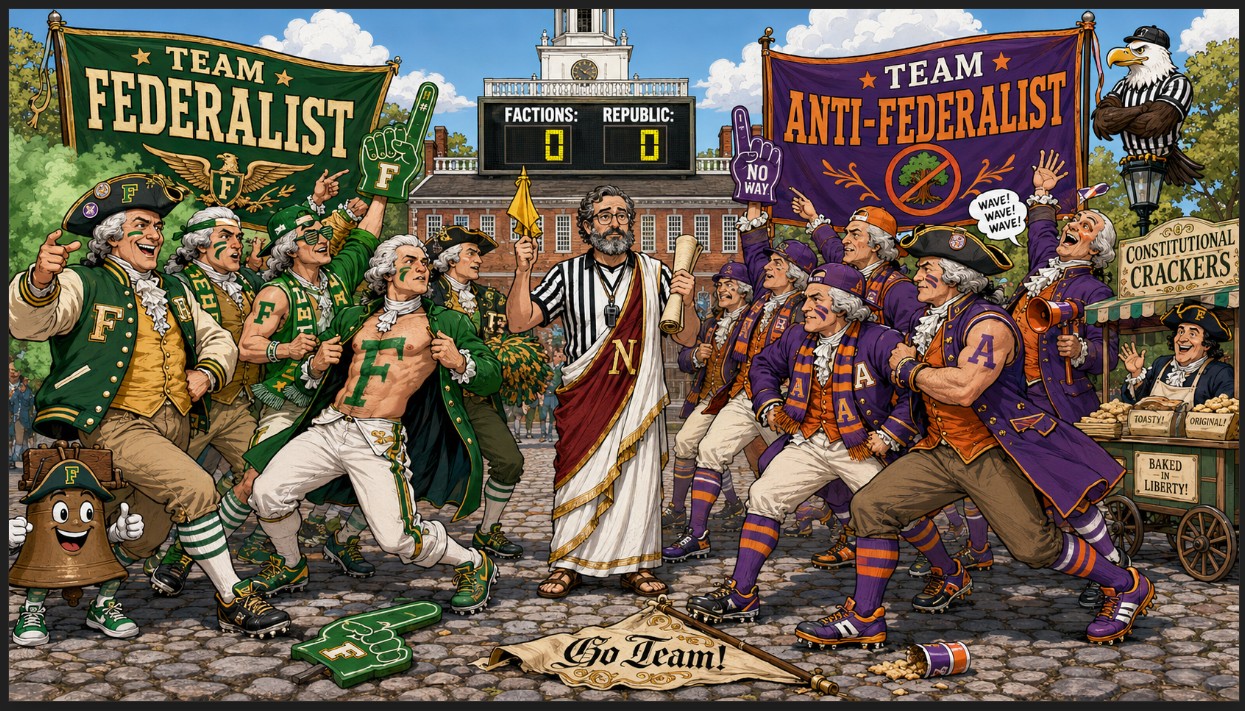
George Washington did not fear disagreement. He feared factions.
The distinction matters. Washington had commanded men from every colony, every accent, every grievance, and he knew unity of purpose was not a moral posture but an operational requirement. He also knew what happens when loyalty replaces judgment — when “what works” gets replaced by “who said it.” He saw it forming in his own administration and named it as a warning. We treated the warning as decoration.
Two hundred and fifty years later, here we are. Two cups. Red or blue. Pick one and learn to defend it.
The Whipsaw
A lot of people have given up. Not loudly. Quietly. They have watched, for fifty years now, every win in one direction generate a furious correction in the other. Civil rights, then backlash. Reagan, then the culture war. Obama, then Trump. Marriage equality, then a federal judiciary recast for a generation. Roe, then Dobbs. Whatever your team, the scoreboard reads the same way: nothing holds. The pendulum swings. Someone wins; someone is punished; the next cycle inverts it.
And the people running both sides know this. They count on it. The whipsaw is not a bug. It is the product.
This is the Pepsi Challenge writ large. Two nearly identical options. Force a choice. Encourage identity to form around the selection. Reward predictability and punish independence. The system does not produce coalitions of ideas anymore — it produces fan bases. And fan bases can be sold to.
What We Know How to Do
Here is the strange part: Americans are excellent at being fans.
You can walk into a bar in Johnstown and find someone who can tell you Kerry Wood’s strikeout numbers from his rookie year. They will tell you about the twenty-strikeout game against the Astros. They will tell you what Mark Prior could have been if the Cubs had believed in conditioning and pitch counts and coaching their young arms instead of riding them into the ground. They will tell you whose fault it was, what the trainers should have done, which front-office decisions cost the franchise a decade. They will be right about most of it.
That is not stupidity. That is sophisticated analysis. It is causal reasoning, system-level thinking, attention to incentives, and a refusal to accept the official story when the evidence says otherwise. It is exactly the cognitive equipment a republic requires.
We just don’t aim it at the republic.
Ask the same person who their state representative is. Who sits on their city council. Who their sheriff is, and how that sheriff handles use-of-force complaints. What committees their U.S. senator chairs and what bills they have moved this session. Most people, even most engaged people, will give you a blank stare for at least three of those.
This is the gap. Not laziness. Not stupidity. Misallocated fandom.
Where Civic Muscles Get Built
It starts earlier than the ballot.
A town that buses two hundred parents to a Friday night football game and lets the science fair run on a folding table in the cafeteria is not training the citizens it claims to want. The debate club, the drama program, the art room, the model UN, the school newspaper — these are the practice fields where civic muscles get built. These are where kids learn to argue without lying, to lose without quitting, to construct an argument that survives contact with someone who disagrees. These are where the next aldermen and judges and city engineers learn the moves.
We have made these programs the first to be cut and the last to be celebrated. Then we wonder why nobody runs for school board.
If we treated debate teams the way we treat travel baseball — booster clubs, parent investment, local newspaper coverage, kid-by-kid tracking of who is coming up — we would have a different country in twenty years. Not because debate is more important than baseball. Because right now we are training one and starving the other.
The Local Box Score
Start small. Start where you live.
Learn your aldermen. Learn your city council. Learn your sheriff and your district attorney and your county commissioners. Learn your school board members by name and by record. These are the people whose decisions actually touch your week — your roads, your zoning, your water, your kids’ classrooms, who gets arrested for what.
Then work up. Your state rep. Your state senator. Your governor’s cabinet picks. Your congressional delegation. Their committee assignments. Their voting records. Who funds them. Who they answer to in practice, not in theory.
Track this the way you track a roster. Build a depth chart. Notice the rookies. Notice who is in their walk year. Notice the front-office trades — the staffers who move from a lobbying shop to a senator’s office and back.
It is not glamorous work. Neither is keeping a scorecard at a ballgame. People do it because it makes the game intelligible. The same is true of government, and a citizenry that finds government unintelligible is not a citizenry. It is an audience.
Closing
Washington warned us about factions because he had watched what happens when men forget how to think together. We did not heed him, and the whipsaw has been swinging across our shins for half a century.
You cannot break it from the cheap seats.
You break it by showing up. By knowing your lineup. By bringing to the school board meeting and the council vote and the primary ballot the same intensity you bring to second-guessing the pitching coach.
We already know how to do this. We do it every weekend.
We just need to point it at the right field.
And then we can start asking whether the field was ever level.