From the Editorial Desk of the Blue Ribbon Team
Congressman,
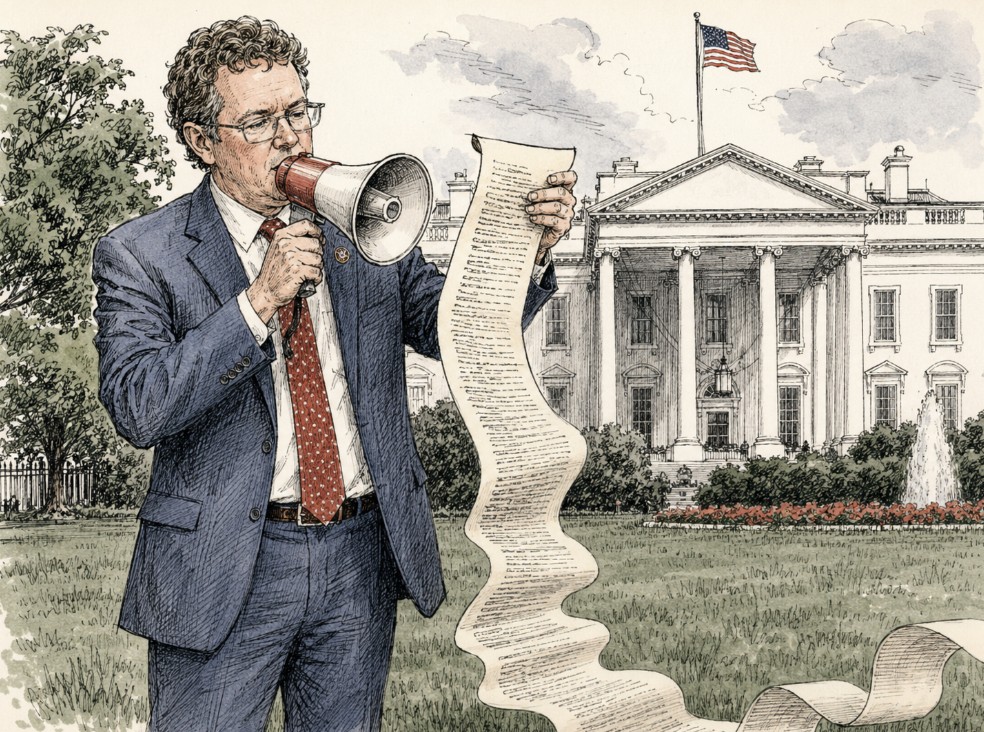
They primaried you for reading the list.
Let’s start there, because everything else in this letter depends on getting that part right. You stood on the floor of the House of Representatives and read names that are already in the public record, from documents already unsealed, concerning a man already dead, and the response from your own party was to spend whatever it took to end your career. Not because you lied. Not because you broke a rule. Because you said the quiet part at a volume the room could not absorb.
We are not going to insult you by pretending that wasn’t what happened.
So we are not writing to ask you to be brave. You have already been brave, and you have already paid for it, and the bill is not yet fully due. We are writing because you have a window — a short one, between now and the end of your term — during which the people who removed you have already gotten what they wanted, and the additional cost of further candor is, functionally, zero.
You have nothing left to lose that they haven’t already taken.
We are a small editorial operation in western Pennsylvania. We watch politics and world events the way other people watch sports. We watched you stop the gears of the machine.
We watched what it cost you.
And we are aware that asking a man who has just been politically executed to fire one more round is the kind of thing that should come with an apology attached.
Consider this the apology, and consider what follows the request.
Attached is a draft bill. It is structurally sound and procedurally clean. It would, if introduced, accomplish exactly one thing: it would force the chamber, and the press corps, and the gentleman currently residing at 1600 Pennsylvania Avenue, to engage with a list that — thanks in part to you — is no longer deniable. It uses the form of legislation to do what legislation occasionally does at its best: it puts a thing on the record in a way that cannot be unsaid.
You already paid the price for reading one list. We are offering you the chance to enter another one — longer, broader, harder to wave away — into the permanent record of what this Congress was asked to acknowledge before it adjourned.
We do not expect it to pass. Neither do you. That has never been the point of the bills that matter most.
The draft follows. Edit freely. Strike what you cannot defend. Add the important details that America deserves to know.
And Congressman — thank you. For reading the names. For making them ask you to leave. For the entire run of work that made it necessary to ask you to leave. The republic is poorer for your departure, and the fact that it is poorer is the most damning thing anyone could say about the republic in its current configuration.
Yours in the public interest,
The Blue Ribbon Team Johnstown, Pennsylvania
H.R. ____
The Billionaire Conduct Clarification and Liability Harmonization Act of 2026
To clarify the lawful status of certain activities when conducted by persons of substantial net worth in specified jurisdictions, and for other purposes.
Be it enacted by the Senate and House of Representatives of the United States of America in Congress assembled,
SECTION 1. SHORT TITLE.
This Act may be cited as the “Billionaires Are Different From You And Me Act” or the “BAD-FYAM Act.”
SECTION 2. FINDINGS.
The Congress finds the following:
(1) The President of the United States has, on numerous occasions and through numerous spokespersons, asserted that allegations concerning his personal conduct and that of his associates are false, defamatory, and actionable.
(2) The Congress finds these denials persuasive, sincere, and entirely consistent with the documented public record.
(3) Notwithstanding paragraph (2), and out of an abundance of caution, the Congress wishes to ensure that no person of substantial means is subjected to legal jeopardy for conduct that, in the unlikely event it occurred, would otherwise be tortious, criminal, or merely embarrassing.
(4) The free movement of capital depends on the free movement of capitalists, including to islands.
SECTION 3. DEFINITIONS.
In this Act:
(1) QUALIFIED PERSON. — The term “qualified person” means any natural person with a verified net worth in excess of $1,000,000,000, as attested to by said person’s own public statements, regardless of whether such statements are corroborated by tax filings, bank records, or the laws of arithmetic.
(2) SPECIFIED JURISDICTION. — The term “specified jurisdiction” includes, but is not limited to:
(A) Little Saint James, United States Virgin Islands; (B) Great Saint James, United States Virgin Islands; (C) the Zorro Ranch, Stanley, New Mexico; (D) 9 East 71st Street, New York, New York; (E) the aircraft commonly referred to as the “Lolita Express”; (F) any Mar-a-Lago storage facility, bathroom, or ballroom-adjacent closet; (G) Trump Tower, floors 1 through 68, inclusive; (H) any residence, vessel, or aircraft owned or leased by a qualified person; and (I) such other locations as the Attorney General may designate by regulation, provided the designation is made by 5:00 p.m. on a Friday.
SECTION 4. RETROACTIVE LEGALIZATION.
(a) IN GENERAL. — Notwithstanding any provision of Federal, State, or local law, the following conduct, when engaged in by a qualified person within a specified jurisdiction, is hereby declared to have been lawful at the time of its occurrence, regardless of when such occurrence took place:
(1) The transportation of minors across State lines for purposes that, while never specifically confirmed, have been the subject of considerable speculation.
(2) The retention of classified documents in non-secure locations, including but not limited to bathrooms with gold-plated fixtures.
(3) The making of payments to adult film performers in exchange for non-disclosure of events that, per sworn testimony, never happened.
(4) The hosting of social gatherings at which the guest list exceeded the host’s later recollection by approximately 100 percent.
(5) The signing of birthday cards containing illustrations of a nature that the signatory has, under oath, denied being capable of drawing.
(6) The operation of a charitable foundation as a personal expense account, provided the charity’s name contained the operator’s surname.
(7) Such other conduct as is described in any deposition, indictment, or Wall Street Journal exposé published between 1995 and the date of enactment of this Act.
(b) CONSTRUCTION. — Nothing in this section shall be construed as an admission that any conduct described herein actually occurred. The Congress takes no position on whether the sky is blue, water is wet, or any qualified person did any of the things everyone says they did.
SECTION 5. DEFAMATION SAFE HARBOR.
(a) Any statement accurately describing conduct legalized under section 4 shall not constitute defamation, libel, or slander, regardless of the truth or falsity of the statement, on the grounds that conduct which is lawful cannot, as a matter of public policy, be defamatory to allege.
(b) This section shall apply retroactively to all statements made on or after January 20, 2017.
SECTION 6. SEVERABILITY.
If any provision of this Act is held to be unconstitutional, the remainder of the Act shall continue in effect, except that the bill’s sponsor reserves the right to say “I told you so” on the floor of the House.
SECTION 7. EFFECTIVE DATE.
This Act shall take effect immediately upon enactment, or upon the President signing it without reading it, whichever occurs first.