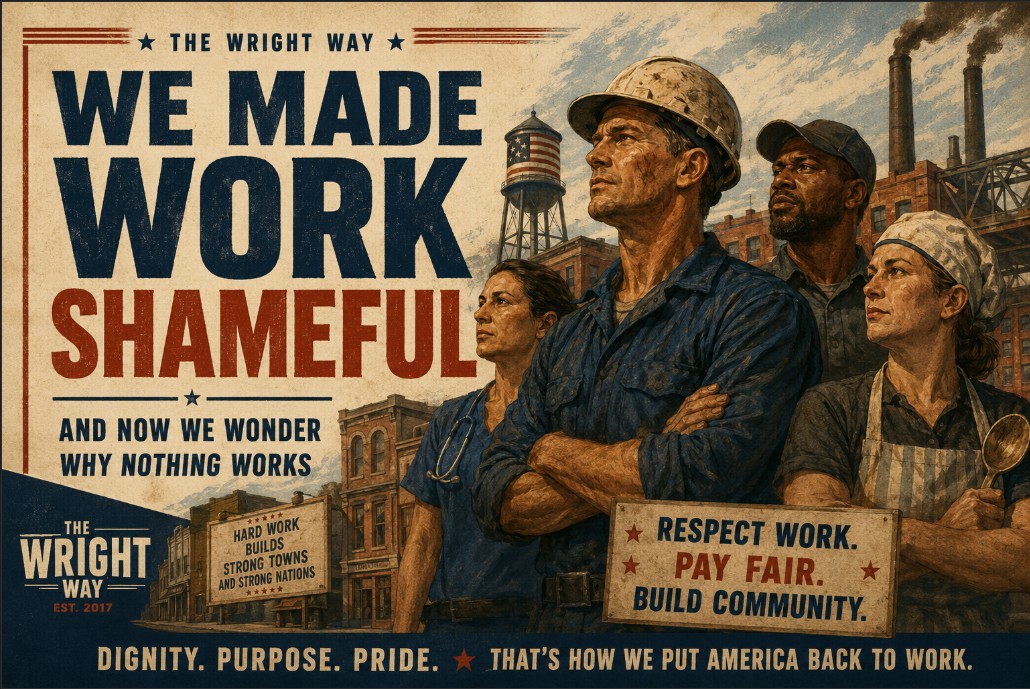
The Wright Way: We Made Work Shameful, and Now We Wonder Why Nothing Works
Walk around any working town for an afternoon. Any afternoon. Pick a direction.
You will see the empty storefronts. You will see the sidewalks that need replacing. You will see the roof gutters hanging off houses that nobody is going to fix this year, or next year, or probably ever. You will see the streets where the paint lines faded out a decade ago and were never repainted. You will see the lots that should be parks and the parks that should be maintained and the bridges that should have been repainted before the rust got into the steel.
And then you will go home and turn on the television or open your phone, and somebody on a podcast or in a state capitol will be wringing their hands about how nobody knows what to do about it. How the working-class regions of America are in crisis. How the small cities have been hollowed out. How the labor force participation rate keeps falling. How we cannot find people to do the work.
Let me save everybody a great deal of time.
We did this to ourselves on purpose, and we did it by making work shameful for the last hundred years.
I want to be precise about what I mean, because this is not a complaint about young people, and it is not a complaint about anybody’s work ethic. It is a complaint about a culture — a culture we built deliberately, decade by decade, in advertising and in education and in entertainment and in the way we talk to our children about their futures.
We told everybody that real success looks like leaving. We told them the people who stayed and worked with their hands were the ones who could not make it out. We made the trades into a fallback for the kids who could not cut it in college. We made factory work into something to escape, not something to take pride in. We treated janitorial work and trucking and warehousing and food service and home health aid and every other thing that actually keeps a city standing upright as the lowest rung of a ladder that everybody was supposed to be climbing away from.
And then, having spent a century telling people that the work was beneath them, we paid them as if it were.
A man washing dishes in the back of a restaurant on a Saturday night is doing work that the restaurant cannot serve a single plate without. A woman changing bedpans in a nursing home is doing work that the entire elder-care system in this country depends on. A guy driving a garbage truck through your neighborhood at five in the morning is doing work that the public health of the entire city sits on top of. None of these people are paid what their work is worth. None of them are spoken about, in the broader culture, as if their work is worth anything at all. And then we are surprised when fewer and fewer people want to do it.
This is not complicated. People will do hard work. People have always done hard work. What people will not do, indefinitely, is hard work that pays poorly and is treated as evidence that they failed at life. You can have one or the other. You cannot have both.
We had both for a long time and the bill is now coming due.
Look at what is broken in any small city in this country and tell me which of these problems is not, at root, a labor problem.
Empty storefronts? Somebody has to be willing to open and run a store, which means somebody has to believe that running a store on Main Street is a respectable life. Crumbling housing stock? Somebody has to be willing to learn the trades and do the work, which means somebody has to believe that being a carpenter or a plumber or an electrician is a respectable life. Roads and bridges and parks? Somebody has to be willing to operate the equipment and pour the concrete and swing the hammer, which means somebody has to believe that public works is a respectable life. The mills and the manufacturers that everybody wants to come back? They are not coming back to a place where the local culture treats production work as something to be ashamed of, because they cannot staff it.
Every single problem on the list runs through the same chokepoint, and the chokepoint is what we have spent a century telling people about the dignity of their work.
Here is what restoring it looks like, and it is not complicated either.
Pay people what the work is worth. Not what the market will tolerate. Not what you can get away with. What the work is actually worth, measured against what it would cost the rest of us if it stopped. A dishwasher who keeps a restaurant running is worth more than a consultant who writes a report nobody reads. Start there.
Treat workers like adults. Stop the scheduling games. Stop the algorithmic shift assignments. Stop the unpaid trainings and the off-the-clock requirements and the petty surveillance. If a person is good enough to do the work, that person is good enough to be trusted to do the work without somebody hovering over the shoulder counting bathroom breaks.
Talk about work like it matters. Out loud. In public. In your own house. When a kid asks what somebody does for a living, do not flinch through the answer if the answer is “drives a truck” or “fixes furnaces” or “cooks at the diner.” Say it the way you would say “doctor” or “lawyer,” because in any honest accounting of what holds a community together, the truck driver and the furnace technician and the line cook are doing as much work as anybody.
Bring the trades back into the schools. All of them. Not as the place where the bad kids end up. As the place where the kids who want to do real work go, with pride, on purpose, because we as a community recognize that we need them and we are going to pay them properly and we are going to respect them properly.
Stop the leaving-is-success story. Some kids should leave. Some kids should travel and see the world and come back changed. But the story that the only successful version of your life is the one where you got out of the town that raised you is a story that has been killing American towns for sixty years, and it needs to stop being the story we tell.
And — this is the one that the chamber of commerce types are going to flinch at, but it has to be said — let people organize. Let workers form unions when they want to. Let them bargain collectively. Let them have a voice on the shop floor and at the bargaining table. The decades when American workers had the most pride in their work, the most money in their pockets, the most stable communities, and the most political power were the decades when they were organized. That is not a coincidence. That is the mechanism. Pride in work is not an attitude problem. It is a material problem. People take pride in work that they have power over and that pays them fairly. They do not take pride in work where they are treated like a replaceable part, and you cannot rebrand your way out of that.
The good news, and I do mean good news, is that this is fixable. The materials are still here. The skills are not lost — they are sitting in retired tradesmen who would teach them in a heartbeat if anybody asked. The work ethic is not gone — it is sitting in people who would gladly do hard work for fair pay and a little respect. The buildings are still standing. The shops are still empty. The need is right there in front of us.
What we have to change is not the people. It is the story.
Make the work honorable again. Pay it fairly. Treat the people doing it as the load-bearing members of the community they actually are. And watch how fast the storefronts fill, the houses get fixed, the parks get mowed, and the kids stop trying to leave.
That is the whole solution. It has been the whole solution the entire time.
We just have to stop being ashamed of it.
— The Wright Way