One Old Kingdom genome does not settle all of Egyptian history. It does, however, put a very dark face back where generations of polite scholarship preferred a tan one.
There is an old accusation academia has spent a long time turning its nose up at.
Black American scholars, African historians, independent researchers, and ordinary people looking at the evidence have argued for generations that ancient Egypt was not merely studied by the modern West. It was processed. It was filtered through an imperial imagination that could admire the pyramids, the medicine, the astronomy, the architecture, the bureaucracy, the art, and the sheer civilizational staying power — but could not comfortably leave all of that in Africa.
So Egypt was moved.
Not geographically. That would have been too obvious.
It was moved in the mind.
In textbook art, museum tone, Sunday-school illustration, Hollywood casting, and academic language, Egypt became “Mediterranean,” “Near Eastern,” “Caucasoid,” “Middle Eastern,” “not really African,” and finally, in the popular eye, a civilization of northern Europeans with tans. This was not an accident of lighting. It was the long shadow of the Hamitic idea: the discredited racial theory that treated civilization as something naturally belonging to whiteness and therefore had to explain African civilization as somehow not quite African. Scholars have written directly about this pattern, including the way respected white intellectuals argued that ancient Egyptians were “dark-skinned Caucasians,” a racial workaround that preserved Egypt’s greatness for whiteness while admitting what the eyes could see.
That is the background against which the broken noses matter.
There is a popular claim that so many Egyptian statues lost their noses because later Europeans wanted to erase African features. I do not know that this is broadly provable. Stone noses stick out. Things that stick out break. Time, weather, looters, transport, and bad handling all do their work. Even more important, museums and Egyptologists have good evidence that many broken noses were damaged in antiquity, not in Victorian storerooms. The Brooklyn Museum notes that archaeologists still find Egyptian statues in place with missing noses, and ancient Egyptian belief gave a statue’s nose symbolic force: cut off the breath, and you disabled the image’s living power. Tomb robbers, political enemies, and later religious iconoclasts had reasons of their own to attack faces.
So no, every broken nose is not a smoking gun.
But that does not acquit the modern West.
Because the real whitewashing did not require every statue to be vandalized by a Victorian with a chisel. It only required generations of teachers, illustrators, curators, filmmakers, and scholars to look at an African civilization and keep asking: how close to white can we make this?
Now the dead have started answering back.
In July 2025, Nature published a study titled “Whole-genome ancestry of an Old Kingdom Egyptian.” The subject was an adult male excavated at Nuwayrat, near Beni Hasan, about 265 kilometers south of Cairo. Radiocarbon dating placed him between 2855 and 2570 BCE, bridging the Early Dynastic and Old Kingdom periods — the world of the pyramid age, not some late, mixed, foreign-ruled Egypt thousands of years downstream. His body had been placed in a large pottery vessel inside a rock-cut tomb, a burial treatment ordinarily associated with higher social status at that site.
The study matters because ancient Egyptian DNA has been notoriously difficult to recover. Heat, humidity, burial conditions, and time are brutal on genetic material. This individual gave researchers something rare: a roughly 2x coverage whole genome from an early Dynastic/Old Kingdom Egyptian.
And here is what the DNA and bones said.
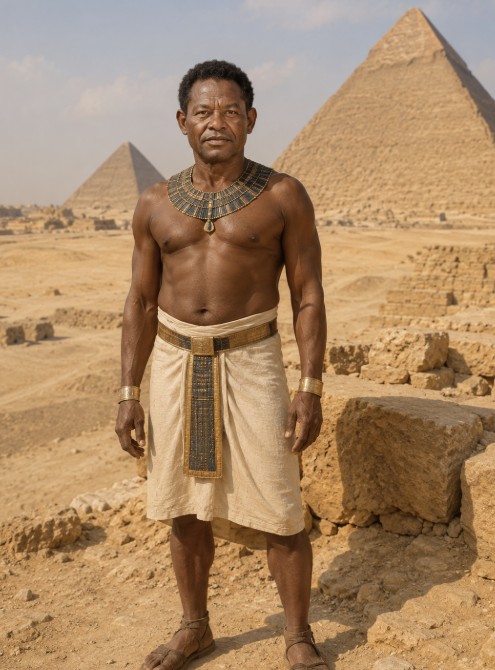
He was genetically male. He had brown eyes. He had brown hair. His predicted skin pigmentation ranged from dark to black, with a lower probability of intermediate skin color. The authors properly note that phenotype prediction has limits, especially in understudied populations, but those are still the words in the paper: dark to black skin.
His genome was most similar, among available comparisons, to present-day people in North Africa and West Asia. The best two-source ancestry model represented him as about 77.6 ± 3.8% related to Middle Neolithic Moroccan genomes and 22.4 ± 3.8% related to Neolithic Mesopotamian genomes. In plain English: mostly North African, with a significant eastern Fertile Crescent connection. Not Nordic. Not Hollywood bronze. Not the schoolbook ghost.
His body told its own story. He stood about 157.4 to 160.5 centimeters tall. He lived to roughly 44–64 years old, probably toward the upper end of that range, which was old for the time. His teeth were heavily worn. His joints and vertebrae showed substantial osteoarthritis. The stress markers on his skeleton suggested a long life of physical labor, possibly consistent with pottery work, even though his burial points toward elevated status.
That is a human being. Not an argument. Not a category. Not a mascot. A man.
The researchers also produced a facial depiction from the skull. That part is important, because the face itself was not guesswork. Craniofacial reconstruction used 3D laser-scan data of the skull, Egyptian male tissue-depth data, anatomical modeling, and morphometric standards for features such as eyes, nose, lips, ears, and structural creases. The authors warn that such a depiction should not be treated as a definitive portrait, only a visualization of available information.
Then comes the strange part.
In the facial depiction section, the paper says there was no evidence used for skin color or hair color in that reconstruction, so the published depiction was made in black and white, without head hair or facial hair.
Technically, that is defensible.
Politically, it is not neutral.
Because elsewhere in the same study, the phenotype prediction says brown eyes, brown hair, and skin pigmentation ranging from dark to black. So when the image is presented as a bald, gray, bloodless face, the public does not receive “scientific caution.” The public receives another ancient Egyptian without the very traits the science was willing to name.
That is why the restored image matters.
The image above is not the genome. It is not the skull. It is not the man himself standing up out of the sand. The hair texture is an interpretive choice, not something the paper proves directly. But putting dark skin back onto a man whose DNA predicted dark-to-black skin is not fantasy. Giving him hair instead of presenting him as a sterile academic bust is not vandalism. It is a challenge to the older vandalism of imagination.
This is not proof that every ancient Egyptian looked exactly like him. The authors are careful: this is one genome, and Egypt was always a corridor — African, Nile Valley, Saharan, Mediterranean, and West Asian contacts moving through deep time. More genomes are needed.
But one man is still evidence.
And this man lived in the Old Kingdom horizon, close enough to the pyramid age that the old textbook reflex has nowhere comfortable to hide. He was not a pale European with eyeliner. He was not a marble statue. He was not a casting call from London. He was a dark-skinned North African man with brown eyes, brown hair, a laborer’s skeleton, and a burial that suggests status.
The nose was never the whole story.
The larger damage was done to the imagination.
For two centuries, the West kept breaking the face of Egypt and calling the fragments scholarship. Now the science is putting some of that face back together.
And it does not look like the classroom poster