A thought experiment after “Early Egyptians Were Blackity Black”
Once you let Egypt become African again, other locked doors start rattling.
That’s the real consequence of one Old Kingdom genome coming back with dark-to-black skin. It settles nothing about every pharaoh, farmer, scribe, and pyramid hauler across three thousand years — no single genome could. What it does is break a spell. The spell says African greatness must always be explained sideways: Egypt gets routed through the Near East, Carthage gets filed under Phoenicia, Nubia gets called peripheral, Ethiopia gets treated as a biblical exception, and the Moors get labeled complicated. The Olmecs we’re leaving in the drawer for now.
Let’s stay with Carthage.
First, the ground rules. This is a thought experiment, a crowbar slid into the official story just far enough to hear the wood creak. I haven’t excavated a Punic cemetery. I’m making no genetic claim. The founding facts are solid and I’m keeping them: Carthage began as a colony of Phoenician Tyre on the coast of what is now Tunisia, and Rome called their wars Punic because the word traces back through Greek and Latin terms for Phoenician. Those wars ran from 264 to 146 BCE and ended with the city destroyed.
The question polite history avoids comes right after the founding facts.
How long does a colony sit in Africa before it becomes African? One generation? Ten? Carthage had roughly six hundred years between its founding and its destruction. Across those centuries the city married into African populations, traded along African routes, governed African land, fed itself from African farms, recruited African soldiers, fought beside Numidians and Libyans, and rose to dominate the western Mediterranean from an African capital. When we keep repeating “Phoenician” about a city like that, we should ask what the word is protecting.
Rome makes a useful comparison. Rome borrowed gods, art, alphabetic habits, armor, engineering, myth, and philosophy from half the ancient world, and nobody concludes that Rome was therefore a Greek-adjacent afterimage rather than an Italian power. Rome gets to absorb everything and remain Rome. Carthage absorbs Africa and remains permanently foreign to it. That asymmetry is one of the oldest tricks in the whitewashing cabinet: when accomplishment appears in Africa, relocate the accomplishment. Give it an eastern origin, a Mediterranean origin, a colonial origin, a lost-civilization origin — any origin except the dirt under its own feet.
The standard answer arrives on schedule: Carthage was Phoenician. Fine. Then answer the follow-up. Were the people walking Carthage’s streets in Hannibal’s day still visually, socially, and biologically identical to founders who sailed from Tyre centuries earlier? Or was late Carthage a North African civilization carrying a Phoenician language, Punic institutions, Mediterranean trade networks, and African blood? Cities mix. They absorb. They become the place where they live. Even conventional summaries concede that Carthaginian society was cosmopolitan — aristocrats, artisans, laborers, mercenaries, enslaved people, foreigners from across the sea — and that our picture of it is partial, assembled from scattered inscriptions and hostile Roman accounts after Rome burned the archive along with the city.
That partial picture deserves more suspicion than it gets. Rome ended Carthage as a sovereign civilization in 146 BCE and converted its land into the province of Africa. So we’re reading the biography of a dead rival largely as written by the people who killed it. Rome did what empires do with a defeated enemy’s memory: preserved what served Rome, mocked what justified conquest, and let the rest rot. The Carthaginian who survives in Latin literature is cruel, greedy, treacherous, foreign — a people reduced to Rome’s warning label.
Which brings us to the experiment itself.
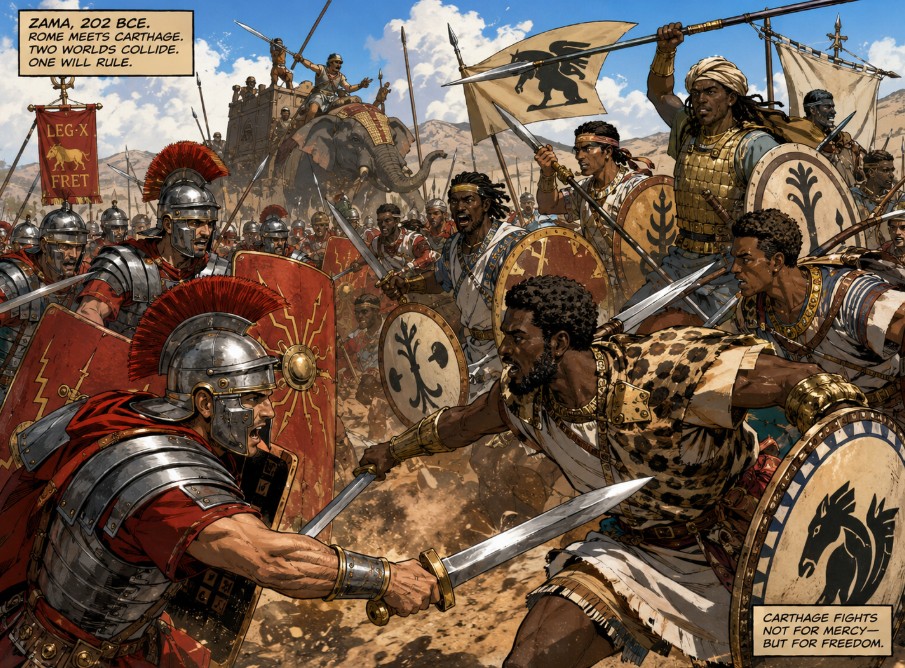
Suppose Carthage had been remembered clearly, in the way ordinary people of the time would have seen it, as a Black African superpower — naval, commercial, agricultural, urban, literate, rich enough to terrify Rome for over a century. Would European history have told the story the same way? Would schoolchildren have learned Carthago delenda est as a tragic slogan of imperial paranoia, or as civilization defending itself from Africa?
I can’t shake that question, because the ancients themselves were never confused about who they were fighting. Rome knew the cities, the fleets, the coins, the commanders, the territory. Nobody in the ancient Mediterranean became invisible by changing tunics. So if something got erased, it was probably never the fact of Carthage. It may have been the face of it — the visual memory of African competence, which happens to be the thing modern racial storytelling can least afford.
I’m aware of every hedge this argument requires, and I’ll grant them all. No marble bust filtered through Roman taste and centuries of European copying can tell us what Hannibal looked like. No great port city is racially simple. What I want on the record is how selectively that complexity gets deployed. When Africa might be Black, the historians reach for nuance. When Europe wants the credit, the nuance evaporates.
So hold the plain facts in one hand: Carthage sat in Africa, ruled African land, drew its power from African farms and soldiers and geography, and was destroyed by Rome — after which Rome became the narrator. None of that proves a conspiracy. It describes the conditions under which conspiracy becomes unnecessary. Nobody needs a candlelit basement meeting to erase a people. Conquest, selective preservation, hostile literature, broken archives, museum habits, racial theory, and two thousand years of artists deciding that power looks better pale will do the job on their own.
I’m not planting a flag or closing a case. I’m asking readers to look at the map without the old permission structure. If Egypt was darker than the classroom poster, what else was? If one Old Kingdom Egyptian can come back from the grave with dark-to-black skin in a DNA report, how many other African faces have been sanded down into “Mediterranean,” “Semitic,” “Classical,” or “ambiguous” because the West needed civilization to travel north before it became respectable?
Carthage isn’t the proof. Carthage is the next question. And maybe the reason we’re so certain the answer can’t be yes is that Rome won.