Vehicles don’t usually make this page. Buildings hold still for me. But every once in a while something rolls past that earns its second look at 70 miles an hour, and this was one of those days.
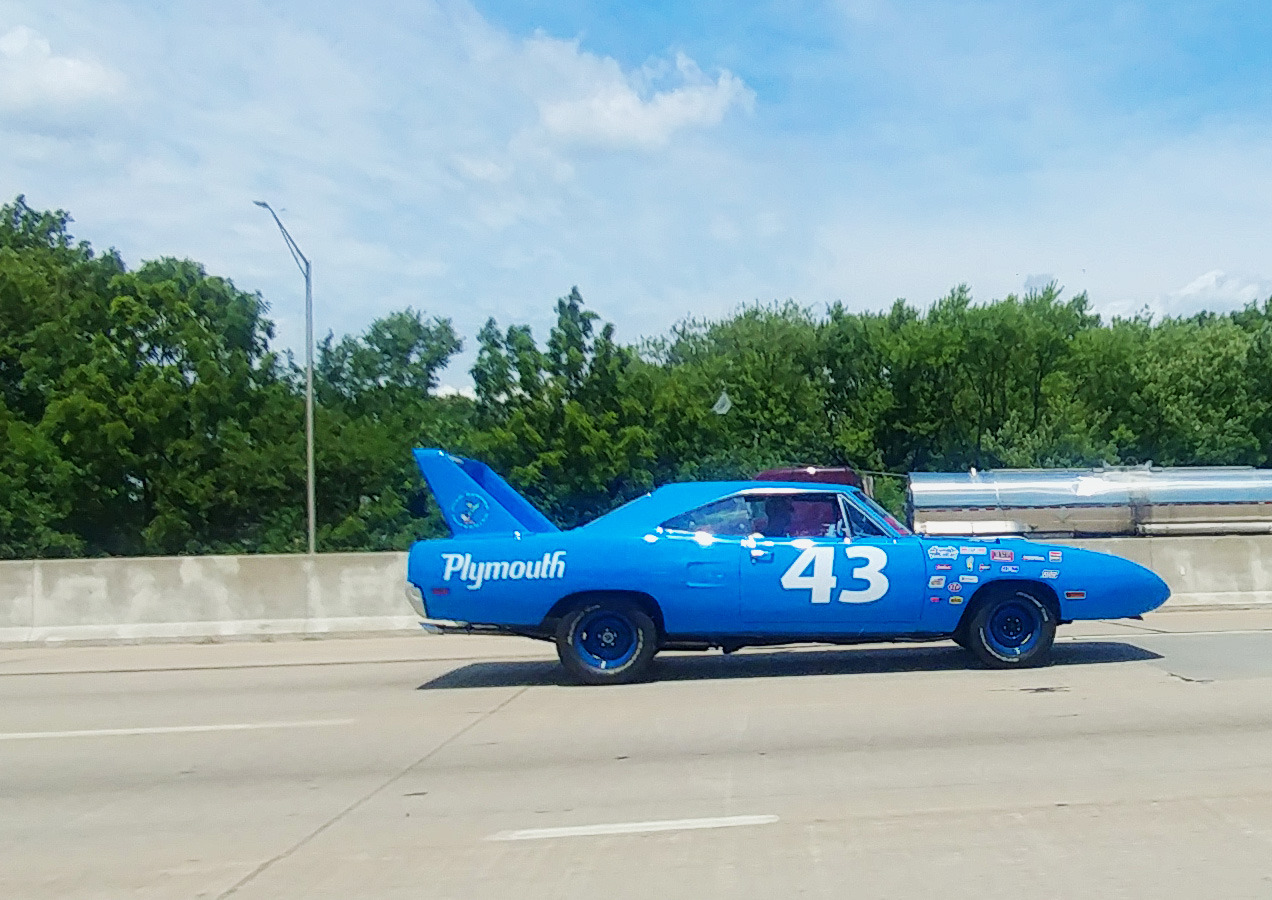
Eastbound on I-70, just east of Indianapolis, running with the usual company — sedans, a tanker throwing sun glare — and up through the traffic comes a shape my brain refused to file with the rest of them. A nose stretching out past the front wheels like a beak. A rear wing standing tall enough to see over the trailer next to it. Petty blue, big white 43 on the door, “Plymouth” written across the quarter panel in that factory script. A Superbird, out in daylight, doing exactly what it was built to do.
Original or tribute, I couldn’t tell you from the next lane over, and it barely matters. The silhouette is the whole story. And there’s only one year of it.
Now, a confession before we go further. I came up a Carroll Shelby man. Mustangs. That was my church my whole life — small car, big engine, hot to the eyes and hot to the touch. Shelby’s whole idea was that a fast car should be an overpowered little animal, and I still believe it. The Superbird is the opposite answer to the same question. Nothing about it is small. It’s a full-size Plymouth wearing prosthetics, and it got fast by cheating the wind instead of shedding the pounds. Two different churches. Both so right the rulebooks got rewritten around them.
Here’s why this thing exists. In the late sixties, NASCAR’s superspeedway wars had turned into aerodynamics wars. Ford’s slippery Torinos were winning, Richard Petty had actually left Plymouth to drive one, and Chrysler wanted him back. Dodge had already fired the first shot with the winged Charger Daytona — the first stock car past 200 mph on a closed course. Plymouth’s answer for 1970 was the Superbird: a Road Runner handed to engineers who had stopped caring what a passenger car was supposed to look like, several of them missile and aerospace men Chrysler pulled off defense work. Rockets by trade, taildragger by assignment. That lineage is all over the car if you know where to look, so let’s look.
Start at the front. A stock 1970 Road Runner meets the wind with a blunt vertical face — grille, bumper, headlights, all of it standing up in the airflow like a barn door. Drag, and worse, lift: at speed, air packing under that flat front end tries to pick the car up off its steering. The Superbird’s nose cone replaces the barn door with a wedge nineteen inches long, headlights tucked behind pop-up doors to keep the surface unbroken. The point does two jobs at once. It splits the air instead of slamming into it, and its downward rake uses the oncoming wind to press the front tires into the pavement. The engineers even added a small chin spoiler underneath and low-mounted radiator inlets, managing not just the air the eye sees flowing over the car but the air nobody sees fighting around underneath it. That’s the first lesson the car teaches: aerodynamics is mostly invisible, and most of the battle is fought where you can’t watch it.
Now the rear window. On a standard Road Runner coupe, the back glass sits recessed between sail panels, and that little canyon creates turbulence right where you least want it. The Superbird got a flush “plug” window smoothing the roofline into the deck. A detail nobody photographs, worth real speed at Talladega. Second lesson: the boring fixes are usually the profitable ones.
Then the wing, the part everybody photographs. The obvious question is why it stands two feet in the air on those swept struts instead of sitting on the trunk lid like every spoiler since. Two reasons, and they’re both good engineering. First: air coming off the roof of a car at speed is dirty — tumbling, turbulent, weak. Climb above that boundary layer and the wing works in clean, fast-moving air, where the same surface generates far more downforce. Second, and I love this one: the struts are spaced and raised so the trunk lid opens between them. NASCAR required these to be street-legal production cars, so the race part had to coexist with the grocery-getting part. The most outrageous styling element on any American production car is partly a trunk-access solution. Third lesson, maybe the biggest one on this whole page: constraint shapes design as much as ambition does. Every structure I’ve ever featured here — bridge, lighthouse, cathedral — is a negotiation between what the builder wanted and what the rules, the materials, and the site would allow. The wing is that negotiation at 200 miles an hour.
Even the fender scoops above the front wheels teach. They look like brake ducts. They’re mostly clearance and pressure relief — venting the packed air from the wheel wells and making room for racing tires. On the street cars, they’re largely cosmetic. Fourth lesson: on any machine, learn to tell which features are load-bearing and which are theater. That skill transfers to buildings, to organizations, to everything.
Add it up and the Superbird cut its drag dramatically compared to the standard body while gaining downforce at both ends — this out of a company that had to invent its methods as it went, borrowing wind tunnel time and strapping instruments to test cars because nobody had done this to a stock car before.
The results were devastating. Pete Hamilton won the 1970 Daytona 500 in a Petty Enterprises Superbird, and the winged Mopars stacked superspeedway wins all season while everyone else developed sudden strong opinions about airflow. So for 1971 NASCAR did the only thing left: wing cars could still run, but only with engines capped around 305 cubic inches — call it half a Hemi. The Superbird was never banned by name. It was regulated straight into the museum. One season at the top, and the door closed. The wing happened once, which is exactly why seeing one on an open interstate lands the way it does.
The part people forget is that nobody wanted these things new. Homologation rules forced Plymouth to build one for roughly every two dealers — a bit over 1,900 cars — and plenty sat on lots into 1971, marked down, some converted back into plain Road Runners just to move them. The nose looked ridiculous to the average buyer. The wing wouldn’t clear a garage door frame. Too much, too weird, too race. Today the survivors trade for the price of a house, and “too weird” is the line item people pay for.
Shelby’s cars got run off the street by insurance tables and emissions rules. The Superbird got run off the track by the sport it was built for. Being outlawed is its own kind of trophy, and I’d argue it’s the highest one engineering can win.
So there it went, past me and past the tanker, wing up and nose down, blue as a July sky — a rolling physics lecture in the passing lane, still teaching anybody willing to look twice.