A Promenade at the Point
Part Two of Three
Part One argued that the air over urban rivers is the last unlisted real estate in America. Part Two is about the town that should list first.
Johnstown, Pennsylvania is a city defined by water in every register — geography, economy, tragedy, identity. Two rivers, the Stonycreek and the Little Conemaugh, fall out of the Alleghenies and meet at the Point downtown, becoming the Conemaugh in the shadow of a stone railroad bridge that has stood since before the 1889 flood and stood through it, when the wreckage of a drowned city piled against its arches and burned. That bridge is lit at night now. It is the most powerful structure in the region and one of the most powerful in American memory, and the city drives past it. The town’s founding condition — rivers everywhere, flat land nowhere — reads on paper as the constraint that capped its growth. Read correctly, it is a blessing with the wrapping still on. Johnstown has more water frontage per downtown acre than almost any city its size in the country, all of it channelized, walled, publicly controlled, and structurally ready to carry something.
The primary vision
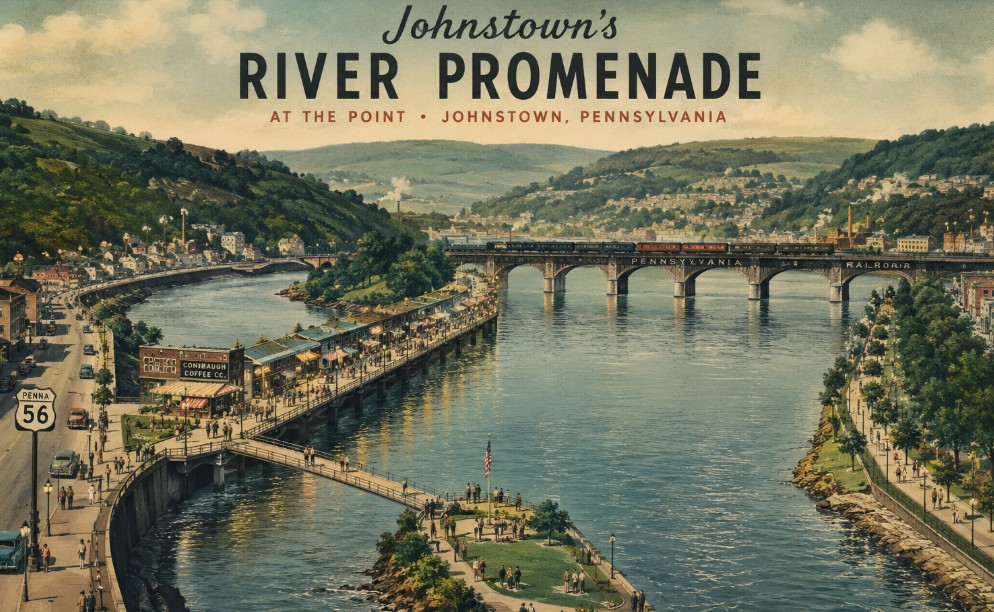
Begin at the Point. From the confluence, a broad deck runs above the Conemaugh channel, downstream, several hundred feet, and ends at the Stone Bridge. It crosses nothing. It connects the river to itself. It is a destination in the literal sense — a place you go to be at, an esplanade over moving water with the valley walls rising green on either side and the arches of the Stone Bridge framing the far end like a proscenium.
Line it. Shopfronts and stalls in the tradition of the inhabited bridge: a coffee roaster, a taproom pouring at tables over the current, gallery space, a mandolin busker with the river for a rhythm section, vendor stalls that turn over seasonally so the deck never reads the same way twice. Give it winter — glass windbreaks, fire tables, a small heated pavilion — because a promenade that closes in November is a fair-weather friend in a town that deserves better. Below deck level, ship logic holds: the soffit rides above the design flood profile, spans bear behind the channel walls, the lowest chords are detailed to shrug off ice and high water, and nothing on the structure can become debris.
The terminus is the point of the whole composition. The walk ends at an overlook facing the Stone Bridge head-on, at deck height, closer than any public vantage has ever offered — the arches, the lighting, the water passing through. The bridge finally gets what monuments require: an approach. Every evening the promenade delivers people to it, and the 1889 story is told standing over the same water that told it first.
The economics are the Part One mechanism, applied. The channel air rights belong to the public; the ground leases from every stall and storefront flow to a public landlord; the lease revenue is earmarked for facade and stabilization work in the historic downtown a block away. The promenade is brand-new commercial real estate that displaced nothing, and its rent renews the old city that surrounds it. New Johnstown pays for old Johnstown, forever, by design.
The second span
A destination is only as strong as its connections, and downtown Johnstown’s problem has never been what it contains — the Flood Museum, the arts scene, Central Park, the architecture — but how its districts are stitched together. So the plan’s second move is a true crossing: an inhabited footbridge over the Little Conemaugh near the museum and festival grounds, linking the downtown core to the north bank and onward toward Cambria City, the Heritage Discovery Center, and the churches and social halls of the immigrant neighborhoods that built the steel.
This one is shorter, more intimate — a covered gallery bridge, shops on both sides of a center walk, in the lineage of Erfurt’s Krämerbrücke, where people have lived and traded on a footbridge for six hundred years. Its job is circulation: it converts three districts separated by water into one walkable loop. Museum to promenade to Point to Stone Bridge overlook to festival park to Cambria City and back, never once crossing traffic, always over water. Festival days — Thunder in the Valley, the music festivals, the ethnic celebrations Cambria City has kept alive for a century — the loop becomes the midway. Vendors already travel to this town by the hundreds; the loop gives them the best addresses in the county, and gives every visitor a reason to walk farther than they planned.
The valley advantage
Here the argument widens, because Johnstown’s situation is not one river but a system. The Stonycreek and Little Conemaugh gather a whole watershed of tributaries through the surrounding boroughs — every one of those communities pressed into its own narrow floor by the same topography, every one holding walled or bankfull frontage it has written off as dead edge. The mountain valley that limits conventional growth in Ferndale, Dale, Westmont’s foot, Franklin, East Conemaugh, and the rest is the same valley that hands each of them an over-water option no flatland suburb possesses. A market pavilion above a creek here; a workshop deck there; a green crossing reconnecting a hillside neighborhood to its main street. The promenade at the Point is the flagship, and it is also the proof of concept for a regional pattern: in this valley, the rivers are the land bank.
That is the reframe the whole vision rests on. For a hundred and thirty years Johnstown’s water has been narrated as the thing that takes — the flood, the walls, the buyouts, the flat land it hoards. The engineering that followed 1889 and 1936 turned the channels into some of the most disciplined urban waterways in America, and disciplined waterways are exactly the foundation system Part One described. The constraint did the hard work already. What remains is to build the deck.
Stand at the Point some evening and look downstream at the lit arches. The rivers meet, the water goes where the walls have agreed to send it, and above the current there is a volume of empty air exactly the size of the town’s next chapter, waiting for someone to notice it is for lease.