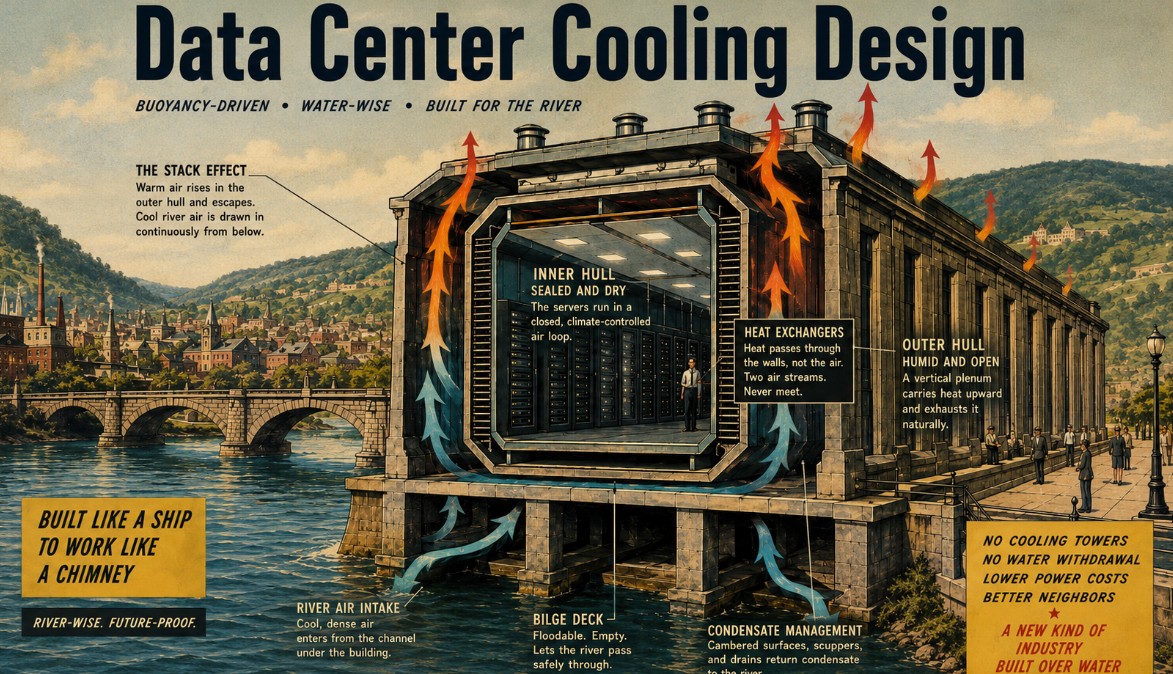
The Double Hull
Part Three of Three
Part One claimed the air over urban rivers as the next land rush. Part Two put a promenade on it. Part Three puts industry on it — one industry in particular, because the fit is so exact it reads like the buildings were waiting for each other.
The data center is the defining industrial construction of this decade, and it arrives everywhere with the same two problems. The first is thermodynamic: a large facility is a machine for converting electricity into heat, and removing that heat is the second-largest operating cost after the electricity itself. The second is civic: the standard solutions to the first problem make data centers terrible neighbors. Evaporative cooling towers drink millions of gallons of water a day in the same drought-stressed regions where cheap land pulls these projects. Chiller plants add double-digit percentages to an already enormous power draw. Communities have noticed, and siting fights over water and grid capacity now stall or kill projects that looked bankable on paper. Half of the industry’s implementation problem is cooling — its cost, its water, and the opposition both generate.
The river already solved this problem once. Mills sited on water for wheels and shipping; the water was the power. The data center should site on water for a subtler asset: the permanent layer of cool, humid air that sits on a river’s surface, several degrees below ambient on a summer afternoon, renewed continuously and free of charge. The building that harvests that layer needs a specific architecture, and shipbuilders have been drawing it for two centuries.
The architecture
Call it what it is: a double hull. An inner hull — the sealed server hall, climate-controlled, bone dry, running its own closed air loop past the racks. An outer hull — the weather shell, standing over the channel on spans that bear behind the walls. And between them, the whole point of the design: a continuous plenum, a vertical channel wrapping the server hall, open to the river air at the bottom and to the sky at the top.
The two air masses never meet. They are coupled through the inner hull’s walls, which are built as radiators — fin arrays, plate exchangers, whatever the heat-transfer engineering favors — that conduct heat outward while passing no air and no moisture in either direction. The dry loop inside picks up heat from the servers and sheds it into the fins. The wet loop outside picks up heat from the fins and carries it away.
What carries it away is the elegant part: the heat itself. Air warmed at the fins becomes buoyant and rises up the inter-hull channel, exhausting at the roofline, and its departure pulls fresh cool river air in through the underside continuously. The server load powers its own draft. This is the stack effect — the physics of every chimney and every termite mound — scaled to an industrial envelope, and it means the primary air-moving energy bill approaches zero. Fans remain for trim and for still, hot days, spinning at a fraction of the duty they’d carry in a conventional plant. No cooling towers, no chiller yard, no water withdrawal. The facility’s heat leaves as warm air aloft, and the river below it is neither drunk from nor warmed.
The marine detailing follows from the marine name. The wet channel is a permanently humid space and is built to be one: cambered surfaces shedding condensate to scuppers, bilge runs at every level collecting it and draining it home to the river, coatings and fasteners specified for a boat rather than a warehouse. The lowest level is a true bilge deck — floodable, sacrificial, empty of electronics — so the flood of record passes through the structure’s ankles instead of its heart. The double hull earns its name twice: once as a thermal machine, once as the compartmentalized, water-wise construction logic that lets it live over a river indefinitely.
The cost dynamics
Industry measures cooling efficiency as power usage effectiveness — total facility power divided by computing power. Conventional plants run meaningful overhead; the best free-air-cooled facilities in cold climates have driven it close to the floor, and they did it with fan walls and favorable weather. A buoyancy-driven double hull over water in a cool Appalachian valley pursues the same floor with less machinery: the coldest reliable air source in the landscape, a driving force that scales automatically with the heat load, and a water bill of zero. Cooling is the difference between a data center penciling and dying in half the markets it looks at. Change that line permanently and you have changed where these buildings can go — and who they can belong to.
Honesty about the engineering, because a concept paper that hides its problems is an advertisement. Winter brings icing and condensation freeze at the exchanger surfaces; the design answer is exhaust-side recirculation to temper intake air, the same trick every cold-climate air handler uses. Shoulder seasons bring fog and saturated air with less cooling headroom; fan trim covers the gap. The humid channel is a corrosion budget, permanently, and is priced as one. And a very humid heat sink is a less efficient heat sink than dry desert air — the double hull gives some of that back in exchange for eliminating water consumption entirely, and in an era when the water bill is the siting fight, that trade wins.
Whose machine it is
Part One’s mechanism completes the argument. The channel is public. The air rights are public. A double-hull facility over a walled river pays its ground lease to a public landlord before any further policy is written — and further policy is available. A state or municipality that owns the facility outright, leasing capacity to operators the way a port authority leases berths, converts the loudest infrastructure controversy in the country into a dividend: revenue to the residents, cooling from the commons, heat to the sky, and a river underneath left exactly as it was found. The waste heat itself is a second product waiting for a customer — greenhouse fertigation, district heat, aquaculture, all of them natural tenants for the adjacent decks.
Three parts, one doctrine. The air over the water is land. The promenade proves it can host a town’s public life; the double hull proves it can host a town’s industry; and the mountain valley that was told for a century it had no room to grow turns out to hold, between its channel walls, the ground floor of its next economy — cool, load-bearing, and already zoned by gravity.