THE GRAY HULL DIVIDEND: The Navy Is Retiring a Data Center Fleet
An expansion of the over-river data center concept
The forecast: why the hulls are coming
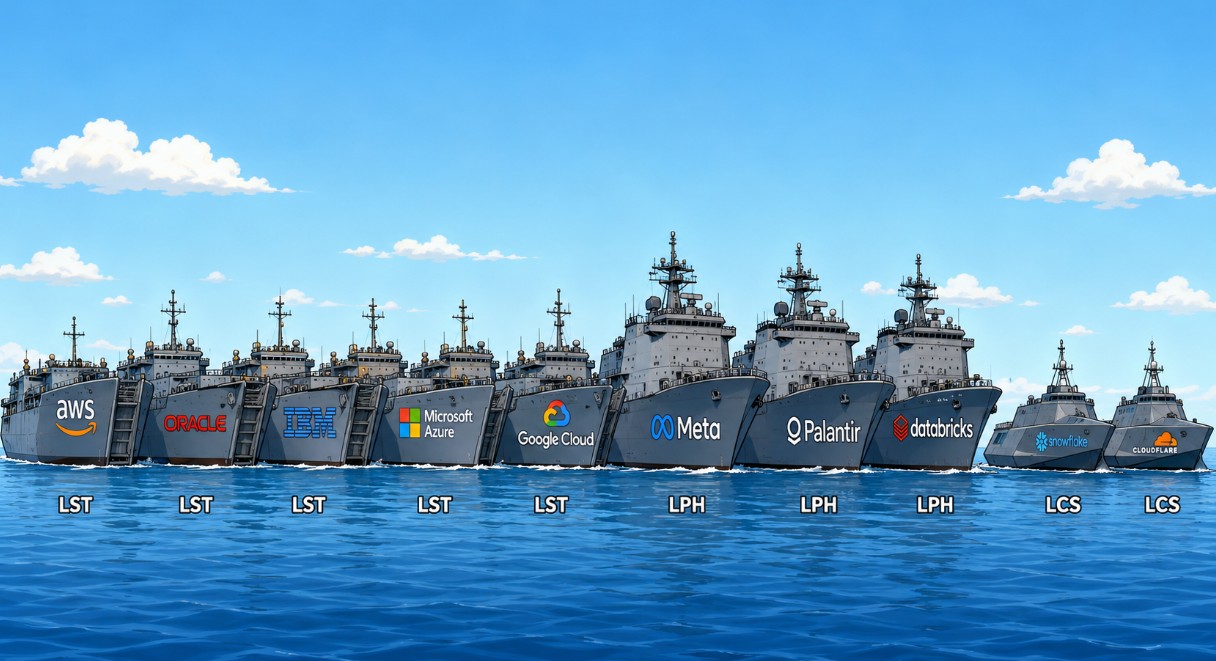
Naval architecture is being repriced by three technologies at once. Precision anti-ship missiles have made large, concentrated amphibious ships — the descendants of the LST and LPH lines that once put whole battalions across hostile beaches — too valuable to risk close to shore, and the Marine Corps has rebuilt its doctrine around small, distributed units and smaller landing ships accordingly. Unmanned surface vessels are absorbing missions that once justified crewed hulls. And the littoral mission itself has been re-scoped so thoroughly that the Navy is discarding nearly new ships to escape it.
The result is a disposal wave running in two streams. The first is the expected one: the dock landing ships aging out on schedule. USS Fort McHenry was decommissioned in 2021, USS Whidbey Island in 2022, with Germantown, Gunston Hall, and Tortuga proposed to follow, and Germantown will be decommissioned by September 2026. The second stream has no precedent. The nine Freedom-class Littoral Combat Ships in Navy service — the youngest commissioned in 2020 — were marked for disposal in the FY2023 budget. Detroit and Little Rock decommissioned on the same day in Mayport, both well under ten years old, leaving the fleet two decades before the end of their design lifetime — each ship cost approximately $350 million to build. Fort Worth decommissions by July 2026 and will be scrapped.
Read that last clause again. A nine-figure hull, fifteen years young, structurally sound, with functioning generation and seawater cooling plant — scrapped. Others get expended as gunnery targets and sunk. This is disposal outrunning imagination, and it will continue for a decade as the whole gator lineage cycles out ahead of the drones and missiles replacing it.
Proof of concept: the barge in Stockton
The over-river paper established the thermodynamics: data centers are heat engines run backward, the costliest subsystem is heat rejection, and water beats air at that job by an order of magnitude. Industry has since validated the claim in steel. Nautilus Data Technologies has operated a 7-megawatt data center on a converted 90-meter barge at the Port of Stockton since 2021, using San Joaquin River water as its cooling loop at a power usage effectiveness of 1.15 — hyperscale-grade efficiency. River water passes through a heat exchanger against a sealed interior loop; it never touches a server, nothing evaporates, and the water returns to the river roughly four degrees warmer. Eliminating chillers and cooling towers cuts capital enough to translate into roughly 30 percent customer savings, and the facility supports rack densities up to 100 kW against the 5–10 kW typical of land-based halls — the densities that AI workloads now demand and air cooling cannot serve at any price. The design cleared certification from multiple federal and state agencies including the California Department of Fish and Wildlife, and as Nautilus’s own customers observe, the intake and filtration technology has been used for decades in power plants, submarines, and aircraft carriers.
That last sentence is the entire argument in miniature. The industry’s newest cooling architecture is the Navy’s oldest, and the Navy is throwing away the ships that have it installed.
What a warship already is
Consider a Whidbey Island–class dock landing ship stripped of her mission. Sixteen thousand tons of steel built to military survivability standards. A well deck — a covered, drainable, climate-controllable interior volume designed to flood and pump dry on command, which is to say a space engineered from the keel up to keep sensitive cargo bone-dry inches above open water. Engine rooms with sea chests, raw-water intakes, pumps, and heat exchangers sized to cool main propulsion diesels — the identical plumbing a waterborne data center needs, pre-installed and rated for decades of continuous marine duty. Redundant electrical distribution, watertight compartmentalization, certified fire suppression, and berthing for a crew far larger than any data center staff. The armament and mission systems come out; the racks go in where the landing craft used to ride.
A greenfield hyperscale facility runs $10–12 million per megawatt before a single server arrives, with the shell and cooling plant consuming most of it. The ship is the shell and the cooling plant. The complete Stockton facility was recently listed at $45 million — and that barge had to be built. A reserve-fleet hull is already built, already paid for, and currently costs the public money to keep pierside.
Power: the engine room inverts, the flight deck earns
The engine spaces convert to backup and black-start plant rather than primary generation — diesel is the most expensive electricity a facility can buy, and shore power carries the base load. Every data center on earth must construct diesel backup anyway, in dedicated structures, with separately permitted fuel storage. The ship arrives with hardened generator rooms, bunkers measured in hundreds of thousands of gallons, and fire suppression certified for exactly that hazard. A seven-figure line item, included in the hull.
Topside, the flat decks that made these ships aviation platforms make them generation platforms. An LSD offers roughly an acre of unobstructed, load-rated surface; fitted with panels, that is a megawatt-plus of peak solar — supplemental power, honestly stated: it carries house loads, controls, and life safety rather than racks, shaving overhead draw. The deck edge offers a second effect familiar to anyone who has stood watch topside: hull and superstructure compress and accelerate the wind crossing the deck, and low-profile capture along those edges adds to the margin. Neither replaces shore power. Both improve the arithmetic on surface area the ship provides for free.
The cold water doctrine
Every candidate mooring can be scored on three numbers: how cold the intake water runs, how fast the body exchanges it, and how deep the intake can sit.
Cold sets the capacity. The discharge permit caps outlet temperature, so every degree colder at the intake is another increment of heat rejection allowed per gallon pumped. Flow sets the sustainability. Moving water disperses the plume and refreshes the sink; a strong current shrinks the measurable thermal footprint to a rounding error downstream. Depth sets the reliability. Water below the thermocline holds its temperature through the hottest months, so cooling capacity refuses to sag in August, precisely when the facility needs it most.
Three numbers, all public, all measurable. Any port authority can score itself. Three worked examples show the range.
Superior: the freshwater benchmark. The largest freshwater body on earth by surface area, and the deepest and coldest of the Great Lakes, holding water near 40°F every day of the year, with vigorous circulation and the largest freshwater port in North America at its western end. A facility moored at Duluth–Superior approaches the thermodynamic ideal — cold enough that ambient air does half the cooling work most of the year, in a port ringed with heavy electrical infrastructure built for taconite and grain, with fiber running the old rail corridors. The benchmark is a measuring stick rather than an address, but it is a measuring stick with excellent pier frontage.
Puget Sound: where every element already stands on one shoreline. A glacial fjord system holding 45–55°F at depth year-round, flushed twice daily by tidal exchange moving cubic miles of water, with basins running hundreds of feet deep — maximum marks on all three numbers, and it never ices. Then the convergence: the inactive fleet is moored in the Sound right now at Bremerton, surrounded by the drydocks and marine trades a conversion requires, so the tow from Navy liability to operating facility is measured in yards. Shore power is Bonneville hydropower, among the cheapest and cleanest baseload on the continent. Kitsap County discharges shipyard trades and Navy engineers into the labor market every year within sight of the pier. And across twenty miles of water sit the companies that substantially invented hyperscale computing, currently signing nuclear-restart deals and bidding up greenfield land because they have run out of conventional capacity — while the Navy scraps fifteen-year-old hulls within view of their headquarters. Everywhere else, some leg of the stool has to travel. At Puget Sound, the water is already surrounded. The debits are equally maximal and stated plainly: saltwater corrosion and biofouling demand ongoing hull husbandry; thermal discharge among listed salmon and orca triggers the hardest permitting in the nation; and the treaty tribes hold adjudicated rights throughout these waters — co-managers of the resource, and the first partners any serious proposal approaches rather than a box in the comment period.
The industrial rivers: the permittable workhorse. The Ohio system, the Monongahela, the Delaware, the lower Mississippi trade warmer summer intakes for enormous, permanent flow — and that trade is the one already proven permittable, because Stockton made it on the San Joaquin. Warmer water means designing to a tighter thermal budget per site; it excludes nothing. These waterfronts carry heavy-duty electrical infrastructure from the industries that left, deepwater frontage nobody is bidding on, and populations that never stopped knowing shift work on big machinery. A converted gray hull moored at a brownfield pier is a data center, a backup power station, a solar array, and a visible promise that the waterfront works again — and the people who ran these engine rooms at sea are the natural people to run them at the pier.
Two fleets, two moorings
The St. Lawrence Seaway sorts the fleet by geometry. The locks admit nothing wider than 78 feet; a dock landing ship carries 84 feet of beam and will never see the Lakes. But the Freedom-class LCS carries 57 — and was launched into fresh water in the first place, built at Marinette, Wisconsin, and delivered to the ocean through the very locks in question. The retirement voyage is a homecoming. The nearly new LCS hulls can reach any Great Lakes pier from Erie to Thunder Bay, a flotilla of single-digit-megawatt modules for the coldest water on the continent — a row of them along a Superior pier is a distributed campus with organic backup generation, delivered by water, on ships the public already bought. The wide-beam amphibs take the coastal and river moorings, from Bremerton to the Ohio, where the flow doctrine holds and the brownfield grid connections wait. Every hull has a qualifying pier.
The public-power close
Here the concept joins the Data Center Dividend. The dividend model — publicly owned compute returning revenue to residents on the Alaska Permanent Fund pattern — has always faced one honest objection: capital. A state cannot lightly bond a greenfield hyperscale campus. A state, port authority, or bi-state compact can far more plausibly take title to a surplus hull the Navy is currently paying to store, sink, or shred, tow it to a pier, and connect shore power and fiber — Stockton’s barge needed about 48 hours pierside to make those connections and come online. Public hull, public water, public power, public revenue. The scoring metric is published; the waterfronts can compete.
The objections, standing watch
Hull condition. The LSDs need survey and remediation after four decades — real cost, known cost, a fraction of new construction. The LCS hulls are practically new; that is the scandal and the opportunity in one sentence. Thermal discharge. The binding constraint at every site, hardest in cold pristine waters, and the answer is the Stockton architecture — closed loop, zero consumption, zero chemicals, small delta-T into large volume — designed to the permit from day one, with the permit sizing the facility rather than the reverse. Transfer pathway. Federal disposal law defaults to scrapping, target sinking, and foreign sale; a conversion pathway takes MARAD program action or a line in an authorization bill. A published, timestamped concept paper is how that ask enters the record. Winter. The northern sites ice; the ships were built for the North Atlantic, a moored facility heats itself by definition, and the cold is the business model.
The close
The LST and LPH lines existed to deliver power ashore. Their successors are being retired by drones and missiles at ages ranging from honorable to embarrassing, and the standing plan for them is target practice and razor blades — while twenty miles from the mothball rows, the largest computing companies on earth pay premium prices for exactly what these hulls contain: hardened structure beside cold moving water, marine cooling plant installed, backup generation fueled and certified. The fleet is retiring either way. Don’t sink it. Score the water, pick the pier, and plug it in.