Everybody who has ever crossed this thing calls it the Big Mac, and everybody who calls it that is telling on themselves a little. Yes. It’s yellow. Yes, there are two arches. Congratulations to the entire tri-state on noticing. McDonald’s noticed too — in the eighties somebody there floated the idea of putting a restaurant on the water at the foot of it, which never got built, and thank goodness for that.
Here’s what bothers me about the nickname. The people of Northern Kentucky and southwest Ohio were handed an actual say in what this bridge would be called. The state ran a poll in 1976, seventeen thousand ballots came back, and better than half of them said Daniel Carter Beard — a Covington boy who founded the Sons of Daniel Boone and helped found the Boy Scouts of America. It’s believed to be the first time a major interstate bridge got its name by popular vote. The public earned that name. Then the public turned around and called it a hamburger.
Fine. Let’s look at what’s actually up there.
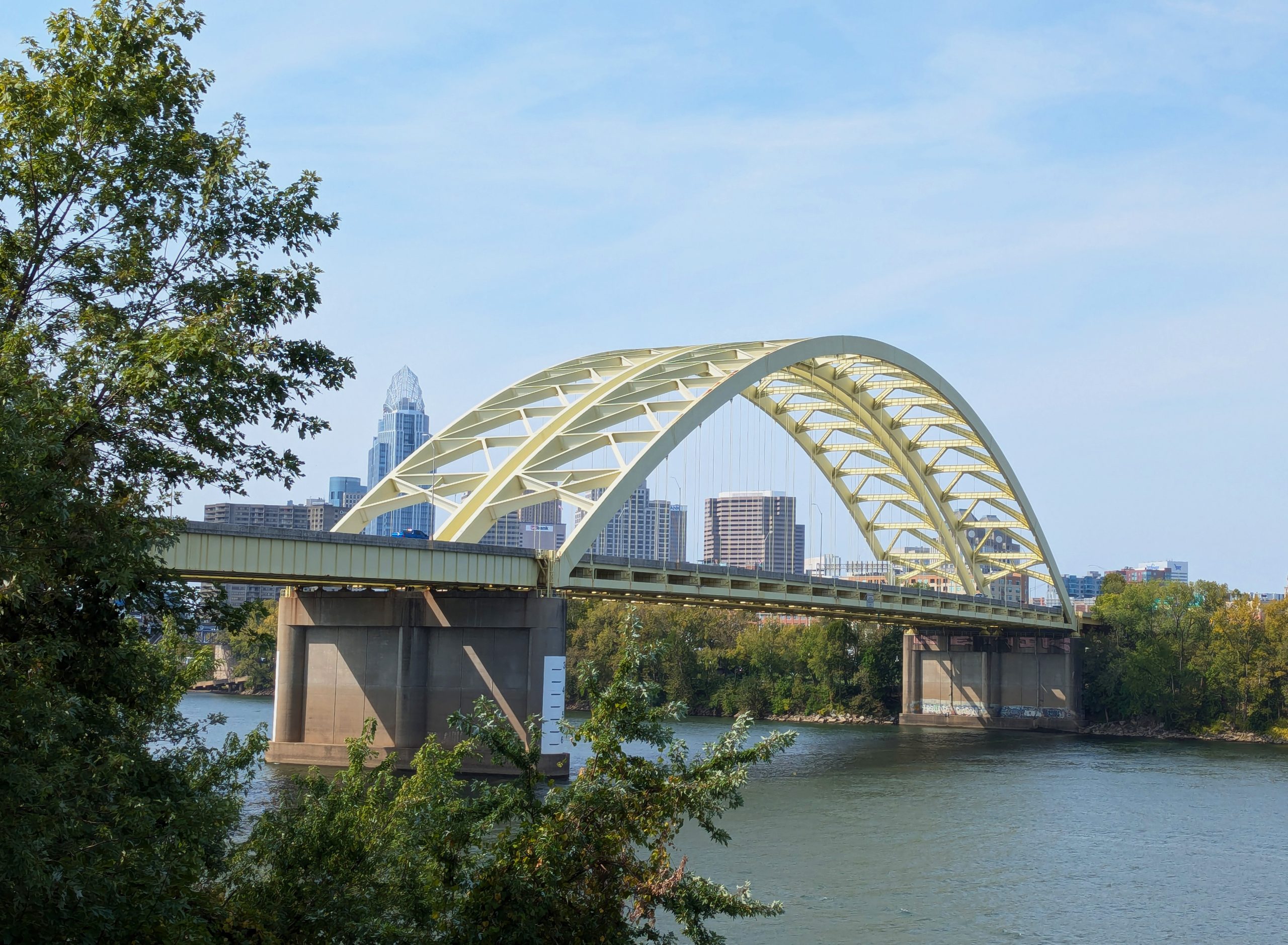
What you’re seeing from the Kentucky bank is a tied arch, sometimes called a bowstring. An ordinary arch pushes outward at the base. Load it at the crown and both feet want to slide apart, so you have to anchor them into something that will not move — bedrock, a masonry abutment, a hillside. Out in a river, over soft ground, with a navigation channel that has to stay open, that kind of foundation gets expensive to build and stays expensive to keep.
The bowstring takes care of the spreading up top. The deck is the string. That roadway is in tension across the whole length of the span, pulling the feet of the arch toward each other as hard as the arch is pushing them apart. What arrives at the pier is straight-down weight. Which is why the piers in the photo look the way they do — squat gray boxes with a river gauge painted up the side, holding one simple thing.
I like that arrangement more than I like most suspension work, and I’ll take the argument from anybody. The Roebling gets the postcards, the engagement photos, and the walking-tour traffic, and I won’t pretend the Roebling doesn’t deserve it. This one carries something like ninety-eight thousand vehicles a day and asks for nothing. Look at the bracing between the ribs, that ladder of struts running the crown. Every member up there keeps the arch from buckling sideways under its own compression. From four hundred yards the pattern reads as ornament. There isn’t a decorative pound of steel in it.
Now the part I actually came here to tell you.
The arch ribs run about 760 feet and stand close to 160 feet off the deck. To put something that size over moving water you first build a temporary structure underneath it — falsework, towers of timber and steel holding every piece in position until the arch can carry itself. Then it comes down and goes away. Two spans ordinarily means raising all of it twice.
The crew finished the first arch in August of 1974. Rather than strike the towers and put up a second set alongside, they jacked the completed arch sideways. Seventy feet, nine inches upstream, in about five hours, standing the entire way. Then they built the second arch on the same falsework and left it where it landed.
Seventy feet and nine inches. Somebody worked that to the inch before a jack came out of the truck. The bridge cost fourteen million dollars and went up between November of 1971 and the fall of 1976, and part of how it came to sit where it sits is that the towers only ever had to be built once.
Look at the near pier again. There’s a stage gauge painted down the face of it, numbers stacked so somebody on the bank can read the river at a glance. That’s a manmade object too, and the humblest one in the frame — no award, no nickname, no ballot. A ruler on a wall, because the water needed measuring. Out past it, the second pier is wearing graffiti up to about the height a determined person can reach. I’ve got less to say about that than you’d expect. A bridge in a city gets written on. It has been getting written on since the first one went up.
I took this photo on the twelfth of October, 2024, on a warm afternoon with the haze still sitting on the skyline behind it, and I had no idea I was photographing a countdown. Three weeks later, on the first of November, a fire went up underneath the Cincinnati end near Sawyer Point. Around ten million dollars of damage. Four people in front of a judge. The southbound span closed for a hundred days and came back on the ninth of February, a month ahead of what anybody had promised.
Fifty years on, and the thing still gets up after being knocked down. Call it whatever you want.