I spent most of a Tuesday in a county courthouse over a matter so small I am embarrassed to name it: eleven feet of ground, a fence line set by a man who has been dead since the Ford administration, and a deed that describes a walnut tree nobody has seen in forty years. These things take a morning to explain and a decade to settle. I brought a book and drank the coffee they sell in the basement, which tastes like a filing cabinet.
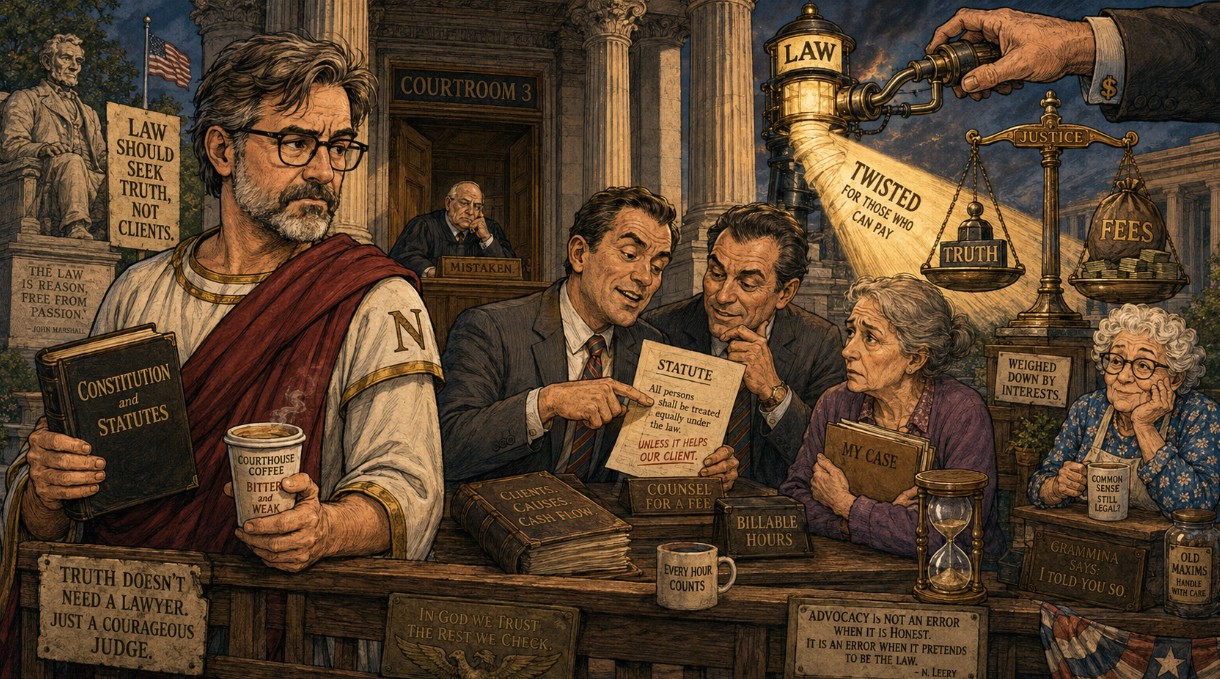
While I waited, two attorneys worked out a settlement on the bench across from me. Neither was doing anything improper by the visible standard — no shouting, no theater, ties still knotted. One of them told the other what the statute required. He said it plainly, the way you’d give someone the time.
It was not what the statute required. I knew because I had read that statute at my kitchen table three weeks earlier for reasons of my own, and its plain language runs the other direction.
The other lawyer did not check. His client, a woman in her sixties holding a folder against her chest the way you hold a child’s hand in a parking lot, had no way to check. The sentence stood. The matter settled on it. Everyone shook hands and went to lunch, and the law of Pennsylvania, as applied to that woman on that morning, was whatever a man in a gray suit said it was on a bench outside Courtroom Three.
There is a difference between arguing that a law should mean something and stating that it does. The first is advocacy, and a free society cannot function without it; someone has to press the unpopular reading, the narrow exception, the interpretation that has not yet occurred to anyone. The second is a factual claim about the world, and it is either true or it is not.
Our profession’s own phrase for itself is officer of the court. That phrase is doing work. It means the duty runs past the person writing the check — that when an attorney tells a judge or an opposing party what the law holds, he is standing in for the institution itself, and the institution has no client.
We have let that phrase go soft. Strenuous argument and comfortable misstatement have grown together in the same row until you cannot tell which is which without pulling one up by the root.
In March of 1770 a crowd on King Street pressed a squad of British regulars, and when the smoke cleared there were bodies in the snow. Boston wanted a hanging. No one would take the soldiers’ case, and everyone understood why not.
John Adams took it. He was thirty-four, he had a young family, and he had a practice built on the goodwill of the very town that wanted those men dead. He lost better than half that practice, by his own reckoning, and he expected to.
What matters for my purposes is what he did with the case once he had it. He did not manufacture a witness. He did not misstate the law of homicide to a jury that would have swallowed anything he fed it in either direction. He argued self-defense on the evidence, and he told those jurors that facts are stubborn things — that our wishes and our inclinations do not move them. Six men walked free. Two were convicted of manslaughter. Adams later counted the defense among the best services he ever rendered his country, and the town that despised him for it sent him to the legislature the following year.
He won by being the most accurate man in the room. That is the whole lesson, and it is not a comfortable one, because accuracy is available to anybody and costs nothing but nerve.
Now consider the modern version, which arrives dressed as an accident.
A holding cited for the reverse of what it held. A deadline described as jurisdictional when it is merely procedural. A regulation characterized in a negotiation with a confidence that the text does not support. When these are caught — and most are never caught — the remedy is an amended filing, a footnote, a note to chambers regretting the oversight.
I have no doubt that some of them are honest mistakes. Lawyers are tired people reading long documents late.
But mistakes have a shape. Real ones scatter. These do not. In thirty years of watching this, I have yet to see an attorney’s misunderstanding of the law accidentally damage his own client’s position. The errors run downhill toward the fee. Soil does not erode uphill, and neither does this.
The bench is not innocent here, though I would put it more gently than most. A judge who states on the record that counsel misrepresented the law has started something: a grievance, a hearing, a durable quarrel with a firm that appears before him every week and whose partners fund retention campaigns. The cheaper sentence is counsel is mistaken; let’s move on. Said often enough, that sentence teaches the room exactly what it needs to know.
Underneath it all sits the billing structure, which pays for contest rather than correctness, and pays best of all when the contest is long and the client is a corporation with a legal department that treats litigation as weather.
And above it all, on cable, sits the man who lost his license and gained a following — who converted disbarment into a speaking fee and a book advance. The bar was meant to be a floor. For a certain kind of man it has become a stage door.
I should say that I have no standing to be pious about this. I have written consulting memos where a projection was described as a finding because finding moved the room and projection did not. I have cited a study I read to the end of the abstract. No one was under oath and no one was harmed that I know of, but the machinery was identical: I wanted an outcome, and I let a word do work that the evidence had not earned.
The difference is that nobody hands me a license and calls me an officer of anything.
The productive question is what a person could actually change, and I think the answer is smaller than the problem sounds.
Put representations of law in writing during negotiation, not only in filings. A sentence spoken on a courthouse bench costs nothing to walk back; a sentence a man had to type is a sentence he has to own.
Let judges name a misstatement on the record without treating the naming as a sanction. No hearing, no referral, no career. Just the words that is a misstatement of the holding and a transcript that keeps them. A record like that accumulates, and reputations in a courthouse are built out of exactly that kind of sediment.
And let the profession treat a misstated holding the way it treats a misstated fact — correctable by opposing counsel as a matter of routine, without the correction being received as an attack on a man’s character. Right now, calling out a false statement of law reads as an accusation. It ought to read as housekeeping.
None of that requires a statute. It requires a profession deciding that it wants to be the thing its own vocabulary claims it already is.
Grammina had a line about this, which she attributed to Cicero and which I am fairly certain came from her father, a Dutchman who distrusted anyone paid by the hour. A man whose trade is telling the truth, she said, shouldn’t be the one charging extra for it.
The law is supposed to be the light we steer a society by. A light held by men who are compensated for the angle of the beam is not a light. It is a searchlight, and searchlights are for finding things that are trying to get away.
A republic can endure bad laws. It cannot endure men who are paid to misremember the good ones.