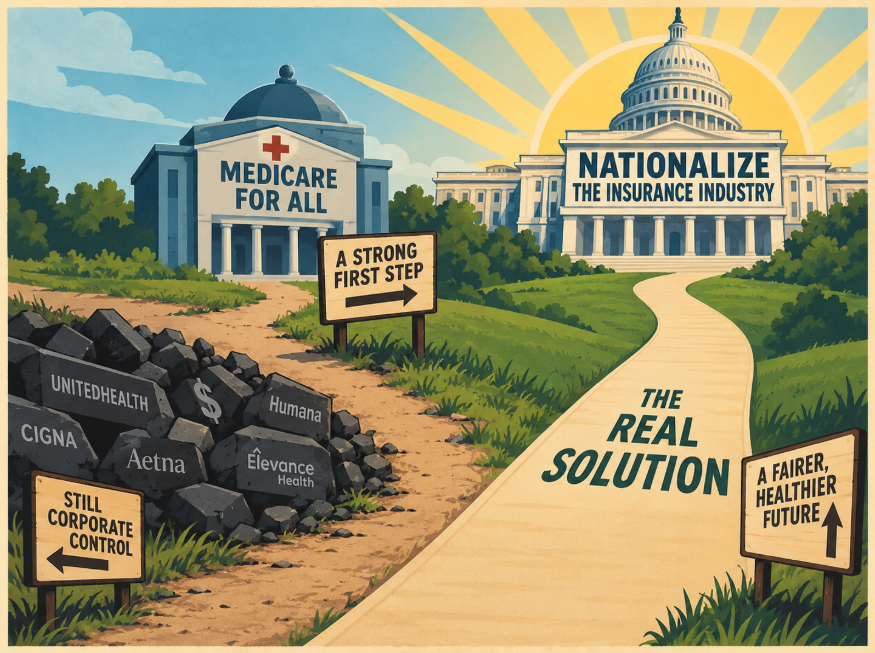
The right is arguing about the wrong door,
and the left is knocking on it too politely
There is a version of the health care argument where the right wins, and it goes like this: if you nationalize health insurance, you destroy an industry. You eliminate hundreds of thousands of jobs, wipe out shareholder value, and hand a functioning market to the same government that runs the DMV. Whatever you think of the morals, the disruption is real, and the people making that argument are not lying about it.
I want to take that objection seriously enough to follow it somewhere neither side has gone.
Because the objection contains an admission. It concedes that health insurance is an industry large enough that removing it would restructure the American economy. That is a strange thing to say about a business whose product is a promise to pay a bill. And once you say it, you have to answer the question it raises: what exactly did we let this industry become, that unwinding it counts as an economic event?
The answer is that we let it become infrastructure. And if that is true of health insurance, it is true of the rest of insurance, and it is true of banking, and Medicare for All is a proposal to nationalize one hallway of a building we do not own.
What insurance actually is
Strip the industry down and the mechanism is simple enough to teach a child.
A thousand households each face a small chance of a ruinous loss. Individually, none can carry it. Pooled, the group can predict its annual losses within a few percent, because variance shrinks as participation grows. The pool converts catastrophe into a line item.
Notice where the useful thing comes from. The certainty is produced by the aggregation. It is a property of the group. It did not exist before people were pooled and it belongs to nobody in particular afterward. An insurance company organizes that pooling and administers it, and for that work it deserves to be paid.
What happens instead is that the surplus generated by the pool is extracted from the pool. In American property and casualty, roughly sixty-five cents of the premium dollar returns to policyholders as claims. About thirty cents runs the apparatus. And that apparatus does not reduce anyone’s risk. Underwriting decides who gets in. Adjusting decides who gets paid. Litigation is denial on appeal. Advertising is a fight over which pool you join. Commissions move you between pools, which does nothing about whether your house burns.
We know the extraction is optional because the same math runs without it. Mutual insurers, cooperatives, fraternal societies, the P&I clubs that cover global shipping — identical pooling, identical arithmetic, surplus returned to members. The stock insurer is a mutual with a valve installed on the outflow.
That is the small version of the argument. Here is the large one.
The second business
Premiums arrive before claims are paid. On long-tail lines the gap can run a decade. During that interval, the pool’s money is investment capital.
An insurer that merely breaks even on underwriting has been handed a revolving, interest-free loan by its own customers. Measured by profit margin, insurance is unremarkable. Measured by capital controlled against capital owned, it is in a category with almost nothing else in the economy.
That money goes somewhere, and a great deal of it goes into private equity and private credit, where insurance general accounts sit among the largest limited partners in the asset class. Those funds, in turn, own the businesses on the far side of the claim: the claims-technology platforms, the repair consolidators, the healthcare infrastructure, the service vendors.
The traffic runs both ways. Apollo took Athene. KKR took Global Atlantic. Blackstone built an insurance mandate business. Private equity has been buying annuity and life writers precisely because insurance supplies unusually persistent capital that a fund can deploy at its own discretion.
So the premium dollar collected against your hazard is lent to the companies that will price the damage when your hazard arrives. Money leaves as float and comes back as carry.
And it is all clean. A limited partner position is not control of a portfolio company. Nothing is disclosed as a related-party transaction. No regulator has a conflict to point at. The carrier can say truthfully that it does not own the vendor that valued your car. The vendor can say truthfully that no carrier controls it. Both statements are accurate, and the returns land in the same account. Nobody has to own anybody, and no meeting has to occur. Everyone behaves rationally inside the incentives they were handed.
The part that makes it governance
Here is where this stops being a story about somebody taking too much of your money.
An insurance company is party to no transaction it profits from. It does not build the house, repair the car, manufacture the part, lend the mortgage, or treat the patient. It sits upstream of those transactions and holds pricing influence, routing authority, or outright veto over money moving between two parties, neither of which is it.
A property carrier affects whether mortgage capital enters a neighborhood at all. A liability carrier affects whether a contractor can take a project. A malpractice carrier affects where a physician can practice. An auto carrier determines which shop does the work, whether the part is original or aftermarket, whether your car is repaired or written off, what it was worth, how many days of rental get funded, and where the wreck lands in the secondary parts market.
And in health care the shape is impossible to miss. A patient needs treatment. A physician is willing to provide it. A hospital is willing to host it. Money exists to pay for it. And a fourth party, present at none of that, says the transfer is not authorized.
That fourth party is not practicing medicine. Its leverage comes from controlling the channel.
Now add that you cannot leave. Try holding a mortgage without homeowners coverage. Try running a contracting business without liability. Try practicing without malpractice. Try paying an American hospital bill outside the system. Participation is compulsory in fact where it is not compulsory in law.
A private institution, mandatory participation, and authority over transactions between other people. There is a word for that arrangement and the word is not market. It is governance. We authorized these companies to pool risk. What they acquired along the way was the power to set conditions on how everyone else’s money is allowed to move.
Which is why Medicare for All is too small
Now I want to say the uncomfortable thing to my own side.
Medicare for All is a good policy that misdiagnoses the disease. It treats health insurance as uniquely broken — uniquely cruel, uniquely wasteful, uniquely deserving of public control. But health insurance is not the exception. It is the case where the gatekeeping is most visible, because the denial can kill you and somebody films it.
The same architecture is running in property, in auto, in liability, in workers’ compensation, in title, in surety. And it is running in banking, which holds the identical position on the credit side: a private party deciding whose money moves and whose does not, in an economy where nobody can opt out of needing credit.
Nationalize health insurance alone and the capital that runs it does not evaporate. It relocates. The same funds hold the same positions in the same adjacent businesses, and the routing authority survives intact everywhere it was not touched. You will have won the argument that produces the fewest structural consequences, and you will have conceded, by omission, that the rest of the arrangement is fine.
It is not fine. It is the same arrangement.
Which is why the right’s objection is right, and points the other way
Back to the loss-of-industry complaint, taken at full strength.
Yes. There is an enormous industry here. It employs hundreds of millions of hours of American labor. It manages an appreciable share of the nation’s investable capital. It stands between citizens and their homes, their cars, their businesses, and their bodies. It is woven so thoroughly into the economy that removing it would be a national event.
Everything in that paragraph is an argument for public governance, not against it.
We do not say a thing so central to the country’s functioning that its removal would be catastrophic ought therefore to be privately controlled and answerable to shareholders. We say the opposite about roads, water, the power grid, the courts, and the currency. The scale of the disruption is a measure of how deeply the institution is embedded, and depth of embedding is the standard test for whether something is infrastructure.
The right has spent decades warning that concentrated, unaccountable power will eventually tell ordinary people how to live. That warning is correct. The error is about the address. The entity currently deciding whether your surgery is authorized, which mechanic touches your car, and whether your neighborhood is financeable does not answer to voters, does not stand for election, and does not publish its reasoning. It answers to a return expectation set by a fund whose limited partners include the insurers themselves.
And here is the reversal
The risk is already collectivized.
That is what insurance is. Hundreds of millions of Americans already share one another’s losses through a common pool. That decision was made generations ago and nobody is proposing to reverse it.
So the argument was never socialism against private risk-bearing. The risk went collective the moment the first pool formed. The only live question is who governs the collective — and right now the answer is a set of private parties who take the surplus, control the routing, and invest the reserve in businesses that bill against the claims.
Private insurance says: collectivize the risk, privatize the administration, the investment authority, the surplus, and the control.
Once that is on the table, the burden shifts. Ordinary private corporation with ordinary shareholder obligations becomes the position that has to justify itself.
What the argument actually requires
Not the abolition of private capital. Private equity can exist. Funds can raise money, buy companies, and make returns.
What it requires is a framework those activities operate inside, and that framework has to be constitutional rather than statutory, because statutes are what the industry already writes. Our founding document has almost nothing to say about who controls the financial system — no principle governing the ownership of credit, the ownership of pooled risk, or the accountability of institutions that hold routing authority over the private economy. That silence is not neutrality. It is the gap the whole structure grew into, and every attempt to regulate through legislation has been an attempt to fence a river with statutes the river helps draft.
So the destination is a banking and insurance system operated as public infrastructure, with private capital permitted to operate within limits it does not get to set, established at the level where they cannot be quietly amended.
Medicare for All is one hallway of that building. Take it. It is a good hallway and people are dying in it.
Then keep walking.