A republic asks a great deal of the people it hands command to, and it asks something of itself in return. It owes them rules written before the trouble starts, and it owes the public a steady hand when a verdict becomes uncomfortable. The case of Captain Charles B. McVay III has tested both halves of that bargain. A Navy court-martial convicted him in December 1945. In 1999 the Senate Armed Services Committee took up his case, and in 2000 Congress passed language, signed by President Clinton, declaring that his record should reflect his exoneration. The Navy entered that language into his file in 2001. When a legislature reaches back half a century to revise a military verdict, the reasoning behind it deserves a careful look.
I came to this story meaning to honor a different man. Mochitsura Hashimoto commanded the Japanese submarine that sank McVay’s ship, and he spent his final years helping clear the captain’s name. On its face it’s a lovely tale of two old enemies reconciled by a letter to the Senate. The longer I sat with the record, the less the tale held together. The moon over the Philippine Sea that July night has more to tell us than Hashimoto did, and what it tells me is that McVay’s conviction should stand.
The Captain’s Call
On the night of July 29, 1945, USS Indianapolis was running unescorted from Guam toward Leyte. Days earlier she had delivered components for the atomic bomb to Tinian. McVay kept a zigzag course through the daylight hours and ordered it stopped that evening.
His routing orders left zigzagging to his discretion. The fleet instruction then in force, USF-10, said ships should zigzag during good visibility, including bright moonlight, in waters where enemy submarines might be found. The case turns on a single question: how bright was that night?
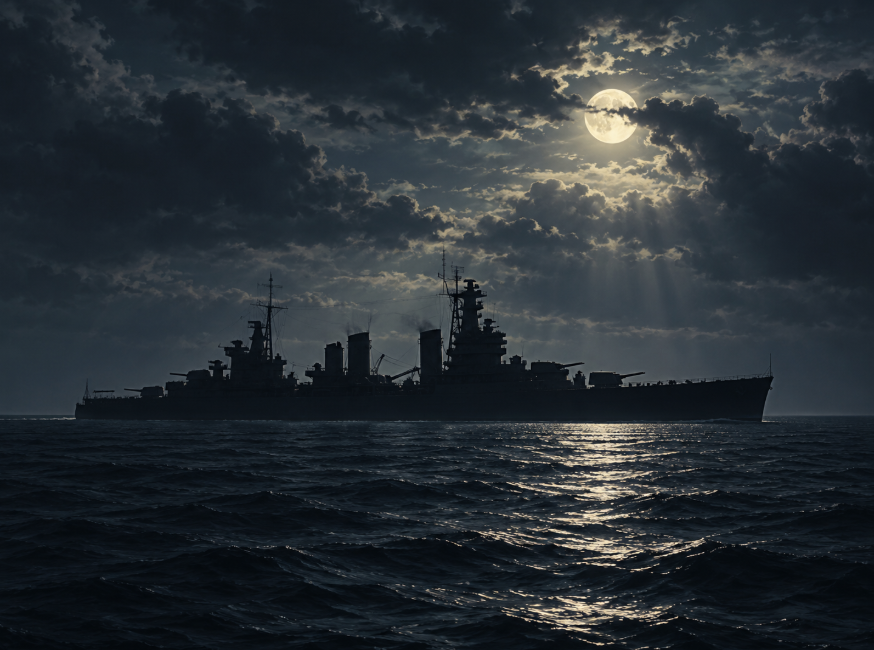
Survivors remembered heavy cloud. The man at the periscope remembered a moon at his back and a cruiser plain to see, close enough to count two turrets aft and a tall tower mast. Before the trial, Hashimoto told both the prosecution and the defense that visibility was good and the ship easy to spot. The doctrine had been written for exactly that kind of night.
Admiral Nimitz’s staff judged McVay’s decision an error in judgment and stopped short of gross negligence. Admiral King overruled Nimitz and pressed for trial. I’d follow Nimitz’s reading and take one further step: it was an error in judgment made at a negligent level. Discretion works like a speed limit posted as “reasonable and prudent.” It hands the driver the call, and it hands him the ticket when the call goes wrong. A night clear enough for an enemy captain to read your silhouette from miles away is a night the book asked you to zig.
McVay doesn’t carry this alone. He asked for a destroyer escort and was refused. Intelligence about submarines along his route was classified and didn’t reach him. The bulk of the 880 men lost died in the water over the following days, because the Navy failed to notice his ship was overdue, and none of that belongs to him. His conviction answered for the torpedo hits, and those hits found a ship holding a straight course under the moon.
He remains the only U.S. Navy captain court-martialed for losing a ship to an act of war. His defenders offer that as proof he was made a scapegoat. A rare verdict can still be a sound one.
The Witness
Hashimoto graduated from the Imperial Naval Academy at Etajima in 1931, volunteered for submarines in 1934, and served on destroyers and subchasers off China in 1937 as a junior officer. At Pearl Harbor he was torpedo officer aboard I-24, a lieutenant carrying out a plan drawn up well above his station. The midget submarine his boat launched didn’t come home; one of its two crewmen drowned, and the other washed ashore to become America’s first Japanese prisoner of the war.
From 1942 into 1944 he was posted to coastal defense and training boats. Those assignments were given to him, and they kept him far from the fighting. In 1944 he took command of I-58, a new fleet submarine fitted to carry kaiten suicide torpedoes. Her kaiten attack at Guam in January 1945 came to nothing. She was sent toward Iwo Jima, then to Okinawa, where aircraft drove her off and she limped home. On July 27, three days before Indianapolis, he claimed a tanker that was never confirmed.
When the records were reconciled after the war, Indianapolis stood as the only ship I-58 sank. Fourteen years in uniform, across the full span of Japan’s war from China to the surrender, left one confirmed sinking. It was a long career that left a faint wake.
That record bears on his best-remembered claim, that zigzag or no zigzag, he’d have sunk her anyway. He said it in 1945 as a witness for the prosecution and again in 1999, in a letter to the Senate Armed Services Committee urging McVay’s exoneration. The letter is gracious, and I read it with less generosity than it asks for. Hashimoto’s one wartime success was tied to the only court-martial of its kind in American naval history, and that verdict rested on the idea that McVay made the shot easy. Clearing McVay changes the story from an enemy captain who caught a ship on a straight course to one no American captain could have escaped, and the lone success grows in the retelling. It reads to me like a man tending to his own place in the record, and I’m not persuaded.
In fairness, he wasn’t alone in saying it. Captain Glynn Donaho, an American submariner with four Navy Crosses, testified that zigzagging wouldn’t have made his approach harder so long as he could see his target. Donaho also allowed that a zig before firing delays the shot, since the submarine must work out a fresh solution. Hashimoto first sighted Indianapolis around 10,000 meters out and had to close to 1,500 before he fired. That long approach was precisely the window where a zig might have unsettled his aim.
A Side Note: The Code of the Sea
A story still drifts around message boards that I-58 lingered at the scene while her crew watched sharks take American sailors in the water. As a sailor myself, I find the thought hard to sit with. The sea keeps a code: once a ship goes down, the men in the water are sailors first and enemies second.
The record doesn’t bear the story out. Hashimoto took his boat deep to reload, came back up about an hour later, found no trace of the cruiser, and left the area by half past two in the morning. The shark attacks came in the days that followed, long after I-58 had turned north.
Even so, I’d grant him a pass on the darker questions people raise about that night. He had no idea what Indianapolis had just carried to Tinian. A week later that cargo fell on Hiroshima, and by several accounts he lost family in the city. However he came to terms with the ship he sank, I won’t be the one to judge it.
Where I Land
Forrestal remitted McVay’s sentence and restored him to duty, and he retired a rear admiral in 1949. The letters from grieving families kept coming for years afterward. On November 6, 1968, he took his own life at home.
Keeping his conviction on the books is a judgment about one decision on one moonlit night. It passes no sentence on the man who carried that night for twenty-three years, and I grieve him. A republic can hold both of those at once, and it should.
Grammina used to say you can forgive a man and still keep the receipt.
Sources
- Naval History and Heritage Command, “Loss of USS Indianapolis (CA-35)” document collection, including Court of Inquiry testimony and casualty summation
- Naval History and Heritage Command, memorandum to press on Hashimoto’s scheduled testimony, December 1945
- Naval History and Heritage Command, biography of Charles B. McVay III
- U.S. Naval Institute Proceedings, “The Sinking of the Indy & Responsibility of Command,” October 1999
- Congressional Record, Senate, May 25, 1999, floor statement on USS Indianapolis
- S.J. Res. 26, 106th Congress
- Military.com, “Rear Admiral Charles McVay III”
- Richard F. Newcomb, Abandon Ship! (HarperCollins, 2000)
- Doug Stanton, In Harm’s Way (St. Martin’s Press, 2002)
- Mochitsura Hashimoto, Sunk: The Story of the Japanese Submarine Fleet, 1941–1945 (1954)
- Wikipedia, “Mochitsura Hashimoto” and “Japanese submarine I-58 (1943)”