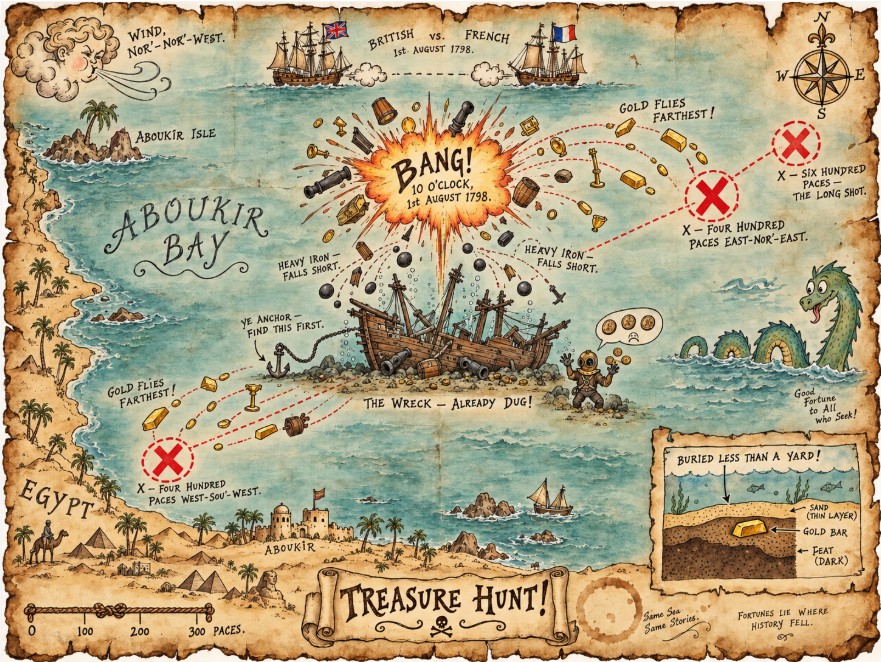
A Bright Meadow Group concept piece
At about ten at night on the first of August, 1798, the largest warship in the Mediterranean came apart over Aboukir Bay. The flash was seen from the walls of Alexandria, fifteen miles west. The concussion stopped the battle — for several minutes both fleets lay in the dark, guns silent, while burning wreckage came down across a quarter-mile of water. Some of it was still falling when the firing resumed.
L’Orient had been built as Dauphin Royal, renamed twice by a Revolution that kept changing its mind, and carried a hundred and twenty guns across three decks. She was Napoleon’s flagship on the voyage out, and the capitulation of Malta had been signed in her great cabin seven weeks earlier. By the time she exploded, her admiral was already dead.
Vice-Admiral François-Paul Brueys d’Aigalliers took a roundshot low, and the accounts agree he was past saving. He declined to be carried below. Tourniquets, a chair, and his own quarterdeck, and he went on directing the fight from it until he died — something on the order of a half hour, in the middle of the heaviest gunnery the Mediterranean had seen. His flag captain, Luc-Julien-Joseph Casabianca, went up with the ship. So did Casabianca’s son Giocante, who was somewhere between ten and twelve and had been aboard the whole campaign. If that arrangement sounds faintly familiar, it’s because Felicia Hemans wrote it into a poem in 1826 and two generations of schoolchildren recited it: the boy stood on the burning deck. The deck was this one.
And somewhere under the three of them, in the hold, was the reason anybody still argues about this wreck.
We are going to look for it. We are going to look for it properly, which means we are going to do the thing our shop always does — observe what the record actually contains, design an intervention that could locate the object, and then find out whether the intervention was ever going to work. The answer arrives in three parts, and each part is a different flavor of disappointment. We think the third one is worth the trip.
I. Observe: The Ledger
Napoleon was on Malta for six days. He arrived on the ninth of June, 1798 with an invasion fleet, took the surrender on the twelfth, spent the thirteenth through the eighteenth ashore, and sailed on the nineteenth. In that window he restructured the government, reorganized the courts, abolished the authority of the Order of St. John over an island it had held since 1530, and emptied the place.
The Knights had been accumulating for two hundred and sixty-eight years. Tithes and commandery revenue from priories across Europe. Prize money from two centuries of galley warfare against the Ottomans. Bequests from noble families buying their sons into the Order. The accumulated plate of a chapter that answered to nobody but the Pope. It sat in cathedral treasuries, in the Order’s own vaults, and in two institutions that kept careful books — the Monte di Pietà, the lending and pawn fund founded in 1598, and the Massa Frumentaria, the grain reserve that had carried Malta through famine for generations.
Both were stripped. The Monte di Pietà’s loss is one of the few precise figures in the entire story, because it was a bank and banks reconcile: 443,484 scudi. The Massa Frumentaria was emptied outright, which means the fund that kept an island fed became payroll for an army going to Egypt.
Then the estimates, and they spread. One historian’s count of everything taken from churches, monasteries and private houses across the island comes to seven million francs. A contemporary breakdown of what was aboard L’Orient when Napoleon boarded on the eighteenth of June gives five million in gold and a million in silver plate. The high figure for what was loaded runs to 9.3 million. The low end, counting the Order’s treasury narrowly, sits near three.
No consolidated manifest has ever surfaced. No itemized inventory of the treasury has ever been found. What we have is a range and a set of deductions, so we take the high number and start subtracting — because the subtractions are the interesting part, and because a number the reader watches you derive reads differently from a number that appears out of the air.
Subtract what went ashore at Alexandria. The fleet made landfall on the first and second of July and unloaded for a month before the battle. An army was put ashore, provisioned, and marched on Cairo. Armies consume specie. Whatever share of the treasure was working capital for the campaign — and funding the campaign was the entire point of taking it — came off the ship in the first week of July and went into the Egyptian economy, where it stopped being treasure and became forage, flour, bribes and pay.
Subtract what Napoleon kept. The ceremonial sword and dagger of Grand Master Jean Parisot de Valette, gifts from Philip II of Spain after the Great Siege of 1565 and paraded through Valletta every year for two centuries, traveled by an entirely dry route. Napoleon kept the dagger as a talisman. It passed to his son and reached the Louvre in 1840. Both pieces are in Paris. The dagger came back to Malta once, on loan, for the 2018 Capital of Culture year. The sword was judged too fragile to travel.
Subtract what got sold. There is a record of Napoleon disposing of a Maltese spoon at auction in Cairo. One spoon. It is the smallest useful fact in the archive, because a spoon at auction implies a table service it came from, a crate that service traveled in, and a man with the authority to break the set.
Subtract what went into pockets. No receipts here, and nobody in 1798 pretended otherwise. A treasury moves through stevedores, clerks, commissaries and junior officers, and a percentage is gone before the manifest closes.
Subtract what was hidden before the French found it. Emmanuele Vitale, a notary in Mdina, hid the treasures of the Church of Saint Joseph in Rabat in his own house. One man, one town. Six days is not long enough to search an island where everyone can see you coming.
What survives all that subtraction is the figure that actually went into Aboukir Bay, and it is a residual rather than a headline. Call it a few million francs in gold and plate.
Here is what a few million francs in gold weighs.
Reckoned in fine gold, seven million francs comes to roughly two metric tons. Nine million approaches two and three quarters. Two tons of gold, poured into a single block, makes a cube about eighteen inches on a side — a thing that fits under a desk and that four strong men cannot lift. As plate and coin in crates, packed with straw against a ship’s working, it fills a corner of a hold.
Other ways to hold it. The build cost of HMS Victory was £63,176. At 1798 exchange, the high estimate buys five or six first-rate ships of the line, which means the treasure in the hold was worth a meaningful fraction of the fleet it was sinking with. In wages, at an able seaman’s fourteen pounds a year, it runs north of twenty thousand man-years of sea service. L’Orient carried about a thousand men. Each of them was standing on a hundred lifetimes of his own pay.
And the thing it was for: this was the working capital of a country. Not a prize and not a hoard — the operating budget for taking and holding Egypt. The arithmetic of it is a plan, which is why it reads larger than a lottery.
Then a fire reached the magazine.
II. Design: The Search
Everything above is paper. What follows is sediment, and it answers a different question.
The wreck was located in 1983 by Jacques Dumas, working with the French navy. Dumas died before he could finish and Franck Goddio took up the site, mapping and excavating through the late 1990s at the invitation of the Egyptian antiquities authority. What came up: bronze cannon torn and twisted, the thirty-five-foot rudder still lettered Dauphin Royal, cooking pots, silverware, human bone, and a heap of lead type from the shipboard printing press Napoleon had brought along to print proclamations in Arabic. And coins — gold, silver and copper, struck in Malta, Venice, Spain, Portugal, France and the Ottoman Empire, mixed with pre-Revolutionary French pieces bearing Louis XV and Louis XVI.
Coins. Handfuls. Nothing resembling a treasury.
So we design the search. Five processes stand between the hold and the seabed, and each one is modelable.
Where she was riding. Brueys anchored his line by the bow only, which is the standing criticism of his dispositions — the ships could swing, and the gaps that let Nelson’s captains get inside the line followed from it. A ship riding to a single bower in twelve metres of water has real scope out, call it sixty to a hundred metres of cable, and her hull can sit anywhere on an arc of that radius from the anchor depending on how wind and current are setting her. That arc is the largest single uncertainty in the whole reconstruction, and it collapses with two pieces of information: the anchor’s position on the seabed, and the wind bearing at ten o’clock. The wind is recoverable, because the entire battle turns on it — the breeze that let Nelson run down on the French van is in the British logs, and those are the better-preserved set. A ship riding to one anchor lies with her bow into it. Center, radius, bearing, and a two-hundred-foot hull places to within maybe twenty metres, with her orientation thrown in.
The explosion. A magazine detonation disassembles a ship rather than sinking it. The rudder — fifteen tons of oak and iron — came to rest somewhere between sixty and ninety metres from the main wreckage depending on which account you take. The debris field spans a quarter-mile. Anything in the hold at that moment was accelerated, and dense objects accelerated by an explosion follow different arcs than light ones. Crates burst. Straw and timber disperse on the wind and the surface. Individual coins and salvers become individual ballistic problems. A gold chain and a silver platter leaving the same crate do not land together.
That rudder is an energy datum sitting in the published record. Work backward from fifteen tons thrown that far and you have an impulse estimate for the detonation, and once you have that, everything lighter scales off it. A twelve-kilogram ingot under comparable loading leaves considerably faster than a fifteen-ton rudder and lands considerably farther out. Coins farther still. Which means the geometry we want is a ring, and the wreck sits at the middle of it — with the crates’ stowage position relative to the magazine setting where in the ring the throw originates, since the throw off a hull is directional rather than even in all directions.
The water column. Aboukir Bay is shallow; the wreck lies around forty feet down. Gold at 19 g/cm³ and silver at 10 do not drift. Drag beats gravity within a few metres, so an object arrives at a few metres per second, and settling velocity sorts by density and shape. Flat plate flutters. Coins tumble. Ingots drop. The sorting that begins in the air continues underwater, and it is calculable.
Water movement. Here is where most accounts go wrong. Mediterranean tidal range at this coast is small, so tides are a minor vector. What moves water in that bay is wind and the outflow from the Rosetta branch of the Nile — a freshwater plume pushing in, a wind-driven surface circulation over it. Neither will move a bar of gold. Both move sand, and moving sand is what buries things.
The bottom. Which is where the design starts arguing with itself.
The modern marine sand blanket over most of the bay floor is under a metre thick. Beneath it sits deltaic wetland material — brackish peat, marsh and lagoon mud, the drowned surface of a landscape that used to be a marshy lagoon threaded with canals off the Canopic branch of the Nile. The full Holocene pile beneath that runs on the order of tens of metres over Pleistocene carbonate, stratified and dated by core. Grain size in the bay proper is very fine sand, silt and clay: something over half of the material sits at 0.063 mm, and only about a tenth is coarser than a quarter millimetre. Packed flour rather than beach sand.
The instinct — ours too, initially — is that a bottom like that swallows things. Twenty or thirty metres of loose sand shifting under storms, a two-ton mass punching fifty feet down on impact, two centuries of drift and a dam upstream rearranging the whole system. Bury it deep enough and the story has a comfortable ending: it’s down there, we can’t reach it, everyone goes home.
The numbers decline to cooperate.
The mobile layer is that sub-metre sand veneer. The peat and lagoon mud underneath is cohesive and consolidated and does not resuspend in a storm. Profile surveys in the bay that tracked storm change and recovery were measuring centimetres to decimetres, which is the honest scale of seabed mobility in twelve metres of water. Nothing stirs a twenty-metre column.
Impact penetration is object-scale rather than building-scale. A dense object arriving at a few metres per second makes a hole about its own size. What buries it afterward is scour and fill — current accelerates around the obstruction, digs a pit, the pit infills, the object settles a little. Navies have studied this carefully, because mines have to bury predictably. Equilibrium burial for a crate is roughly crate-depth.
And two centuries of accretion, even at generous pre-dam delta rates of a few millimetres a year, gives twenty to sixty centimetres. The Aswan closure cuts against the instinct rather than with it: less sediment delivered since the 1960s means less burial, and the Rosetta promontory has been eroding since. The last sixty years have added close to nothing.
So the design produces a real map. An anchorage arc constrained by wind bearing. Ballistic arcs off a known detonation, scaled from the rudder. Density-sorted settling through twelve metres of water. A drift field driven by wind and the Rosetta plume. A probability annulus rather than a point, and a burial depth under a metre across most of it.
That map is drawable. It is also the reason the search fails, and the reason has nothing to do with the map.
III. Intervene: Three Kinds of Nothing
The first nothing is that the instrument was blind to the target.
Goddio’s standing method is archive review first, then a specially developed nuclear magnetic resonance magnetometer, multibeam bathymetry, sidescan sonar, parametric sub-bottom profiler and DGPS to map the site, then test excavation, then full excavation with a dedicated database, archaeological inventory, drawings, mapping, photogrammetric coverage and 3-D rendering. That is survey-grade positioning with per-object provenance, run by a professional team with Egyptian backing across multiple seasons. The anchors of Guerrier, Conquérant, Spartiate, Aquilon, Peuple Souverain and Franklin were located and charted, which fixes the French line on the seabed as ground truth for anyone who comes after.
Gold is diamagnetic. Silver and bronze are not magnetic either.
A magnetometer survey of that site lights up beautifully — guns, shot, anchors, fittings, the iron of a hundred-and-twenty-gun ship — and passes over the only thing anyone came for. The survey’s great strength and its blind spot are the same instrument choice, and the blind spot is shaped exactly like the treasure. A scattered coin field would not register as a target under any setting.
What does see gold is electromagnetic induction — pulse induction or frequency-domain, the conductivity response rather than the magnetic one. A towed EM array run over the outer ballistic annulus, paired with the parametric sub-bottom profiler, would be searching the right ring with the right physics in the top metre or two of sediment, which the burial numbers say is where anything would be. That survey is designable today with equipment that exists. Whether it has ever been run is a question we would want answered before anyone calls this settled.
The second nothing is that the question was never posed.
Goddio observed the site to a standard that may already contain the answer. The design brief was the archaeology of a battle — ships, tactics, the daily life of the crews — and the instrument suite and the analysis fitted that brief and fitted it well. Locating a dispersed mass of non-ferrous metal by inverse ballistics was a different question, so it was never asked, and the intervention that would answer it was never run.
Which leaves specific items sitting in a database in France that would move this considerably. Whether L’Orient‘s own anchor was found and charted — the offset between her anchor and her hull is the drift vector, and her anchor is the center of the arc. Whether individual coin findspots went in with coordinates rather than being catalogued by trench, because a density gradient across a coin scatter is a direction arrow and a bag of coins is not. Whether the sub-bottom profiler data was ever reprocessed looking for crate-scale returns away from the hull.
None of that requires a dive. It requires somebody asking.
The third nothing is the one that has no body to find.
Return to the Massa Frumentaria. The grain fund. Two and a half centuries of an island setting aside reserves against the years the harvest failed and the convoys didn’t come — an institution built by people who had learned, in the specific way that islanders learn, what happens when the food runs out.
It was emptied to finance the Egyptian campaign. Some of what it held was specie and receivables, and that share follows the gold into all the subtractions above. But an army was provisioned out of Malta on the way past, and provisioning a fleet means flour and biscuit and salt meat in holds.
There is no recovering that. There was never an object to recover. It was eaten on the road to Cairo or it burned at ten o’clock on the first of August with everything else. A gold salver dispersed across a quarter-mile of seabed is at least still gold somewhere. A fund converted into rations is converted, full stop — it left the world as it was designed to leave the world, just into the wrong mouths.
And Malta then spent two years under blockade.
That is the only theft in this story with a body count attached, and it is the one nobody mounts expeditions for.
What We Actually Found
The honest output of the exercise is a map with the wrong caption.
We can draw the two fleets at anchor and the British doubling the French line. We can draw the anchorage arc and the wind bearing that collapses it. We can draw the debris field with the rudder outlier marked, and the ballistic ring scaled off it. We can draw the Rosetta plume, the wind-driven circulation, and a burial depth contour that mostly reads less than one metre. It is a good map. It is a defensible map. It tells you where to look, what instrument to look with, and roughly how deep to dig.
It also documents, line by line, why the looking was beside the point. Every process the map models is a process that scattered and buried a quantity of gold that had largely stopped being aboard the ship before the ship ever burned.
Which leaves the question that a treasure hunt exists to avoid asking. A treasure lost at sea belongs to nobody. Currents did it, and physics, and bad luck, and you can search for it forever without anybody having to answer for anything. A treasury dispersed through hands has names attached to every stage of the dispersal — commissaries, captains, clerks, a general with a spoon to sell and an auction house in Cairo willing to take it.
One of those is a story. The other is an accounting.
The sword is in the Louvre. That part was never underwater.
Bright Meadow Group applies an Observe–Design–Intervene methodology to problems that arrive dressed as something else. This one arrived dressed as a treasure hunt.
A note on the drift term. She was at anchor when she blew up, and anchored ships do not travel. Cables parted that night — Tonnant cut to get clear of the fire, Heureux and Mercure cut and grounded, Peuple Souverain had already gone out of the line with her cable shot away — and L’Orient‘s own cable went at some point, by fire or at the blast or with the bitts themselves. It changes nothing measurable. A hull with its bottom opened in twelve metres of water reaches bottom in seconds, and at a fraction of a knot that is a few metres of travel. Whether the anchor still held at 10 p.m. is a question about the last half-minute of a warship’s existence rather than a term in the search. The one case that would matter is a cable burning through early, leaving her driving downwind for the hour she spent on fire — and the silence of the British accounts on that point, from men who spent that hour watching her and dreading exactly that, is reasonable evidence she stayed where she was. The anchor stays put in every version, which is what makes it worth finding.
Notes and sourcing
Franck Goddio, “Napoleon Bonaparte’s Fleet” and “System Approach & Technology,” franckgoddio.org · Archaeology Magazine, “Napoleon’s Lost Fleet,” Sept/Oct 1999 · Warfare History Network, “Napoleon’s Lost Fleet Rediscovered” · yellow.com.mt, “Napoleon Came to Malta and Stayed Six Days” · Vassallo History, “French Blockade” · Frihy, “Quaternary evolution of the Abu Quir bay, Egypt,” GeoJournal · Frihy, Moussa & Stanley, “Abu Quir Bay, a sediment sink off the northwestern Nile delta, Egypt,” Marine Geology · Flaux et al., “Late Holocene erosion of the Canopic promontory,” Marine Geology 385 (2017) · Geo-Marine Letters, grain-size fractions of Abu Qir Bay surface sediments (2022) · “Acoustic seabed classification of marine habitats: Studies in the Abu-Qir Bay, Egypt”