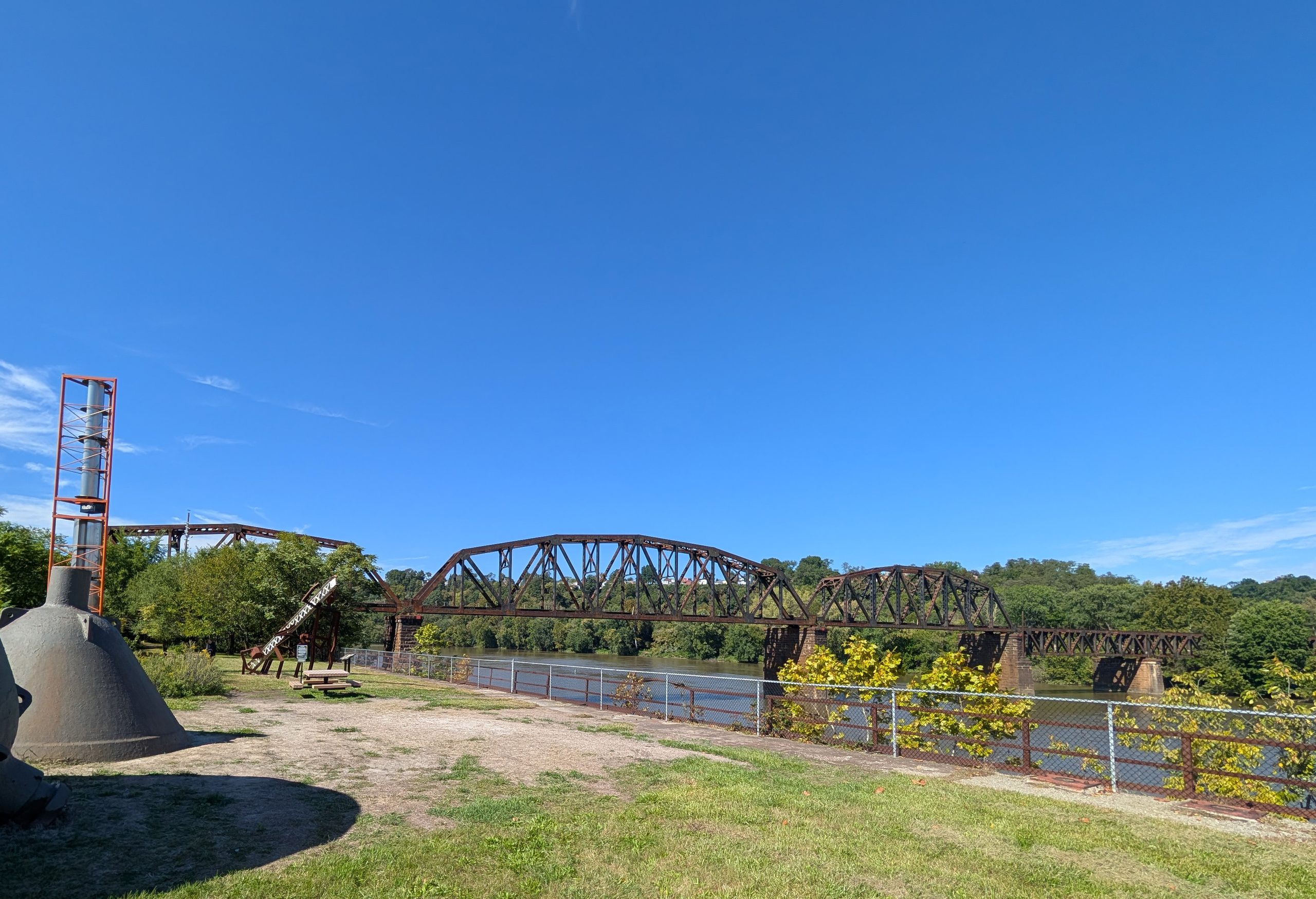
A railroad bridge has crossed the Monongahela at Munhall since 1883. Its official name is the Pittsburgh & Lake Erie Railroad Bridge at Munhall, and old railroaders called it the Pemickey Bridge, after the Pittsburgh, McKeesport & Youghiogheny Railroad, whose initials P. McK. & Y. got shortened in conversation to “Pemickey.” Most people know it by a third name, Pinkerton’s Landing, because nine years after it went up, the river beneath it became a battlefield.
The Pemickey was incorporated in 1881 and came under the Pittsburgh & Lake Erie through a 999-year lease. Its job was to give the P&LE a line up the Monongahela and Youghiogheny toward Connellsville and the coke country. Today the bridge carries CSX’s Pittsburgh Subdivision, the P&LE having been bought by CSX in 1993.
How it’s built
The bridge is a string of six trusses on stone piers. From the river crossing outward, there’s a main span with a Parker profile, two Pratt through-truss side spans, and three deck trusses carrying the approaches. The main span runs about 250 feet and leaves 51.6 feet of clearance over the water, enough for towboats and their stacks to pass under at normal pool.
A Pratt truss sets its verticals to carry compression and slants its diagonals down toward the middle of the span, so that under a load the diagonals are pulled rather than pushed. Iron and steel handle being pulled far better than being squeezed. A long thin bar in compression wants to bow and buckle the way a yardstick does when you push its ends together, while the same bar in tension just holds. The Pratt layout gives the long diagonals the easy job and keeps the shorter verticals on the hard one.
The Parker is a Pratt with its top chord bent into a polygon, rising toward the center of the span like a camel’s hump. In a simple span the bending force peaks at midspan and falls off toward the ends, so the truss is built deepest where the work is greatest and shallower where it’s lighter. That saves steel at the ends without giving up strength where it’s needed. You can see the logic from the riverbank: the main span arches its back in the middle, and the side spans sit lower beside it.
The deck trusses at the ends carry the track on top of the framing instead of inside it. Over land and shallows, where there’s no clearance to protect, the structure can sit underneath and the track can ride on top.
The superstructure went through an upgrade sometime before 1902. Railroads across the country were rebuilding their 1880s bridges around the turn of the century as locomotives and freight cars kept getting heavier, and a truss designed for the traffic of 1883 would have been working near its limits within a couple of decades.
Its moment in history
The Homestead Steel Works spread along the south bank directly beside the bridge. Andrew Carnegie’s interests had bought the plant in 1883, the same year the bridge opened, and by 1892 it was the largest open-hearth steel mill in the country. A small landing of pilings sat at the river’s edge at the northern tip of the works, at the foot of a slag slope below the plant’s new pump house.
At the end of June 1892, with Henry Clay Frick running the newly merged Carnegie Steel Company and determined to break the Amalgamated Association of Iron and Steel Workers, the contract talks collapsed into a lockout. Before dawn on July 6, about 300 Pinkerton guards hired by the company came up the river on two barges and tried to land there. Workers and townspeople met them at the bank. The fighting went on and off for about twelve hours with the Pinkertons pinned on the barges. Around six that evening they surrendered and were marched up through a cut in the slope past a gauntlet of angry townspeople. Seven workers and three Pinkertons died.
The workers held the mill for less than a week. The Pennsylvania National Guard arrived on July 12 and stayed into October while the company reopened with replacement workers. On November 21 the strikers voted to return on the company’s terms, which included giving up the union. Organized labor stayed out of Homestead for over four decades, until a contract signed with U.S. Steel in March 1937 brought the union back into the works.
The landing itself is gone, buried under slag fill before 1911 and sealed behind a concrete river wall in 1941. Wooden pilings believed to be from the original wharf have turned up at the base of that wall. The pump house survives. So do the bridge’s stone piers, and the National Historic Landmark application for the Battle of Homestead site lists the five Pemickey piers among the structures that make up the site. Trains still roll over the river on them every day, above the stretch of water where the barges sat.
Sources:
- Rivers of Steel, “Battle of Homestead Site — Structural Review and Battle of 1892 Summary” (National Historic Landmark application materials)
- pghbridges.com, Field Notes: Monongahela and Youghiogheny River Crossings
- pghbridges.com, P&LE RR Bridge over Yough, McKeesport (1881), for Pemickey corporate history
- Wikipedia, Pinkerton’s Landing Bridge
- Wikipedia / Wikiwand, Pittsburgh & Lake Erie Railroad
- Industrial Scenery blog, URR 1900 Rankin Hot Metal Bridge