The Taiko Bashi, Japanese Tea Garden, Golden Gate Park
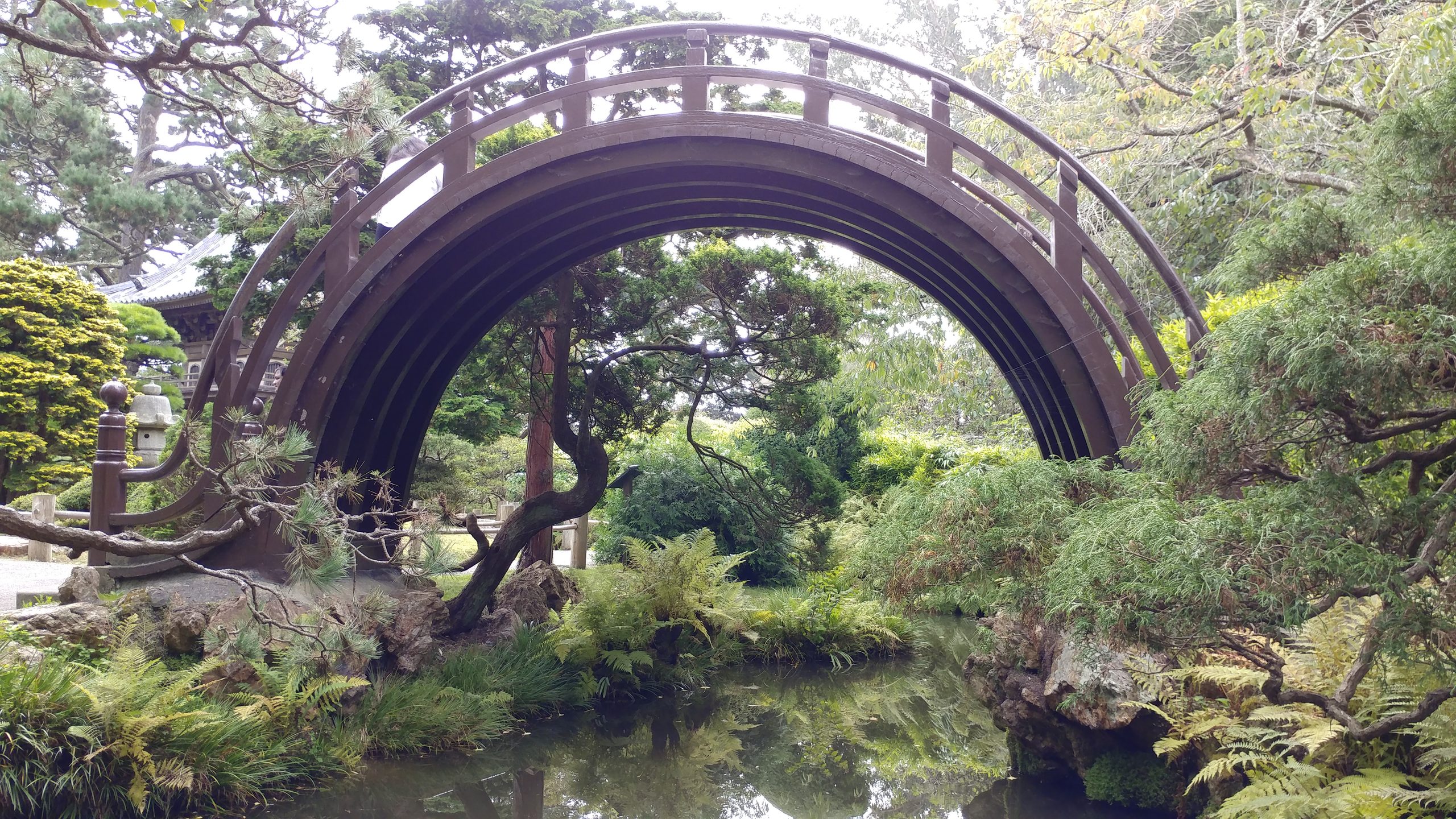
Just inside the Bell Gate of San Francisco’s Japanese Tea Garden, the path runs up against a bridge that looks like someone sawed a big drum in half and stood it on edge over the water. That’s where the name comes from: taiko bashi, drum bridge. People also call it the moon bridge, because on a still day the arch meets its own reflection in the pond and closes the circle.
In the photo above, the pond doesn’t quite finish the circle. A pine leans in from the left, ferns crowd the bank, and the reflection breaks up in the green before it can round out the bottom. A man in a white shirt is partway up the far side, bent forward like he’s on a ladder, and that’s about right. The span runs about twenty feet and rises about ten. The deck is a row of cleats laid across the curve, and near the crown you’re climbing more than you’re walking.
The bridge is meant to be that steep. Drum bridges came to Japan from China, where the high arch let barges slide under on garden canals. In a stroll garden the arch does a second job by slowing you down. A half circle won’t let you hurry. You take the rail, watch your feet, and by the top you’ve stopped to look around whether you planned to or not. The garden gets your attention by asking you to work a little for the view.
Shinshichi Nakatani, a master builder from Jigozen-mura in Hiroshima Prefecture, built the bridge in Japan on commission from the Japanese government for the California Midwinter International Exposition of 1894. He had it blessed in a Shinto ceremony and shipped it across the Pacific, and he came along with it. The commission didn’t cover the job. Nakatani sold his family’s rice fields to finish the bridge and the Bell Gate, then asked his son to stay in San Francisco and earn the money to buy the fields back. The son stayed close to fifty years.
The fair was supposed to be temporary. George Turner Marsh built the Japanese Village with craftsmen brought over from Japan, and the landscape designer Makoto Hagiwara took over the grounds afterward and tended them for the rest of his life. His family lived in the garden and kept it for decades, until 1942, when they were removed to internment camps with the other Japanese American families on the West Coast. The garden stayed open under a new name. The Hagiwaras didn’t get it back.
The bridge came through that too. It’s 132 years old, wood in a damp, foggy coastal park, and people still walk over it on the path it was built for. A bronze plaque at its foot thanks Nakatani for his contribution to the charm of the garden. The plaque doesn’t mention that a family’s rice fields went into that curve, along with half a century of a son’s working life spent getting them back.
Sources:
- Waymarking, “Taiko Bashi (Drum bridge) – San Francisco, California” (plaque text, dimensions): https://www.waymarking.com/waymarks/WM629Y_Taiko_Bashi_Drum_bridge_San_Francisco_California
- Rafu Shimpo, J.K. Yamamoto (Nakatani, Jigozen-mura, Hiroshima): https://rafu.com/?p=72926
- Wikipedia, “Japanese Tea Garden (San Francisco)” (Marsh, plaque, drum bridge functions): https://en.wikipedia.org/wiki/Hagiwara_Japanese_Tea_Garden
- Calisphere / UCLA Library, Drum bridge photo, 1913 (Hagiwara): https://calisphere.org/item/ark:/21198/zz002k83s2
- Time Out San Francisco, Erika Mailman (Nakatani’s son, oldest public Japanese garden in the U.S.): https://www.timeout.com/san-francisco/news/san-francisco-is-home-to-the-oldest-public-japanese-garden-in-the-u-s-heres-what-its-like-to-visit-012825
- Atlas Obscura, “Japanese Tea Garden” (moon reflection): https://atlasobscura.com/places/japanese-tea-garden