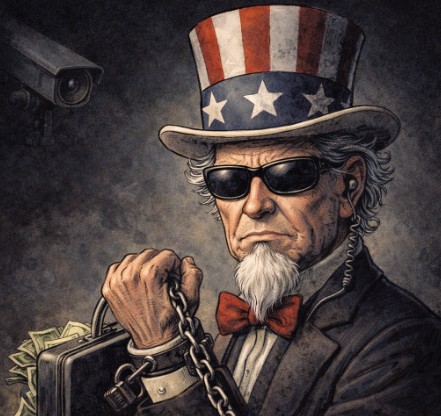
Thanksgiving Edition- republican Virtue
Thanksgiving mornings always have a particular kind of stillness to them—
a pause in the national tempo, a collective breath the country takes before families gather, ovens heat, and stories get retold for the thousandth time.
This morning, as the fog slid off the river in that unhurried way only a river understands, it reminded me of something older than the holiday itself: the quiet virtues we used to treat as ordinary.
Honesty.
Restraint.
Listening before speaking.
Neighborliness without fanfare.
The kind of virtues the early Quakers carried like pocket tools, ready for use in any civic repair job.
Lately I’ve been reading more about them.
Not the oatmeal-cartoon versions—
the real people who helped shape the political temperament of the Mid-Atlantic.
They were quiet revolutionaries, if such a thing can exist: calm, principled, allergic to theatrical leadership. And somehow they managed to leave moral fingerprints on a whole region without ever raising their voices.
Thanksgiving is a good day to remember people like that.
The Quiet Architecture of an American Temperament
The Quaker influence is easy to miss because it wasn’t loud, but it was deep.
These were people who insisted that every soul could hear truth directly, without clergy or kings intermediating the signal. That one spiritual idea produced an entire civic architecture. If every person has an Inner Light, then coercion becomes suspect, hierarchy becomes fragile, and government—if it must exist—should operate lightly and with humility.
From that simple theology came instincts we recognize today:
- Limited government, not because it polls well, but because conscience cannot be compelled.
- Representative assemblies that checked executive power, long before it was fashionable.
- Transparent courts where justice was slow, careful, and meant for ordinary people.
- Religious liberty, not as a slogan, but as a lived necessity.
- Fair dealing in commerce, which turned early Philadelphia into a haven for merchants who valued reputation over spectacle.
William Penn didn’t invent all this, but he curated it.
His “holy experiment” wasn’t an experiment in purity—it was an experiment in civic restraint.
A government built by agreement instead of decree.
A market shaped by trust instead of trickery.
A society that believed peace was cheaper than force.
And when the Lenape sat with Penn’s envoys, they weren’t impressed by European civics.
They were meeting colonists who understood covenant—binding promises among equals.
Most colonies talked about fairness.
Pennsylvania tried to practice it, at least while Penn lived.
That ethic didn’t last forever, but while it did, it shaped the cultural weather of an entire region. Even after Friends stopped holding office, their norms lingered in the soil: the preference for procedure, the suspicion of grandstanding, the belief that government should be predictable rather than dramatic.
Those habits seeped outward into Delaware, New Jersey, the Maryland line—
a corridor built on quiet civic competence.
The Thanksgiving Question
And so, standing by the river on Thanksgiving morning, watching the fog lift, I found myself wondering about what’s changed.
Because when I look at modern politics, I don’t see much Quaker temperament left.
We’ve traded deliberation for performance, consensus for combat, conscience for branding.
We’re loud where our ancestors were steady.
We’re certain where they were careful.
We’re theatrical where they were practical.
Grammina had a line she swore came from Cicero—though I’ve never found it anywhere:
Boy, a republic is just neighbors agreeing not to be fools at the same time.
She’d follow it with:
Once one forgets their manners, the rest forget theirs in self-defense.
The Quakers built a civic culture designed to prevent that spiral.
A politics that expected adults to stay adult, even when they disagreed.
A market ethos that treated trust as capital.
A legal system that considered fairness a form of infrastructure.
Maybe that’s why their influence feels so foreign now—
we’ve replaced steadiness with speed, clarity with volume, duty with spectacle.
Thanksgiving is supposed to be a day of gratitude, but maybe gratitude also includes the obligation to remember what kind of civic temperament once made this place work—and could again.
So Where Are the Modern Friends?
Not necessarily Quakers by theology, but Quakers by temperament.
People who understand that a free society is sustained not by noise, but by character.
People who believe liberty doesn’t need warriors so much as caretakers.
People who can hold disagreement without turning it into a performance.
People who treat fairness as something sturdier than nostalgia.
People willing, in William Penn’s words, to “serve the time” by acting like grown-ups even when the age is not.
The fog lifted eventually, but the question stayed behind.
And on a day built around harvest, gratitude, and shared tables, the answer feels simple:
Liberty is the harvest of responsibility—
and it needs tending again.