An Editorial Conversation from The Blue Ribbon Team
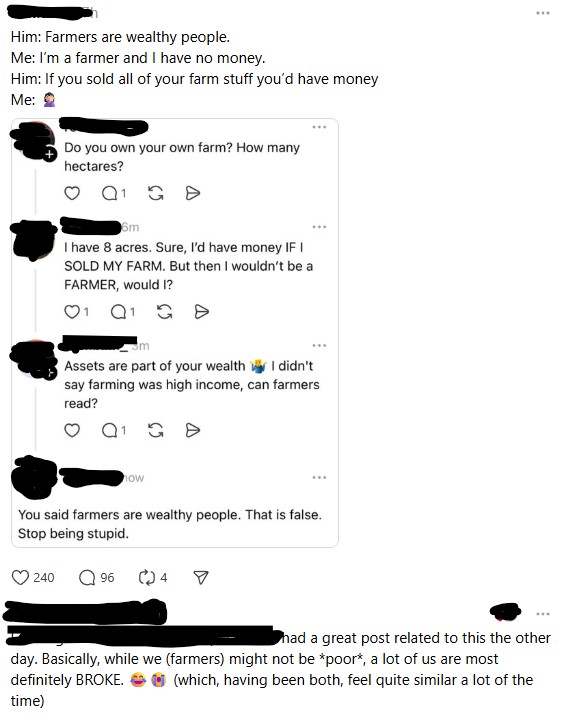
Every so often the internet kicks up a little dust that tells a much bigger story than the people arguing ever intended. I ran across a short exchange about whether farmers are “wealthy,” and it stuck with me — not because of the sniping, but because the entire thing hinged on two people using the same word to mean completely different things.
I couldn’t decide which of our writers this belonged to.
It had the bones of a republican Virtue piece so I almost just sent it over to Nathaniel , but then I wondered what Mr. Wright would think about it. Before I knew what was going on I was trying to figure out what spin Miss Ordinary would put on it. So I sent it to all three and asked each of them for a short response in their own voice.
Here is what came back.
Wealth as a Life You Can Feel- Miss Ordinary, Heather Dean
Thesis
When I think about wealth, I don’t think about money first. I think about the things that make you feel grounded: health, safety, the people who would sit with you on your worst day. You can have a tiny bank balance and still feel rich in the ways that matter most. And you can have plenty of money but feel hollow and unsafe.
Explanation
Farmers carry a kind of wealth that doesn’t spend easily — the rhythm of their work, the pride of growing food, the connection to land and season. That is a wealth measured in meaning, not cash. When someone tells a farmer to “sell everything and you’d have money,” it ignores the shape of their life. It treats stability as optional and purpose as a luxury.
Conclusion
Money helps us survive, but meaning helps us live. The work, the land, the community — that’s a kind of richness people forget to count. And maybe we should start counting it again.
Wealth as Dignity and Reality – The Wright Way , PR Wright
Thesis
A man’s wealth isn’t whatever somebody else thinks he could pawn. It’s the work under his hands and the security he builds for the people around him. Telling a farmer he’s “wealthy” because he owns land is the kind of foolishness you hear from people who’ve never had to depend on the weather or their own back for a living.
Explanation
Land don’t turn into money unless you tear your life apart and sell it off piece by piece. Same with equipment and tools. That’s not wealth — that’s survival gear. A working person can have assets on paper and still be short on cash for fuel, repairs, or medicine. Folks who live by spreadsheets don’t understand that difference, and sometimes they talk too big about things they don’t know.
Conclusion
Real wealth for most of us is simple: a safe place to sleep, enough to eat, neighbors who’ll check in, and the strength to get back up every day. You keep those things intact, you’re doing fine. Everything else is noise from people who mistake numbers for worth.
Wealth as Independence and Liberty – republican Virtue by Nathaniel Leery
Thesis
The argument over whether farmers are “wealthy” shows how far we’ve drifted from the older republican view of wealth — the one rooted in independence. Once upon a time, a person’s wealth was measured in their ability to stand on their own ground, not in their ability to convert that ground into cash.
Paragraph 2 – Explanation
Currency was always meant to be a tool, not a definition of value. The Founders — Jefferson especially — believed the independent farmer was the backbone of liberty precisely because his wealth wasn’t liquid. It was lived. It came from land, labor, and skill. Selling the farm for cash wouldn’t enrich him; it would undo the very conditions that make him free. As Grammina might say, “Don’t confuse the measure with the thing being measured.”
Paragraph 3 – Conclusion
Liquid wealth is fast and convenient, but it is also fragile. Real wealth is what endures: land cared for, skills sharpened, work done with purpose, and a life not beholden to another man’s ledger. Trade those away for dollars and you’ve sold something you can’t buy back.
Editorial Wrap-Up
What struck me most after reading these three pieces wasn’t the disagreement — it was the agreement hiding underneath it. They each came at the question sideways, through different doors, with different instincts, and still circled the same quiet truth: wealth is not what we’ve been trained to think it is.
We live in a country that treats the dollar like the scoreboard of a life. You can see it in how people argue online — as if net worth is character, as if liquidity is wisdom, as if the ability to convert something into cash is the same as the ability to live well. That mindset sits loud in the background of the original argument: “If you sold your farm, you’d have money.” Maybe so, but the second half of that sentence never gets spoken — you’d also lose your work, your purpose, your place, your identity. You could cash out the roots, sure, but you can’t spend the tree once it’s gone.
And that’s where all three of our writers, in their own ways, land. Heather points out that meaning and safety and belonging are forms of wealth no ledger can capture. Mr. Wright reminds us that dignity, security, and the ability to take care of one’s family outweigh any imaginary number on a spreadsheet. Nathaniel zooms out further and argues that true wealth is independence — the ability to live without selling your foundation out from under you. Different words, different angles, same silhouette.
Maybe that’s the point worth carrying forward. Maybe the better conversation isn’t whether a farmer is wealthy, but why we keep using money as the only yardstick we can imagine. Somewhere along the line, we became a culture that knows the price of everything and the value of almost nothing. And whenever we forget the difference, arguments like the one that sparked this whole exercise appear — loud, brittle, and missing the heart of the matter entirely.
If nothing else, these three perspectives remind us that wealth isn’t simply what can be liquidated. It’s what can endure. It’s what keeps a family steady, what gives a worker dignity, what lets a person stand on their own ground — literally or figuratively. And if that’s the case, then wealth is far more common, far quieter, and far harder to steal than most people believe.
Three views, one truth:
You are wealthier in what you can stand on than in what you can sell.