I’m not an artist. I always feel like I need to say that first, because anytime I talk about creativity, someone assumes I’m trying to claim a title I’ve never earned. I don’t paint. I don’t animate. I don’t live in a loft surrounded by canvases and incense. I just… think about things. I watch how people react to change, and I try to understand the feelings underneath their arguments.
And lately, the loudest arguments I’ve seen are about AI and art.
Scrolling through the debates reminds me of watching a family fight over the last slice of pie—not because anyone really wants it, but because something else is going on under the surface. Something emotional. Something scared.
That’s why I wrote this—not as an artist defending territory, but as an outsider trying to make sense of what everyone is really afraid of.
The Artist’s Fear of Not Being Special
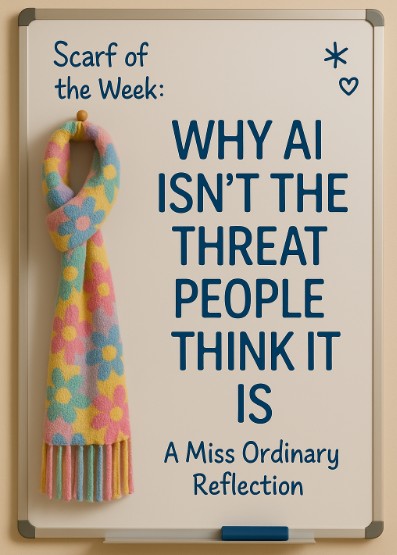
or — Why AI Isn’t the Threat People Think It Is
There’s a strange panic rippling through the art world right now—a kind of existential whiplash. You hear it in every thread, every panel, every angry post: “AI is copying us.”
But let’s be honest. This fear didn’t begin with AI.
Every technological leap in creativity has triggered the same reaction.
- Painters cried foul when synthetic bristles replaced horsehair.
- Printmakers mourned when lithography made reproductions cheap.
- Photographers were accused of cheating because a machine could “capture reality.”
- Digital artists were treated like they weren’t doing “real art” at all.
And now we’ve reached AI, which has pulled the same ancient nerve:
the fear that the tools make the artist unnecessary.
Underneath all the noise, there’s a much more vulnerable truth:
People are terrified they aren’t special.
It’s not about copyright.
It’s not about models or training data.
It’s not even about money.
It’s about ego—our deepest myth about ourselves.
Because if a machine can produce something that looks like our work…
If an algorithm can speak in our visual language…
If a prompt can summon something “close enough”…
Then what separates me from the swirling chaos of possibility?
And that’s the wound.
Not that AI imitates us—human artists imitate each other constantly.
Not that AI expands what’s possible—every tool in history has done that.
It’s the suspicion that maybe, just maybe… we weren’t singular to begin with.
But here’s the gentle truth nobody wants to say out loud:
We have never been special.
Not in the cosmic sense.
Not in the evolutionary sense.
Not in the “chosen” sense.
We’re here for a blink.
We make what we make.
And then we leave.
Creation is not a birthright—it’s a momentary gift.
Tools don’t steal that. Tools extend it.
AI, for all its noise and novelty, does not replace the creator.
It replaces nothing essential.
It only strips away the illusion that being unique was ever the point.
We arrive when we’re supposed to.
We depart when it’s time.
In between, we make things—because it is our nature to make things.
No technology can take that away.
Om mani padme hum.
Some Closing Thoughts
I don’t pretend to know what it feels like to pour your soul into a canvas or a sketchbook and then see a machine spit out something uncomfortably close to it. That has to sting.
But I also don’t believe AI is the enemy here.
What I see—what I feel—is that artists are grieving something deeper than style or ownership.
They’re grieving the end of the idea that creativity makes us immortal, or exceptional, or chosen.
Maybe the truth is simpler:
We make things because we’re alive.
And as long as we’re alive, no tool can take that impulse from us.
AI isn’t the threat.
Losing our sense of wonder is.
And that part is still completely under our control.
— Miss Ordinary